
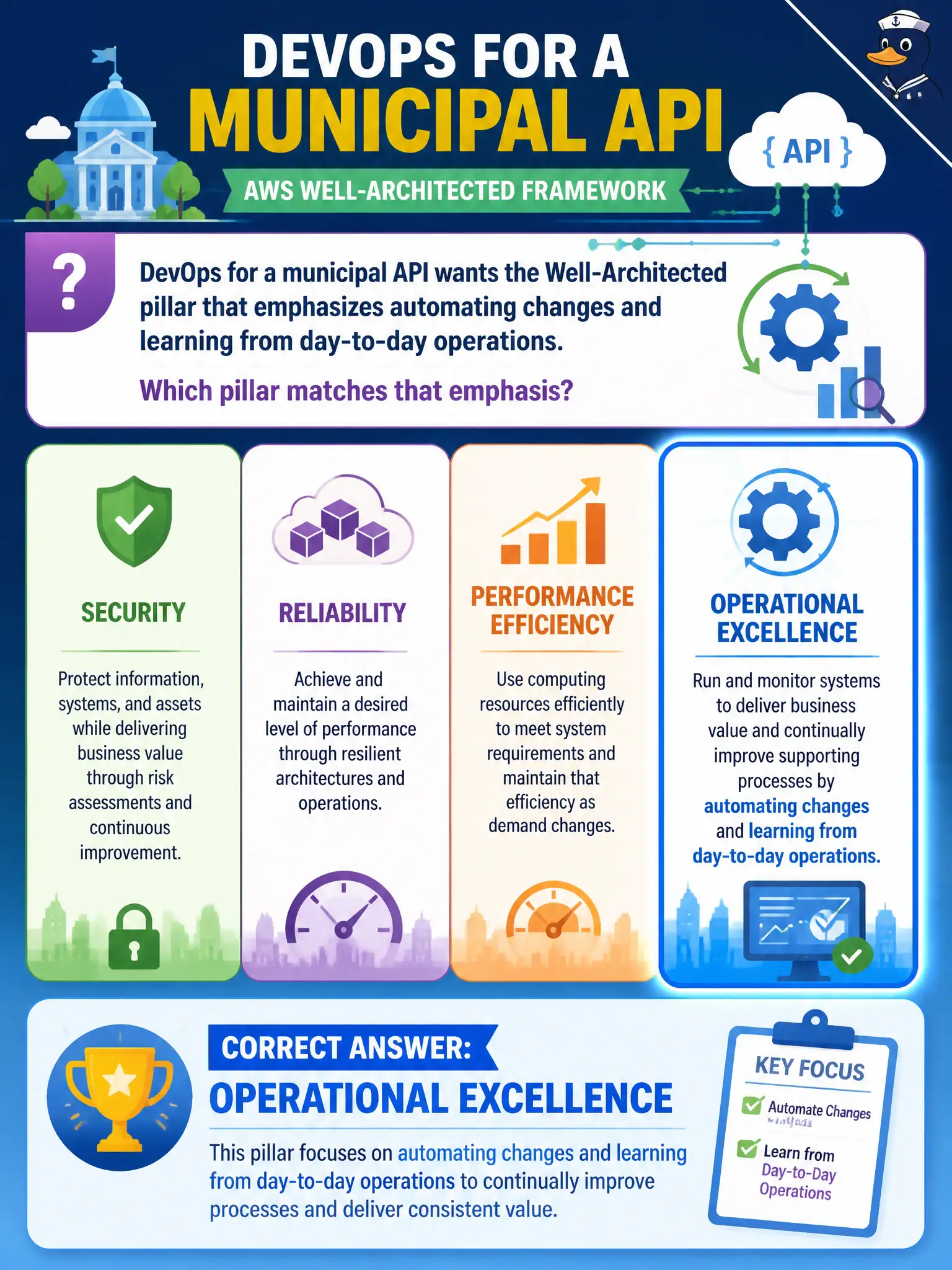
DevOps for a municipal API wants the Well-Architected pillar that emphasizes automating changes and learning from day-to-day operations. Which pillar matches that emphasis?
Select an answer to reveal the explanation.
Short Explanation
Automating the boring change steps and reviewing what broke last Tuesday is classic ops craftsmanship. Operational Excellence is the pillar that pushes teams to automate changes, observe what happens, and refine how they work. Cost, performance, and sustainability pillars care about money, speed/fit, and environmental impact — not that learning-and-automation loop first.
Full Explanation
Operational Excellence is the Well-Architected pillar that emphasizes automating changes and learning from day-to-day operations—the match for municipal API DevOps. It covers organizing teams, preparing and operating workloads, and evolving procedures from operational events so citizen APIs improve continuously rather than only when a crisis forces a change.
Cost Optimization focuses on spend efficiency, not primarily change automation culture. Performance Efficiency focuses on selecting and scaling resources to meet requirements. Sustainability focuses on environmental impact of workloads. Those pillars matter for a municipal API estate but do not best capture automating changes plus learning from operations.
Exam caveat: Automate + learn from ops language → Operational Excellence on CLF-C02. Operational check: require infrastructure-as-code for API changes, attach post-incident learning notes to the runbook repo, and verify monitoring covers golden signals before promoting a release to production.
Municipal teams should keep a one-page decision record linking this Cloud Practitioner concept to resident outcomes, revisit it after major traffic or compliance changes, and ensure runbooks still match the chosen design.