
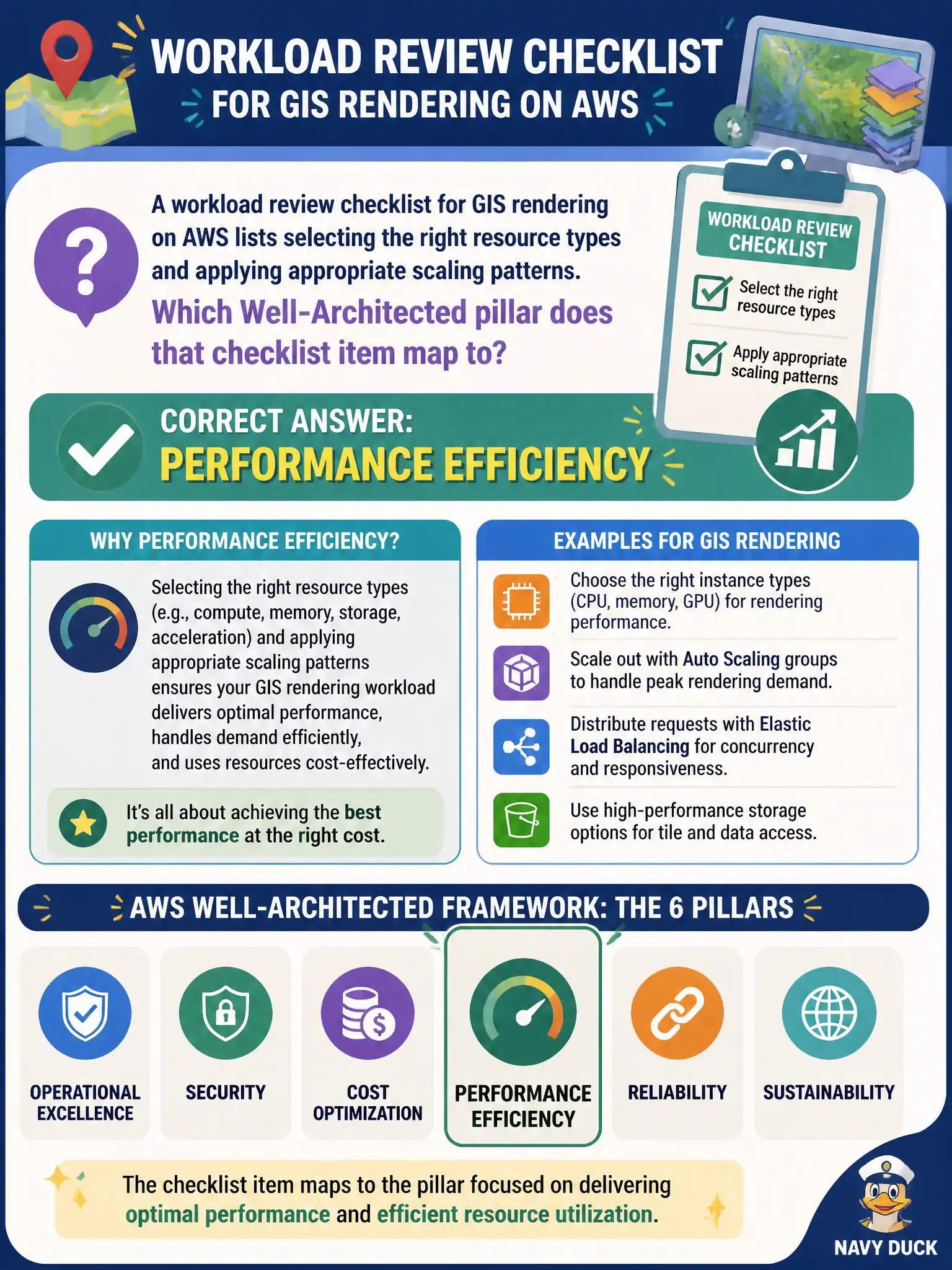
A workload review checklist for GIS rendering on AWS lists selecting the right resource types and applying appropriate scaling patterns. Which Well-Architected pillar does that checklist item map to?
Select an answer to reveal the explanation.
Short Explanation
Picking the right engine size and knowing when to add lanes is a performance story. Performance Efficiency is the pillar about selecting appropriate resource types and scaling so the workload stays efficient as demand changes. Security locks the doors, Cost Optimization watches the bill, and Sustainability watches the footprint — related, but not that checklist line.
Full Explanation
Performance Efficiency is the pillar that maps to a GIS rendering checklist item about selecting the right resource types and applying appropriate scaling patterns. That guidance helps municipal GIS workloads choose compute, storage, and scaling approaches that meet rendering time requirements efficiently.
Security addresses protection of data and access, not primarily resource-type selection for render speed. Cost Optimization addresses avoiding unnecessary spend, which may follow from good sizing but is not the pillar named for resource selection and scaling patterns. Sustainability addresses environmental impact rather than the performance-oriented checklist language in the stem.
Exam caveat: Right resource types + scaling patterns → Performance Efficiency. Operational check: benchmark representative GIS render jobs across candidate instance or service shapes, enable scaling policies that match map-request load, and track p95 render time against the city’s published SLA.
Municipal teams should keep a one-page decision record linking this Cloud Practitioner concept to resident outcomes, revisit it after major traffic or compliance changes, and ensure runbooks still match the chosen design.