
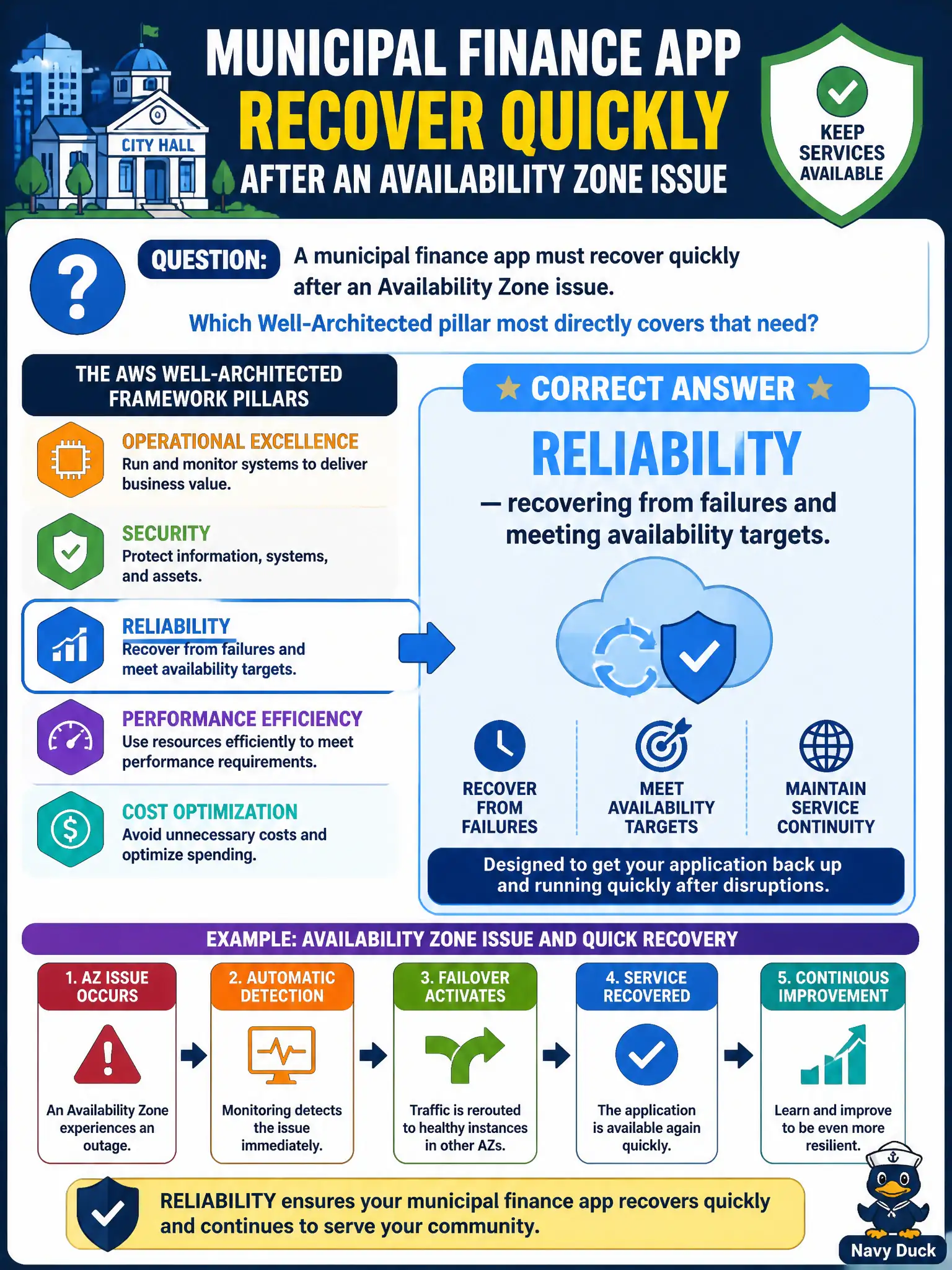
A municipal finance app must recover quickly after an Availability Zone issue. Which Well-Architected pillar most directly covers that need?
Select an answer to reveal the explanation.
Short Explanation
When an AZ wobbles, finance still needs the books back. Reliability is the pillar about recovering from failures and hitting availability needs. That recovery story—not GPU shopping—is what the app requires.
Full Explanation
Reliability is the Well-Architected pillar that most directly covers a municipal finance app recovering quickly after an Availability Zone issue. It emphasizes recovering from failures and meeting availability targets—foundations, change management, failure management—so finance services return to serving residents and staff after AZ impairment.
Cost Optimization alone asking whether unused instances were deleted may save money but does not define recovery behavior. Performance Efficiency alone asking whether the fastest GPU was chosen misses availability and recovery. Operational Excellence alone defined only as prettier console dashboards understates that pillar and still is not the primary home for AZ recovery design.
Exam caveat: AZ failure and recovery language → Reliability pillar on CLF-C02. Operational check: confirm the finance app spans multiple AZs, test failover or AZ impairment in non-production, measure recovery time against the city’s target, and document alarms that detect the failure path.
Municipal teams should keep a one-page decision record linking this Cloud Practitioner concept to resident outcomes, revisit it after major traffic or compliance changes, and ensure runbooks still match the chosen design.