
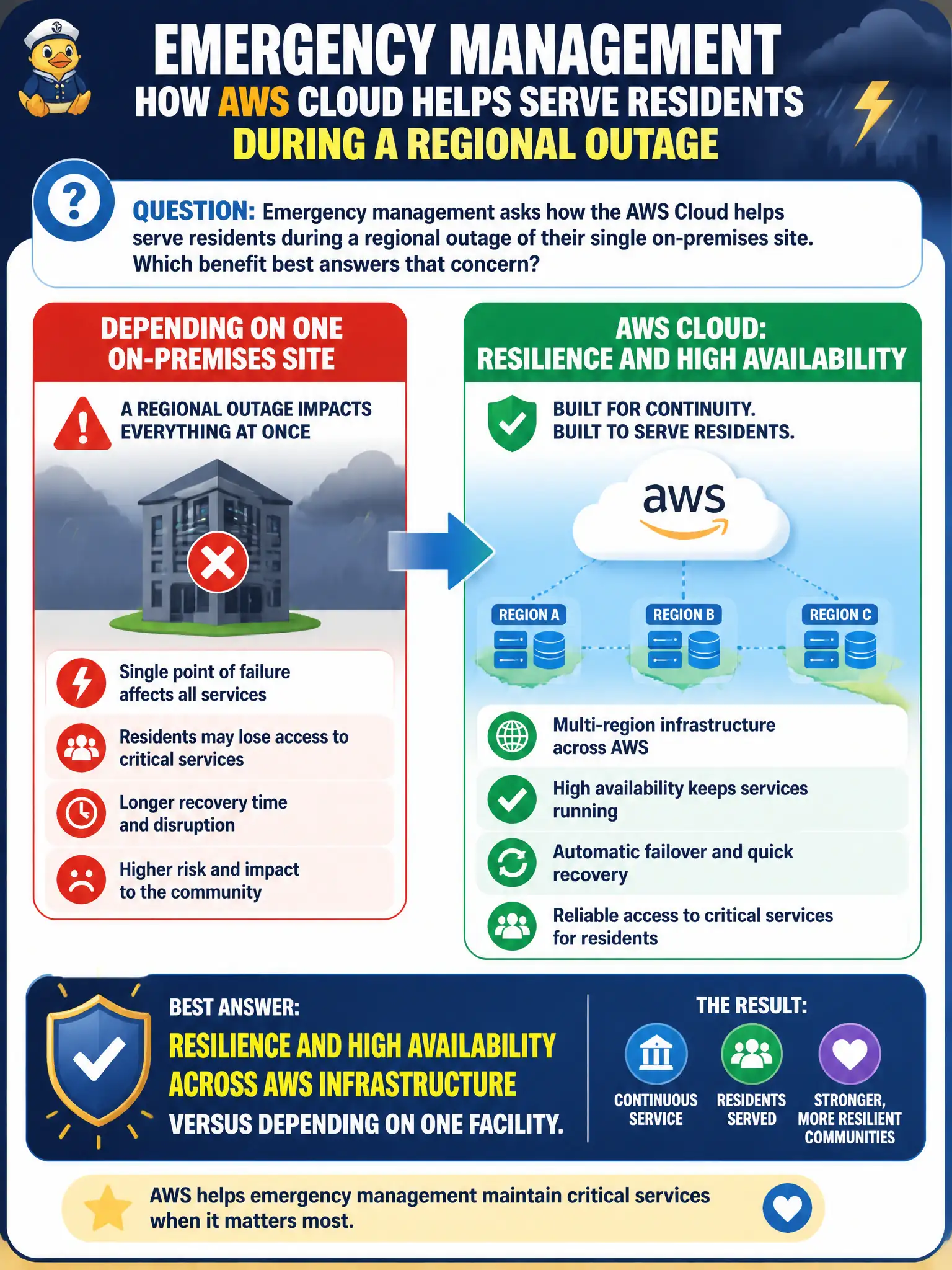
Emergency management asks how the AWS Cloud helps serve residents during a regional outage of their single on-premises site. Which benefit best answers that concern?
Select an answer to reveal the explanation.
Short Explanation
One basement going dark should not silence emergency alerts. AWS resilience and high availability let you design beyond a single facility so residents still get served. Continuity is about surviving site loss—not a forever-free coupon or cheaper chips alone.
Full Explanation
Resilience and high availability across AWS infrastructure answer emergency management's concern about serving residents when a single on-premises site suffers a regional outage. Designing beyond one facility—using distributed AWS patterns such as multi-AZ (and, where appropriate, multi-Region) architectures—reduces dependence on the basement that just went dark so alerts and critical citizen paths can continue.
Guaranteed free compute forever during every regional disaster is not an AWS contractual reality and is not how continuity benefits are framed on the exam. Cheaper CPUs as the only named advantage for continuity planning confuse unit pricing with architectural resilience. Requiring all disaster recovery traffic to terminate only at the failed site guarantees the DR plan fails when that site is unavailable.
Exam caveat: Resilience/HA is about surviving facility loss; cost advantages and free-tier myths are distractors. Also distinguish RPO/RTO planning depth (more Solutions Architect) from the Cloud Practitioner-level benefit framing in the stem. Operational check: document the primary site failure scenario, verify critical emergency workloads have a recovery path that does not depend on the failed facility's LAN, and run a tabletop or technical failover drill with success criteria residents can still receive alerts.