
A school district IT lead summarizes why AWS for the board in one phrase about matching capacity to unpredictable enrollment portals. Which benefit should that phrase name?
Select an answer to reveal the explanation.
Short Explanation
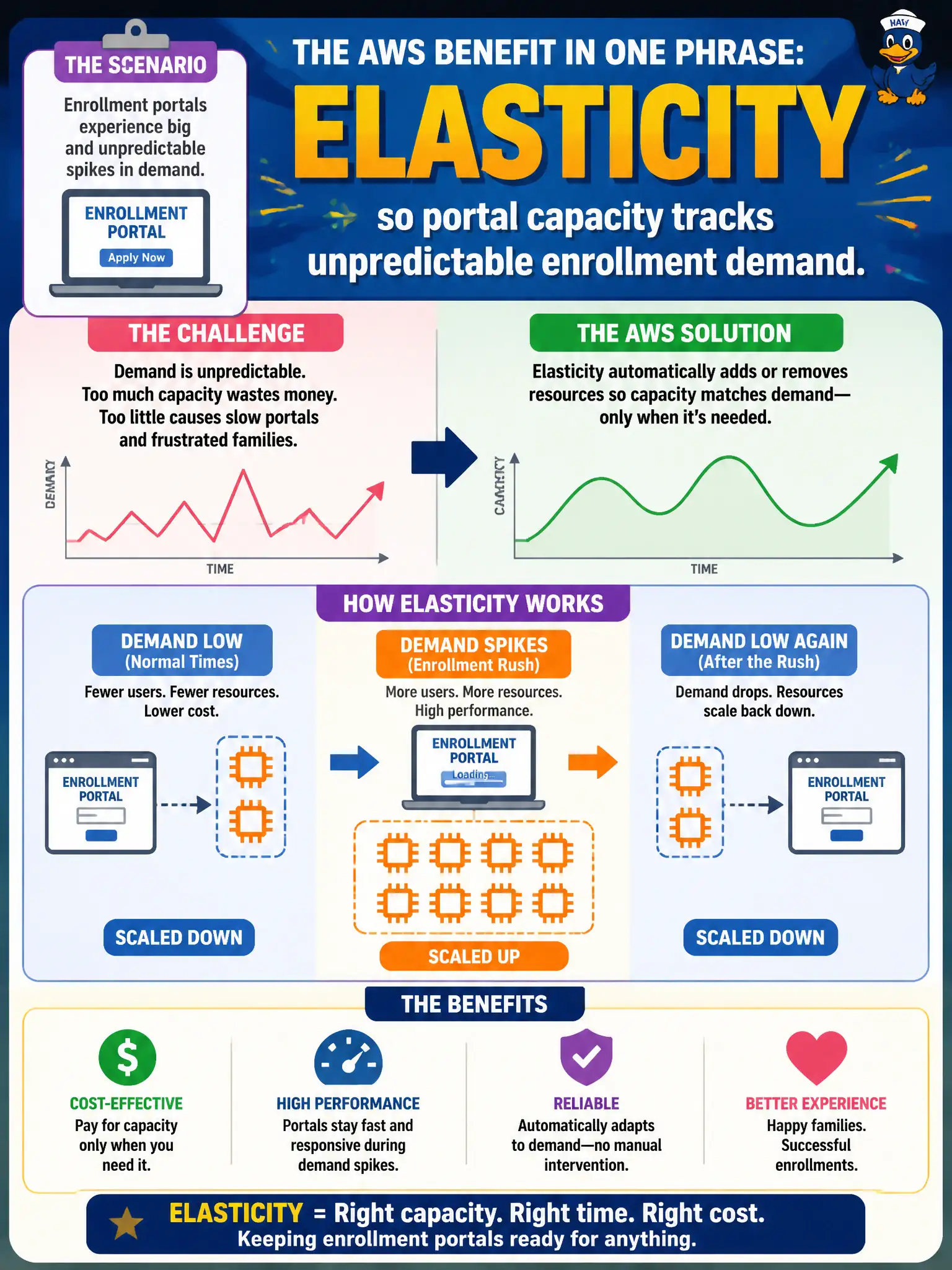
Enrollment portals surge when parents rush the site and quiet down afterward. Elasticity is the board-ready word for matching capacity to that unpredictable load—not “we bought cheaper disks.” Say grow-and-shrink with demand, and the story sticks.
Full Explanation
Elasticity is the board-ready phrase for matching capacity to unpredictable enrollment portal demand in a school district. When parents surge onto registration sites at open enrollment, capacity scales out; when traffic calms after deadlines pass, capacity scales in—so leadership is not stuck explaining a permanent peak-sized CapEx fleet during quiet months of the academic calendar.
Cheaper hard-disk media as the complete reason to adopt AWS may be a procurement talking point but does not describe demand matching for volatile parent traffic. Permanent CapEx servers sized once for the highest historical peak institutionalize over-provisioning and ignore year-to-year enrollment volatility. Disabling Auto Scaling so every portal stays fixed at night-shift size prevents the very grow-and-shrink behavior the board needs named in plain language.
Exam caveat: Elasticity is not economies of scale and not high availability. Pick elasticity when the stem emphasizes variable or unpredictable load on citizen-facing portals. Operational check: enable Auto Scaling policies on the enrollment portal in a staging account, replay last year's open-enrollment traffic shape or a synthetic equivalent, and show the board graphs of capacity tracking demand alongside the cost curve before go-live.