
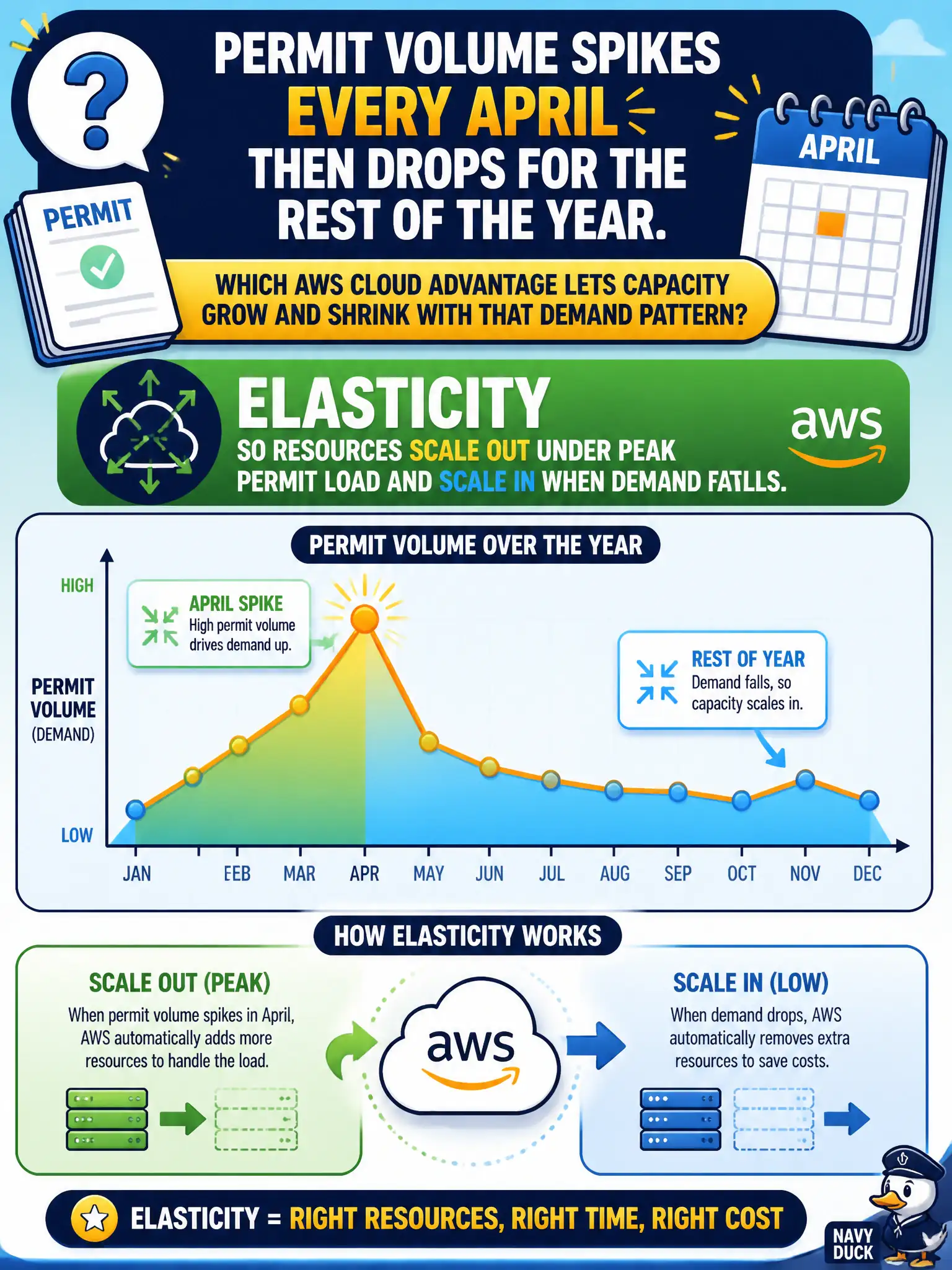
Permit volume spikes every April then drops for the rest of the year. Which AWS Cloud advantage lets capacity grow and shrink with that demand pattern?
Select an answer to reveal the explanation.
Short Explanation
April permit season is like a fairground that packs the lot one weekend and empties the next. Elasticity means you add capacity when the line forms and give it back when the parking lot clears—without owning a permanent megafleet. That grow-and-shrink story is the answer, not a forever-sized basement box.
Full Explanation
Elasticity is the AWS Cloud advantage that lets capacity grow and shrink with April permit spikes and quieter months afterward. Resources scale out under peak permit load and scale in when demand falls, so the municipality pays for peak capacity when residents are actually in line rather than owning a permanent fleet sized for one busy month.
Buying a fixed five-year server fleet sized for the April peak and leaving it idle afterward is the classic anti-pattern elasticity replaces: capital locked into unused capacity. High availability alone addresses surviving component or facility failures; mirroring disks in one closet does not by itself match capacity to seasonal demand. Economies of scale coupons that freeze capacity at last year's average confuse unit-cost advantages with demand matching and can leave the portal under-provisioned in April.
Exam caveat: Elasticity (scale to demand) is frequently confused with high availability (remain accessible through failure) and economies of scale (lower unit cost). CLF-C02 expects you to pick the concept that matches the demand pattern in the stem. Operational check: enable Auto Scaling or an equivalent elastic pattern on the permit workload in staging, drive a synthetic April-like spike and a quiet-month trough, and confirm instance or task counts rise and fall while Cost Explorer reflects the shape of demand.