
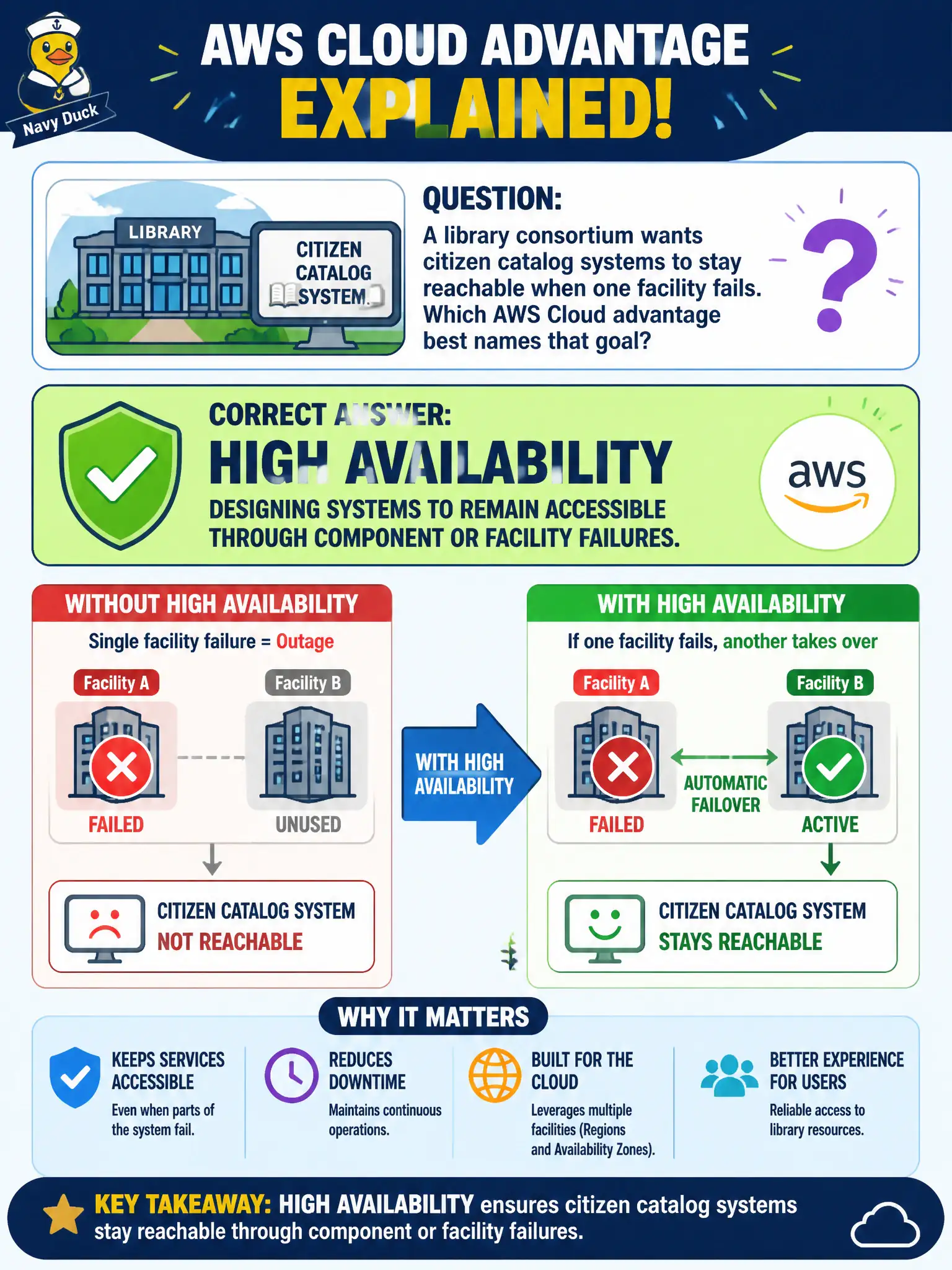
A library consortium wants citizen catalog systems to stay reachable when one facility fails. Which AWS Cloud advantage best names that goal?
Select an answer to reveal the explanation.
Short Explanation
If one library building goes dark, patrons still need the catalog. High availability is the cloud idea of staying reachable when a piece or a place fails—not a bargain on disk drives. Design for that continuity, and the consortium’s goal lines up.
Full Explanation
High availability names the library consortium's goal: design citizen catalog systems to remain accessible through component or facility failures so patrons can still search holdings when one building goes dark. The advantage is architectural continuity across failure domains, not a pricing anecdote.
Cheaper hard-disk media prices than any municipal bid may lower storage unit cost but do not keep a catalog reachable when a facility fails. Agility that only covers how fast staff write grant proposals misuses the agility concept, which is about rapid IT change and experimentation—not grant paperwork speed. Spot pricing that guarantees zero interruptions for every catalog query misstates Spot behavior; Spot is about discounted spare capacity with interruption risk, not a high-availability guarantee.
Exam caveat: High availability is design for continued access despite failures; it is not synonymous with lowest media price, Spot Instance discounts, or process agility. Operational check: deploy the catalog across multiple Availability Zones (or an equivalent multi-facility pattern), simulate loss of one AZ or site path in a controlled test, and verify read paths remain available while monitoring alarms fire for the failed component.