
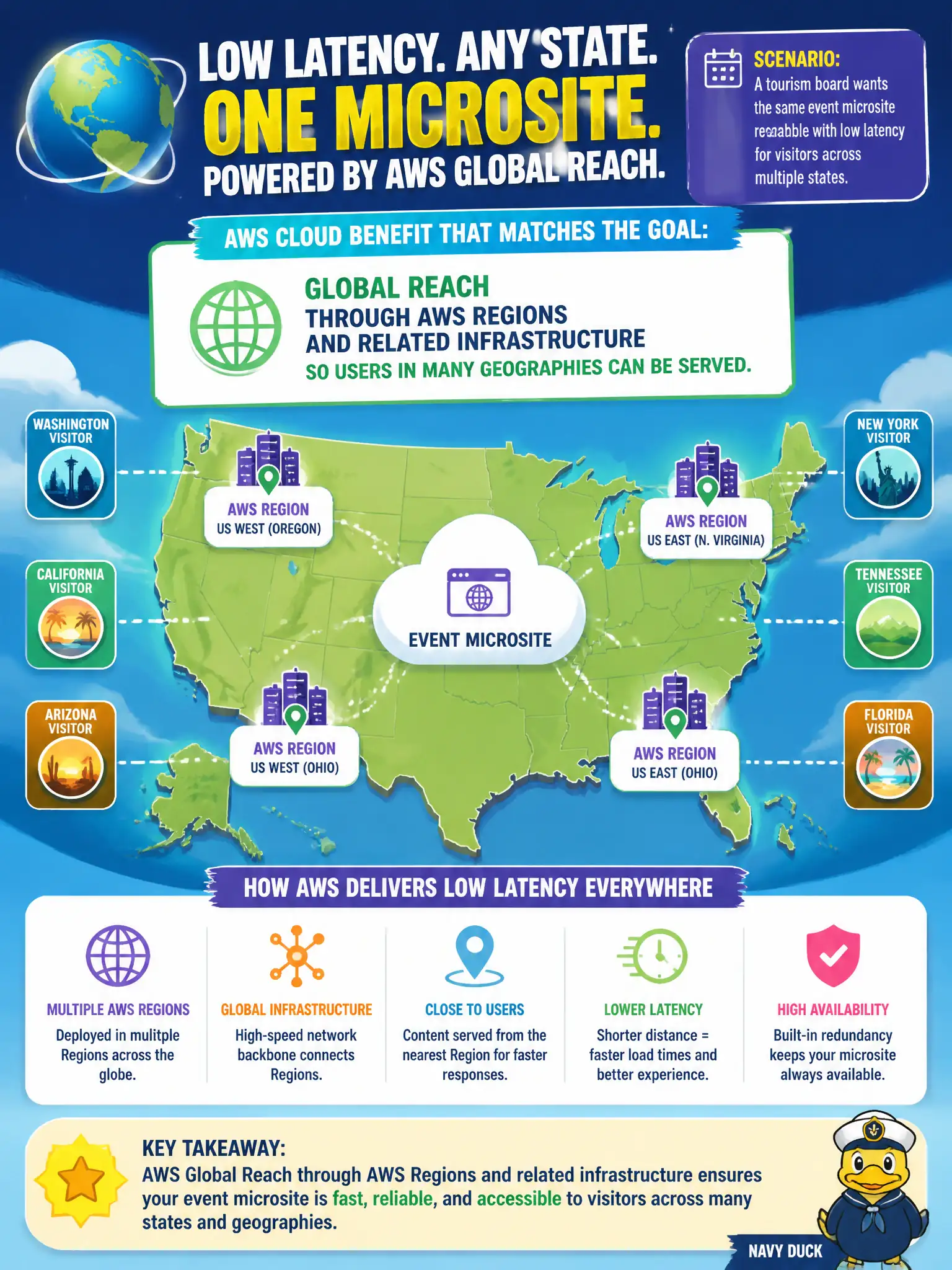
A tourism board wants the same event microsite reachable with low latency for visitors across multiple states. Which AWS Cloud benefit best matches that goal?
Select an answer to reveal the explanation.
Short Explanation
Tourists in different states should not all crawl back to one dusty rack under city hall. AWS global infrastructure lets you put the microsite closer to people across regions. That global-reach benefit is the point—not forcing everyone through a basement hop.
Full Explanation
Global reach through AWS Regions and related global infrastructure is the benefit that matches a tourism board's need for an event microsite with low latency for visitors across multiple states. Placing or caching content closer to users in different geographies improves proximity and latency characteristics compared with forcing every request back to one municipal basement.
Keeping every visitor request on one basement server to "guarantee a single physical location" optimizes for centralization, not latency or multi-state reach. Disabling multi-Region options so all traffic must hairpin through city hall deliberately worsens the visitor experience the board wants to improve. Requiring each visitor to VPN into the municipal LAN before loading the microsite adds friction unsuitable for public tourism traffic and does not create geographic proximity.
Exam caveat: Global reach is about serving users across geographies via AWS infrastructure; it is not the same as high availability within one Region, nor does it require VPN onboarding for anonymous website visitors. Operational check: publish the microsite with a content delivery or multi-AZ design appropriate to the exam-depth scenario, measure latency from test clients in at least two distant states, and verify DNS and TLS work for public visitors without municipal VPN enrollment.