
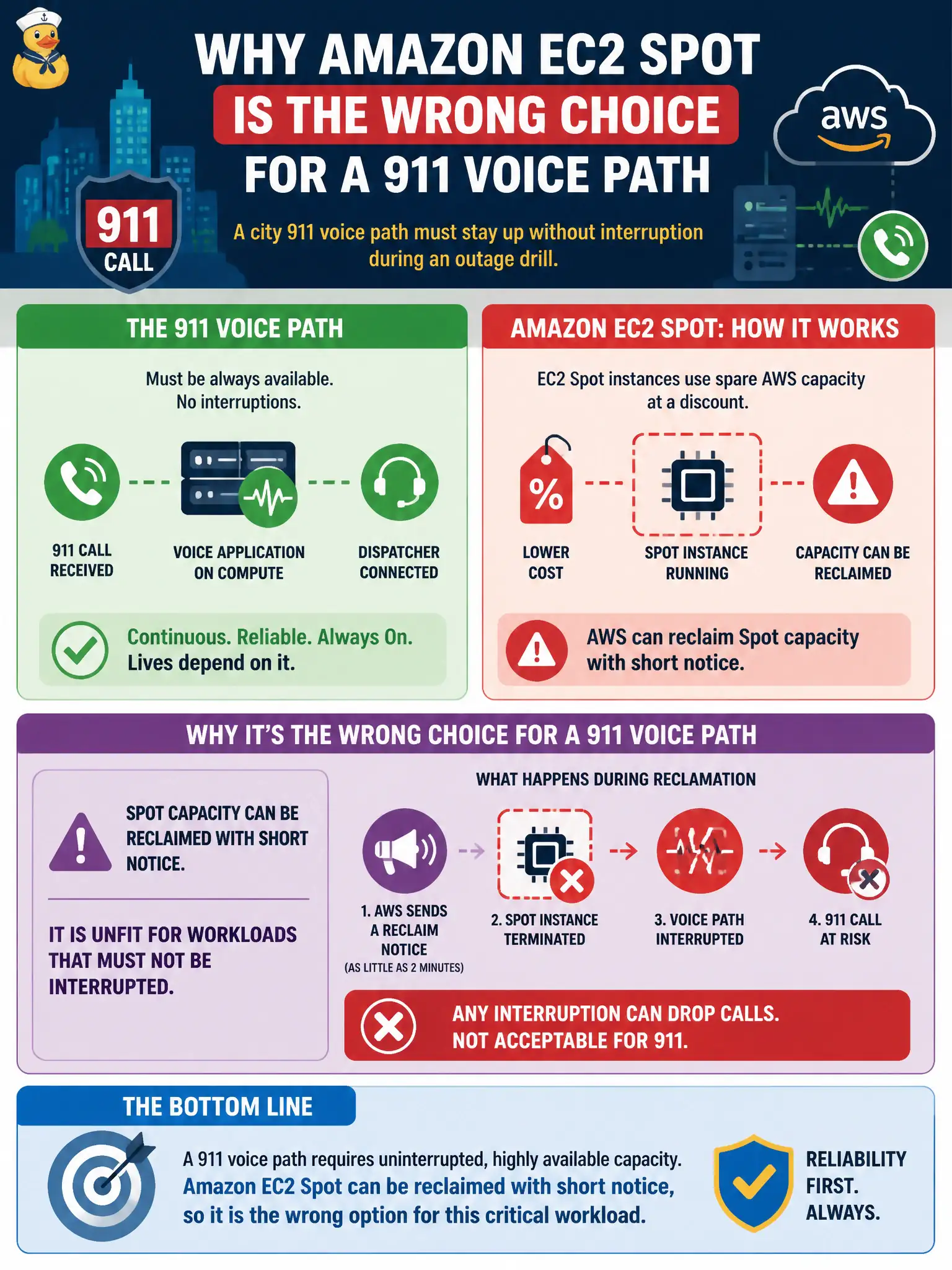
A city 911 voice path must stay up without interruption during an outage drill. Why is Amazon EC2 Spot the wrong purchase option for that path?
Select an answer to reveal the explanation.
Short Explanation
Picture a 911 line that cannot drop mid-call. Spot is interruptible spare capacity AWS can reclaim. Keep must-not-stop paths on On-Demand, Reserved, or Savings Plans instead.
Full Explanation
A city 911 voice path that must stay up without interruption during an outage drill is a poor fit for Amazon EC2 Spot because Spot capacity can be reclaimed with short notice. Workloads that must not be interrupted—emergency voice, CAD front ends, synchronous citizen safety systems—belong on On-Demand, Reserved, or Savings Plans capacity with appropriate HA design, not on reclaimable Spot. The defining Spot trade-off is price versus interruption risk.
Spot does not always cost more than On-Demand; it is typically cheaper, which is why people misuse it on critical paths. Spot Instances run in AWS Regions; they are not limited to on-premises data centers. Spot does not automatically convert every workload into a Reserved Instance commitment. Distractors invent false Spot properties while the real disqualifier is interruption.
Exam caveat: If the stem says "must not be interrupted," eliminate Spot immediately. Spot shines for batch, CI, and stateless scale-out with checkpointing—not 911 voice continuity drills.
Operational check for 911: place voice path components on non-Spot capacity across multiple AZs, test failover without relying on Spot pools, use Capacity Reservations if launch guarantees are required during declared emergencies, monitor instance health, and explicitly ban Spot in architecture standards for safety-critical synchronous services.