
A county license desk wants EC2 capacity that stays on single-tenant hardware but does not need to pick and control a specific physical server for bring-your-own licensing. Which tenancy option matches that need?
Select an answer to reveal the explanation.
Short Explanation
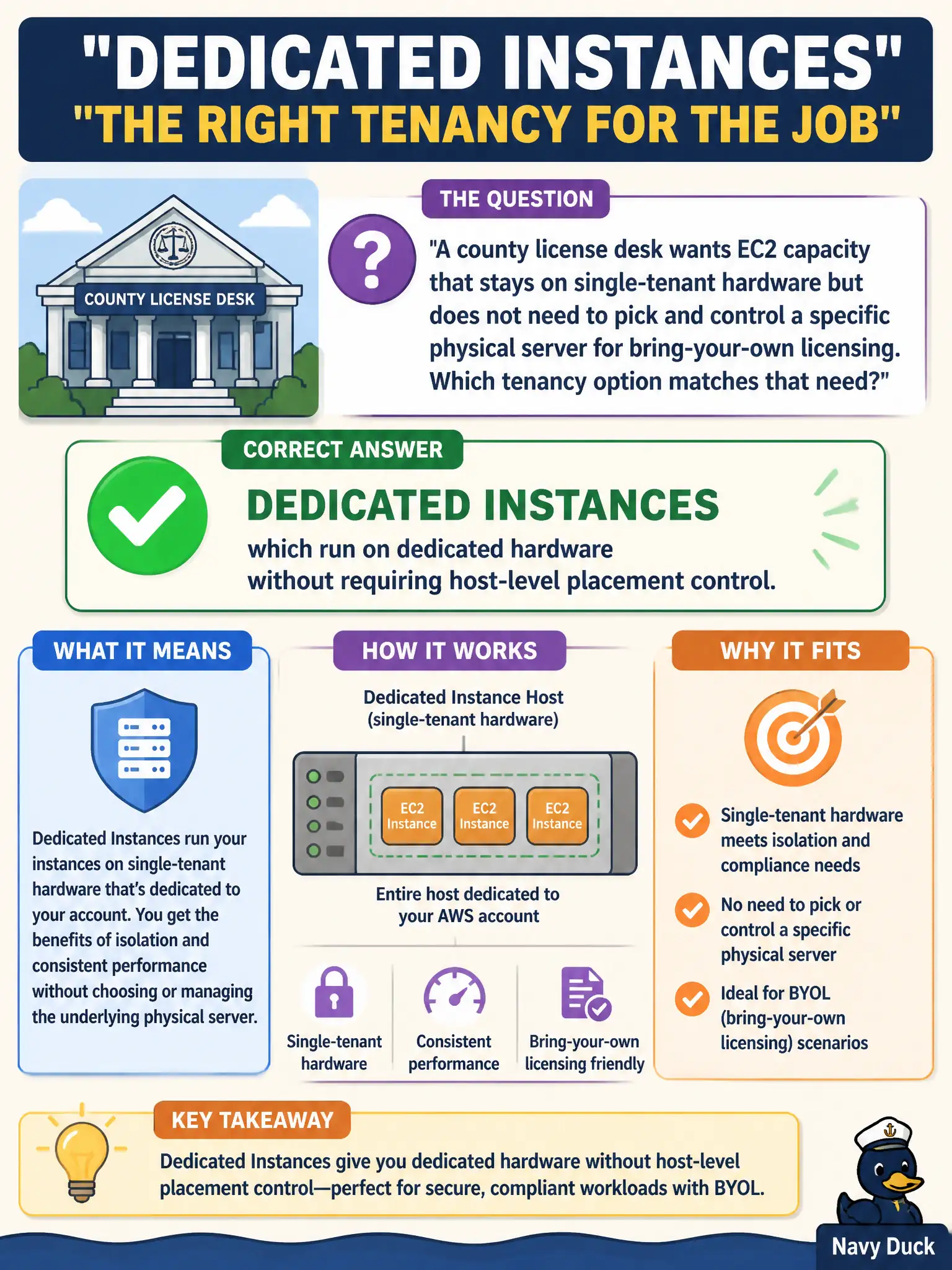
Think of wanting single-tenant hardware without babysitting a named physical box. Dedicated Instances give you dedicated hardware without host-level placement control. Shared tenancy and Spot are different stories.
Full Explanation
A county license desk that wants EC2 capacity on single-tenant hardware—but does not need to pick and control a specific physical server for bring-your-own licensing—should choose Dedicated Instances. Dedicated Instances run on hardware dedicated to the customer without requiring the host-level placement visibility and control that Dedicated Hosts provide for socket-level license mapping. That distinction matters for municipalities that want tenancy isolation without full BYOL host inventory management.
Shared tenancy on the default multi-tenant host pool still shares physical servers with other customers, which fails the single-tenant hardware requirement. Spot Instances are interruptible discounted capacity; interruption risk does not equal dedicated hardware. Amazon S3 Intelligent-Tiering manages object storage classes and provides no dedicated EC2 hosts at all. Only Dedicated Instances match "dedicated hardware without host-level placement control."
Exam caveat: Dedicated Hosts = entire physical server with socket/core visibility for BYOL; Dedicated Instances = dedicated tenancy without that host control; default shared tenancy = multi-tenant. Read the stem carefully for whether socket mapping is required.
Operational check for the license desk: select dedicated tenancy when launching instances or in configuration, confirm billing implications of dedicated tenancy, verify that applications do not actually require socket-level reporting (if they do, upgrade the design to Dedicated Hosts), document tenancy choice for auditors, and avoid conflating Spot savings with tenancy isolation.