
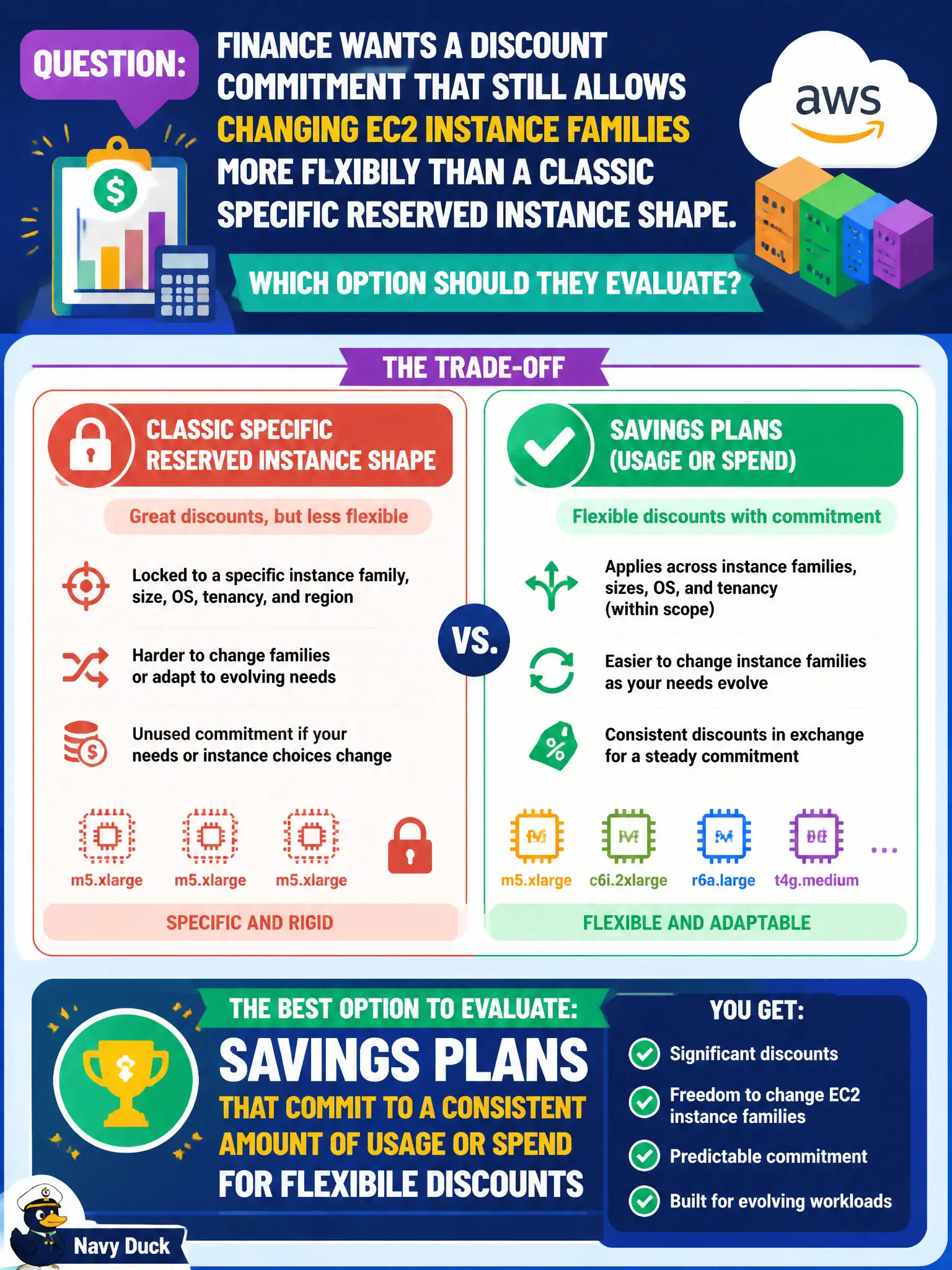
Finance wants a discount commitment that still allows changing EC2 instance families more flexibly than a classic specific Reserved Instance shape. Which option should they evaluate?
Select an answer to reveal the explanation.
Short Explanation
Savings Plans are like a prepaid transit pass for compute spend — you promise a spend rate, AWS drops the price, and you keep more room to change trains (instance families) than some rigid RI seats. Spot is interruptible spare capacity, Free Tier is a starter allowance, and data transfer is a different bill line.
Full Explanation
Finance that wants a discount commitment while still allowing changing EC2 instance families more flexibly than a classic specific Reserved Instance shape should evaluate Savings Plans. Savings Plans commit to a consistent amount of usage (measured in dollars per hour) in exchange for discounted rates across eligible compute usage, with Compute Savings Plans offering broader flexibility across instance families, sizes, and more than a narrowly scoped RI. That flexibility is attractive for evolving municipal application fleets.
Spot Instance requests never include a commitment and can interrupt anytime—they are a different discount mechanism. AWS Free Tier credits do not permanently replace paid production compute. Outbound data transfer waivers do not eliminate all EC2 compute charges. Distractors either describe non-commitment discounts or invent waivers that do not substitute for Savings Plans.
Exam caveat: Standard RIs can be less flexible (though size flexibility exists within families for some RIs); Convertible RIs and Savings Plans increase flexibility in different ways. CLF often highlights Savings Plans as the flexible commitment discount model.
Operational check for finance: analyze Cost Explorer recommendations, choose Compute versus EC2 Instance Savings Plans based on how often families change, commit only to the steady baseline—not peak festival traffic—track utilization, and educate app teams that launching exotic instance types still consumes the commitment favorably under Compute Savings Plans when eligible.