
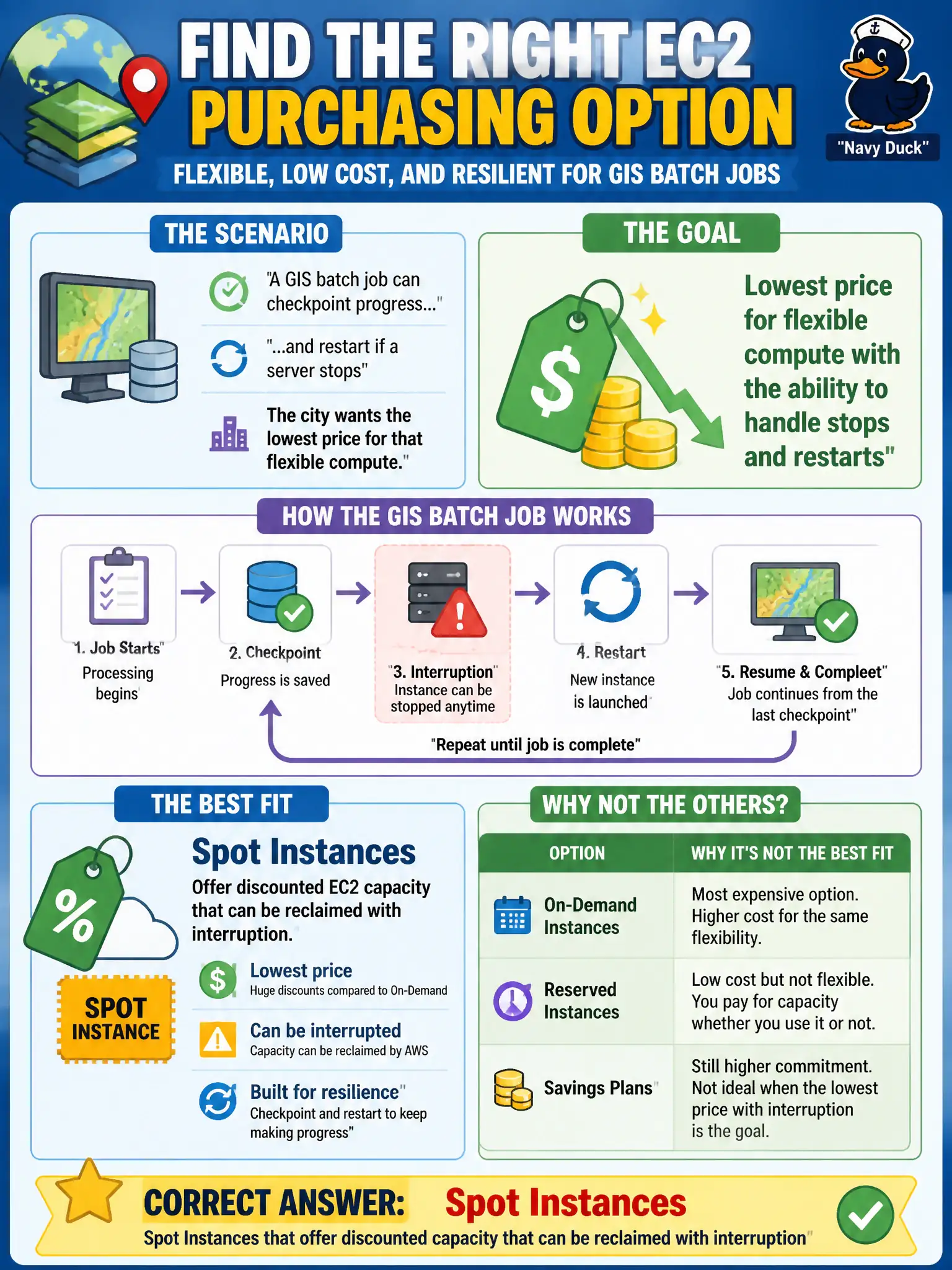
A GIS batch job can checkpoint progress and restart if a server stops, and the city wants the lowest price for that flexible compute. Which EC2 purchasing option fits?
Select an answer to reveal the explanation.
Short Explanation
Spot is the last-minute flight seat — cheap, but the airline can bump you, so only pack bags you can recheck. Checkpointable GIS batch loves that deal; On-Demand is steadier and pricier, Dedicated Hosts are for license maps, and Reserved commits are for steady must-run capacity.
Full Explanation
A GIS batch job that can checkpoint progress and restart if a server stops—and for which the city wants the lowest price for flexible compute—fits Spot Instances. Spot offers discounted EC2 capacity that AWS can reclaim with interruption notice, making it ideal for fault-tolerant, restartable batch and analytics work. Municipal GIS rendering or bulk geocoding that saves progress periodically can ride Spot savings safely.
On-Demand maximizes price with no interruption risk, which contradicts "lowest price" when interruption is tolerable. Dedicated Hosts are not required for every batch job regardless of licensing needs. Standard Reserved Instances lock commitment assumptions and do not primarily optimize for interruptible deep discounts the way Spot does. When the stem stresses lowest price plus restartability, Spot is the answer.
Exam caveat: Spot interruption is the key trade-off. Never put non-checkpointed sole copies of critical databases on Spot. Combine Spot with managed batch orchestration where possible.
Operational check for GIS batch: implement checkpointing to S3, handle Spot interruption notices, diversify instance pools, use Spot Fleet or Auto Scaling mixed instances if appropriate, fall back to On-Demand for deadline-critical evening runs before council demos, and monitor interruption rates so SLAs for overnight map jobs remain realistic.