
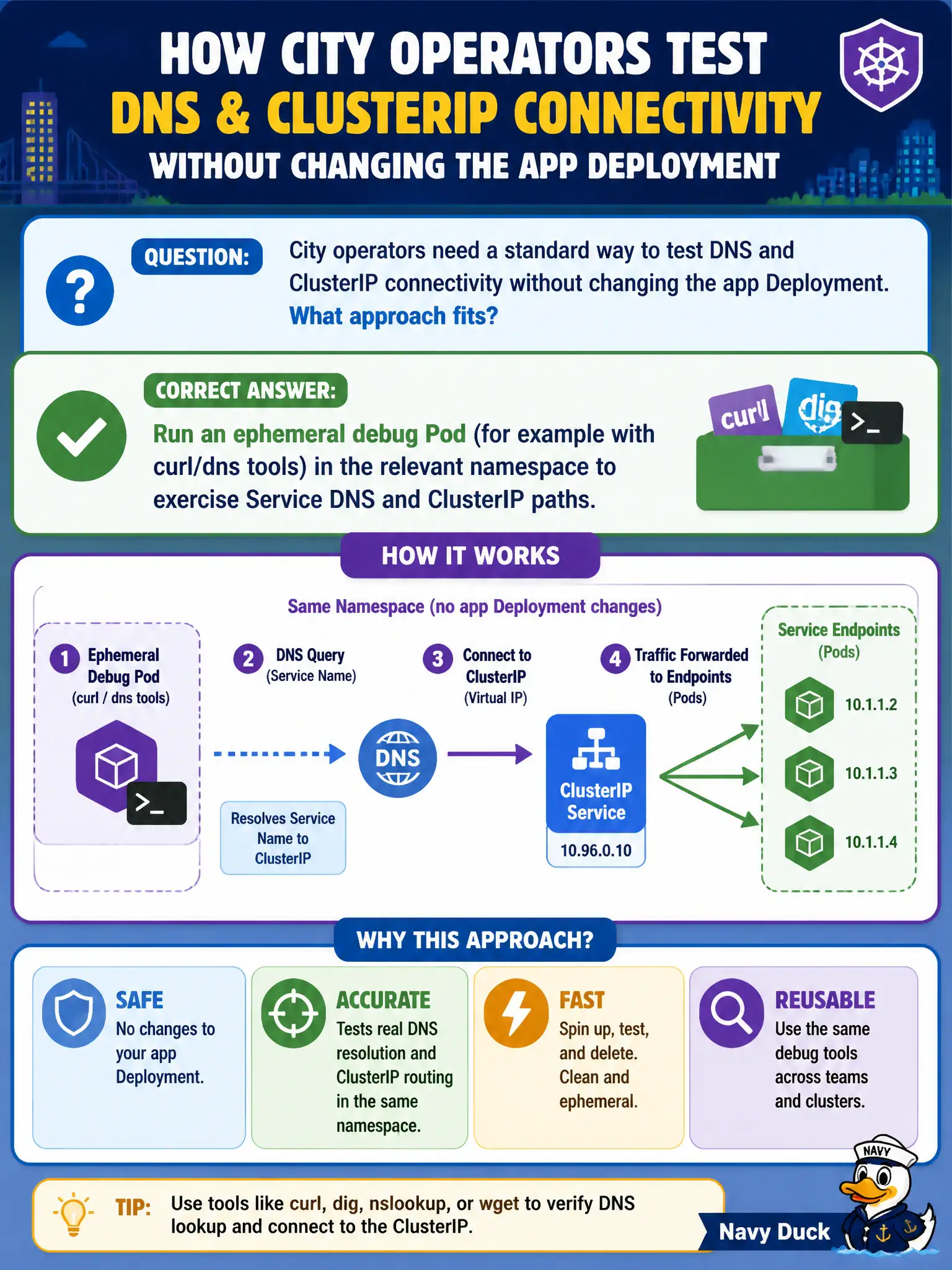
City operators need a standard way to test DNS and ClusterIP connectivity without changing the app Deployment. What approach fits?
Select an answer to reveal the explanation.
Short Explanation
Spin up a throwaway detective Pod with curl—probe DNS and ClusterIP without remodeling the app. It’s the clean lab coat for connectivity checks.
Full Explanation
To test DNS and ClusterIP connectivity without changing the app Deployment, run an ephemeral debug Pod (for example with curl/dns tools) in the relevant namespace to exercise Service DNS and ClusterIP paths. A throwaway detective Pod is the clean lab coat for connectivity checks in city clusters. Rebooting every worker node and assuming networking is fine if kubelet starts is disruptive and does not specifically validate Service DNS/ClusterIP from a namespace. Scaling CoreDNS to zero briefly to force clients to use IP literals only breaks DNS for everyone and is not a test method. Editing the production Service selector live to point at a busybox Pod permanently hijacks production traffic and is poor practice. Exam caveat: Use kubectl run with --rm -it and a known image policy-approved for the cluster. Test both FQDN and ClusterIP. Operational check: Launch the debug Pod in the app namespace, dig the Service, curl the ClusterIP:port, record results, and delete the ephemeral Pod when finished. In municipal production practice, record the finding in the incident ticket with command output snippets, confirm the fix under change control, and re-validate the user-facing civic service before closing the change window.