
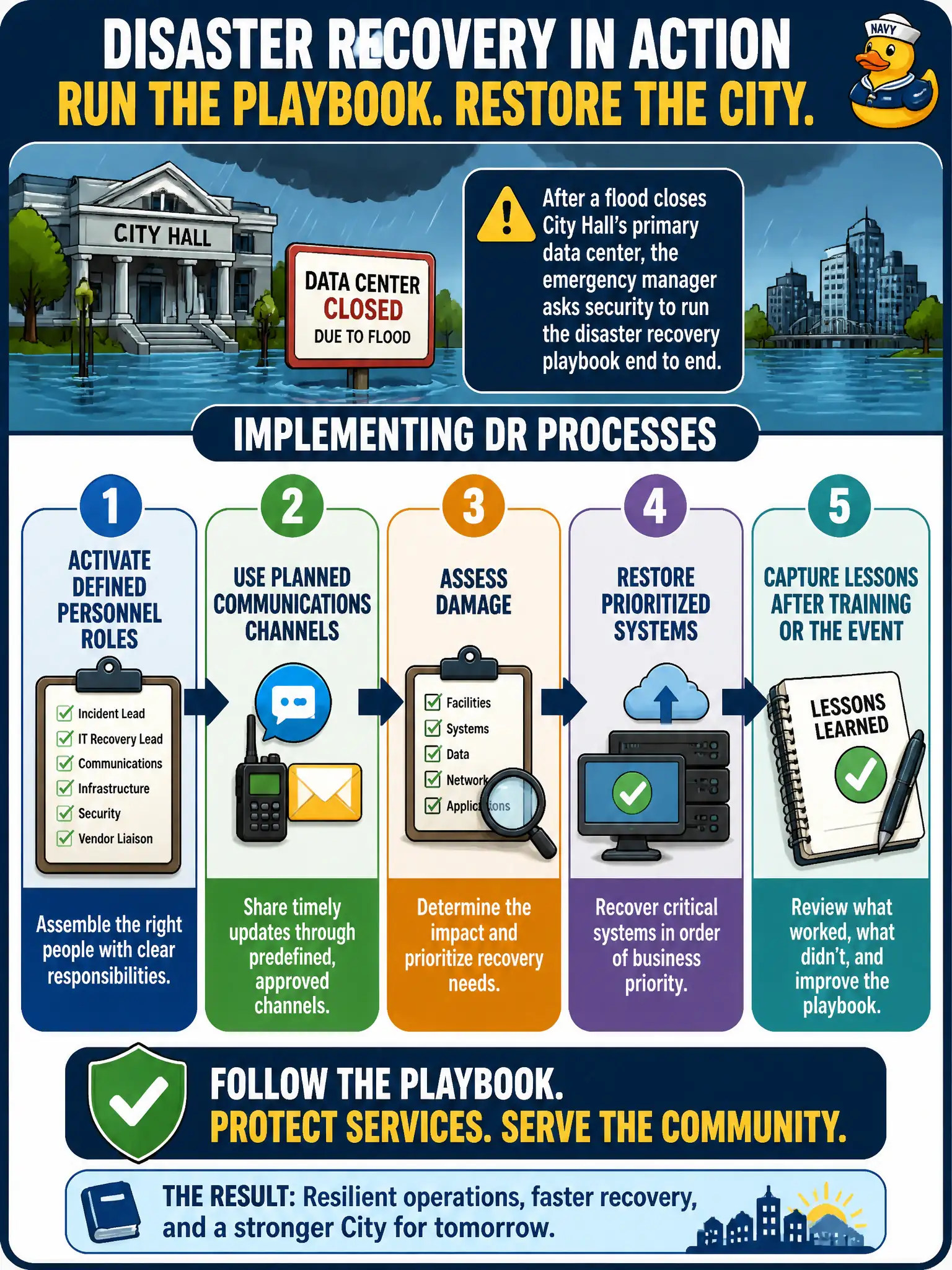
After a flood closes City Hall’s primary data center, the emergency manager asks security to run the disaster recovery playbook end to end. Which set of activities best reflects implementing DR processes?
Select an answer to reveal the explanation.
Short Explanation
DR is a play, not a panic. Roles, radios/email trees, a clear look at what broke, restore the must-haves first, then train and learn. Skipping those steps turns recovery into guesswork.
Full Explanation
Implementing disaster recovery processes means executing the playbook as a coordinated operational sequence, not improvising around the outage. After a flood closes City Hall’s primary data center, security and emergency management activate predefined personnel roles so decision rights and technical tasks are clear. They use planned communications channels—internal call trees, public information officers, and regulator notification paths—so staff and residents receive consistent guidance. Damage and impact assessment identifies what is lost, what remains usable, and which dependencies block recovery. Restoration then follows documented priority so life-safety, revenue, and essential civic services return before lower-tier applications. Training and after-action lessons close the loop so the next activation improves rather than repeats the same gaps.
Replacing the entire DR plan with a new vendor RFP before any restoration freezes recovery in procurement theater; planning updates belong after—or parallel to—stabilization, not as a substitute for bringing systems back. Focusing only on rebuilding the primary site while deferring role assignments and public messaging leaves responders without command structure and the public without authoritative information during the crisis window. Skipping damage assessment and restoring every application at once ignores dependency order and capacity limits; equal-priority restoration often delays the few services residents actually need first.
Exam caveat: DR process elements (roles, communications, assessment, prioritized restore, training/lessons) are distinct from merely owning a written plan. CISSP-style items often test whether you recognize the full process set versus a single technical rebuild step. Also distinguish DR (IT recovery) from broader business continuity that sustains operations with alternate work methods.
Operational check: walk the city’s DR runbook and confirm named role cards, contact lists, assessment checklists, restoration priority tiers, and a lessons-learned owner exist and were exercised—not merely filed. After any activation or drill, verify that findings produced concrete playbook edits.