
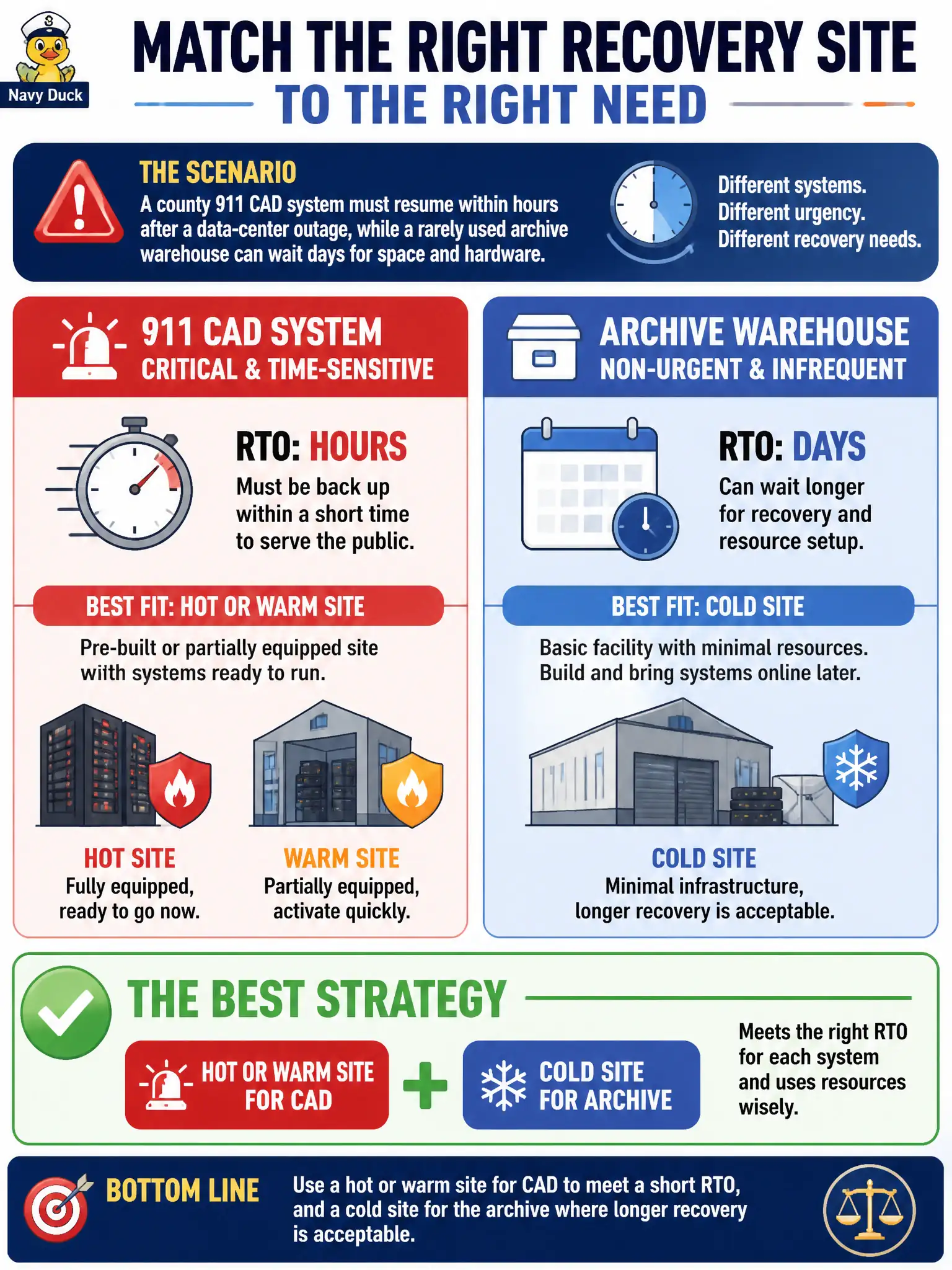
A county 911 CAD system must resume within hours after a data-center outage, while a rarely used archive warehouse can wait days for space and hardware. Which recovery-site strategy best matches those two needs?
Select an answer to reveal the explanation.
Short Explanation
Think of a spare garage versus a fully stocked spare kitchen. CAD needs gear ready fast—hot or warm. The archive can wait for empty space and install day—cold. Match the site type to how quickly the service must come back.
Full Explanation
Recovery-site selection for municipal systems is an RTO- and RPO-driven design decision, not a one-size-fits-all procurement. A county 911 computer-aided dispatch (CAD) workload that must resume within hours requires a hot or warm alternate site: pre-positioned compute, network paths, and sufficiently current data so dispatchers can resume operations before public-safety impact becomes unacceptable. By contrast, a rarely used archive warehouse with multi-day tolerance can use a cold site—facility space and utilities without standing idle servers—because the cost of continuous readiness exceeds the value of faster restoration for that workload. Matching site class to service criticality is how government continuity programs spend limited budgets without endangering life-safety systems.
Placing both workloads in a cold site fails the CAD recovery-time objective; cost avoidance does not authorize multi-day outages for emergency dispatch. Reversing the pairing—hot for the archive and cold for CAD—misreads change-rate and criticality: archival data may change infrequently, but that is irrelevant when CAD is the system that must return first. Relying only on mirrored disks inside the primary facility addresses local disk failure, not loss of the entire data center to flood, fire, or power collapse; geographic diversity remains necessary when the facility itself is the failure domain.
Exam caveat: hot, warm, and cold describe readiness and cost trade-offs; they are not synonyms for backup frequency. A warm site may require some configuration or data catch-up yet still meet a short RTO, while a hot site implies near-immediate failover capability. Do not assume every civic system deserves a hot site—over-provisioning archives wastes funds that should protect CAD, ERP, and other high-priority services.
Operational check: for each critical municipal application, document RTO/RPO, map the chosen recovery site type, verify contracts include capacity and network readiness, and run an exercise that proves CAD can meet its hours-scale target while confirming the archive’s cold-site activation steps are still workable when leadership accepts longer downtime.