
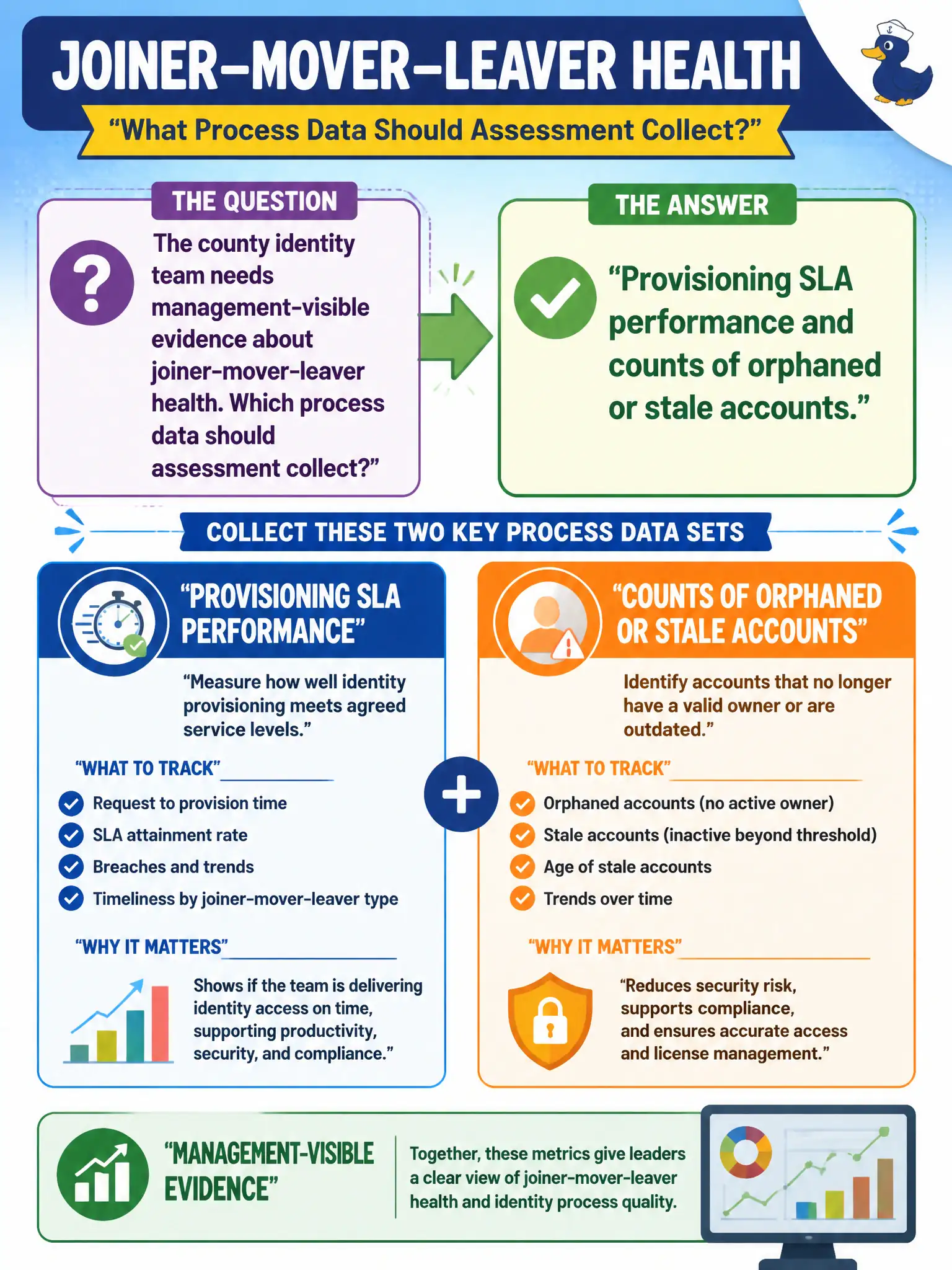
The county identity team needs management-visible evidence about joiner-mover-leaver health. Which process data should assessment collect?
Select an answer to reveal the explanation.
Short Explanation
Management wants receipts on account hygiene—how fast people get access and how many ghost accounts linger. Screensavers, follower counts, and unsupported opinions are not that evidence.
Full Explanation
Domain 6 expects collection of security process data for account management, including provisioning timeliness and orphaned-account rates. For a county identity team, provisioning SLA performance shows whether joiners receive access in time without risky workarounds, while counts of orphaned or stale accounts reveal mover-leaver failures that leave excess privilege behind. Those metrics are management-visible evidence of joiner-mover-leaver health and support review of IAM control effectiveness.
Counting decorative screensaver themes says nothing about identity lifecycle risk. Public social-media follower totals for IT are vanity metrics unrelated to access hygiene. Personal opinions of help-desk staff without supporting tickets or logs are anecdotal and cannot be trend-analyzed or audited as process data.
Exam caveat: Process data collection focuses on measurable control performance (SLAs, orphan rates, review completion)—not aesthetics, popularity, or unsupported opinion. When stems ask for management-visible IAM evidence, pick operational identity metrics.
Operational check: Define provisioning SLA targets, automate orphaned-account reports from HR feed mismatches, present both metrics in the county’s management review pack, and assign remediation owners when orphan counts or SLA breaches trend upward.