
A water utility plans penetration testing near pressure-control PLCs. What scoping principle is most important?
Select an answer to reveal the explanation.
Short Explanation
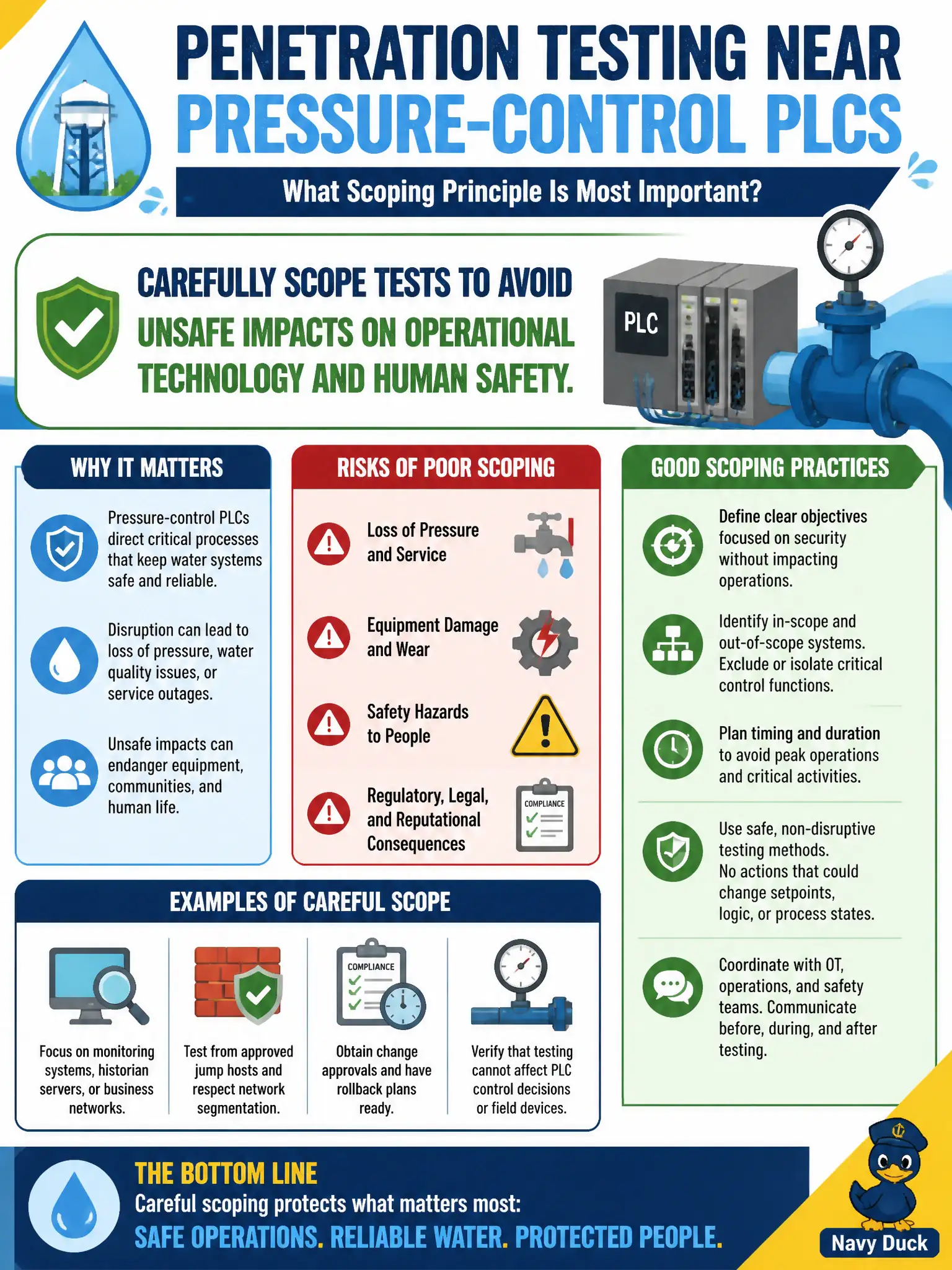
Water pressure controls are not a throwaway web lab—bad tests can flood or starve neighborhoods. Scope tightly for safety. Unrestricted destruction, no freezes, or blinding operators is how OT testing goes wrong.
Full Explanation
Security testing near industrial control and operational technology must prioritize human safety and operational continuity. For a water utility planning penetration testing near pressure-control PLCs, carefully scoping tests to avoid unsafe impacts—using constrained techniques, change freezes, isolation where possible, and operator coordination—is the governing principle. Realism never outweighs the risk of disrupting pressure control that could flood, starve, or otherwise endanger neighborhoods and plant staff.
Running unrestricted destructive tests in production to maximize realism is reckless in OT and can cause physical harm or environmental damage. Treating OT the same as a disposable lab web app with no change freeze ignores safety interlocks, timing sensitivity, and the inability to ‘just restore from backup’ for live process control. Disabling all monitoring during testing so operators cannot intervene blinds the people responsible for safe operation precisely when anomalous test traffic may need immediate stoppage.
Exam caveat: CISSP stress-tests OT/ICS scoping: safety first, rules of engagement, and constrained methods. When stems mention PLCs, pressure, or physical processes, reject ‘maximum realism at any cost’ distractors.
Operational check: Co-write rules of engagement with OT engineers and safety officers, define prohibited techniques and abort criteria, schedule tests during approved windows with heightened monitoring, use mirrors or non-production segments when feasible, and keep operators empowered to halt the engagement instantly.