
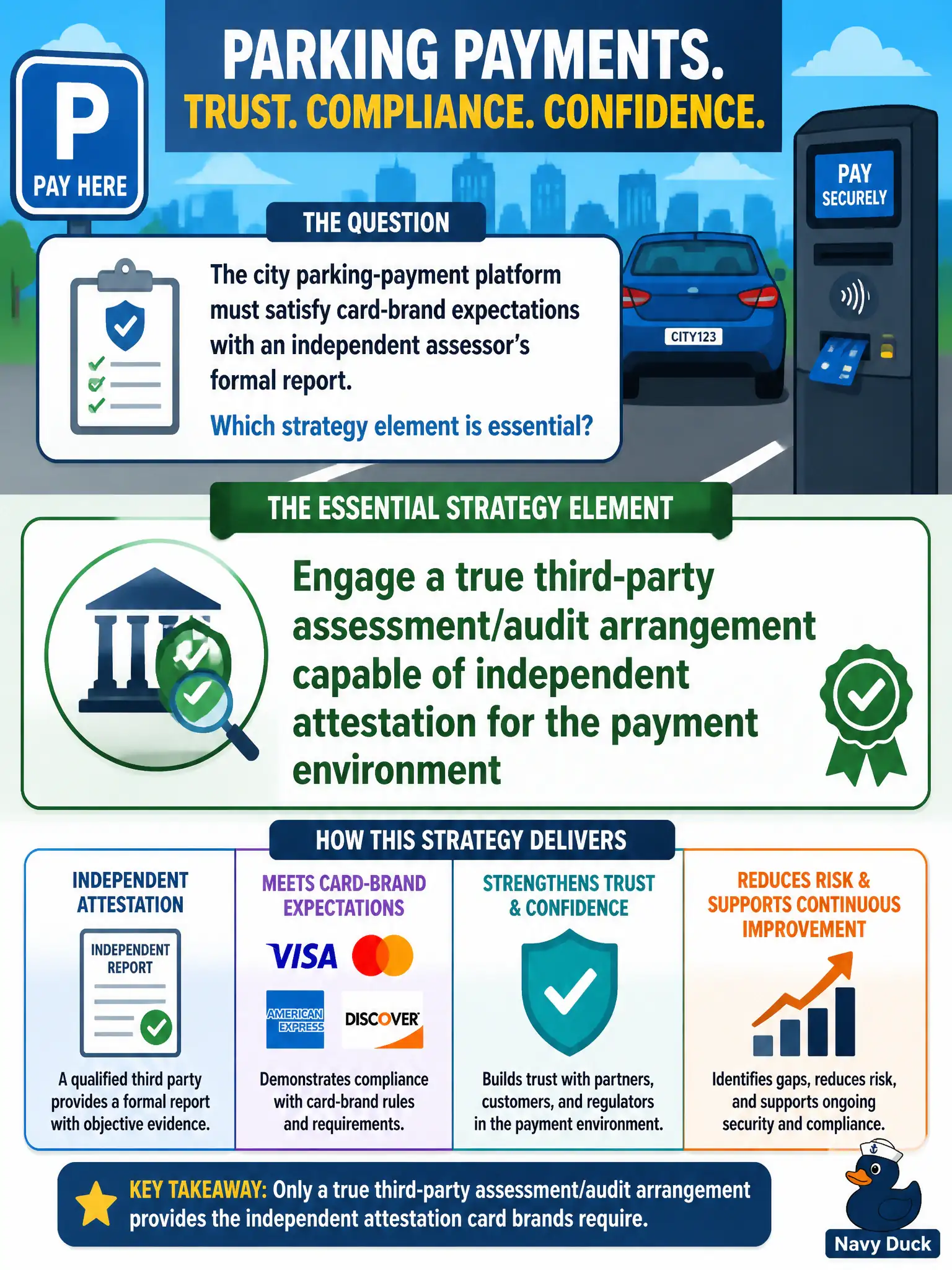
The city parking-payment platform must satisfy card-brand expectations with an independent assessor's formal report. Which strategy element is essential?
Select an answer to reveal the explanation.
Short Explanation
When the card brands want a real independent stamp, the parking manager's self-checklist will not cut it. Bring a proper third-party assessor arrangement—independence is the point.
Full Explanation
When card-brand expectations require an independent assessor’s formal report for the parking-payment platform, the strategy must engage a true third-party assessment or audit arrangement capable of independent attestation for that environment. Independence and formal reporting are the point: self-signed checklists and informal internal scans do not satisfy stakeholders who demand an outside opinion on PCI-scoped controls.
Relying solely on self-attestation checklists signed by the parking manager lacks independence when the brands or acquirer expect a formal third-party report. Treating vulnerability scan PDFs from an internal intern as equivalent to a QSA report confuses useful hygiene evidence with attestation authority. Skipping assessment because terminals use encryption mistakes a single technical control for a scoped, independently attested control system.
Exam caveat: know when self-assessment questionnaires suffice versus when independent third-party assessment is mandatory—payment stems usually signal the latter. Operational check: confirm card-brand or acquirer level drives QSA versus SAQ paths, contract an appropriately qualified assessor, maintain the ROC/AOC evidence chain, and keep encryption and other technical controls as part of—not a substitute for—the attested scope.