
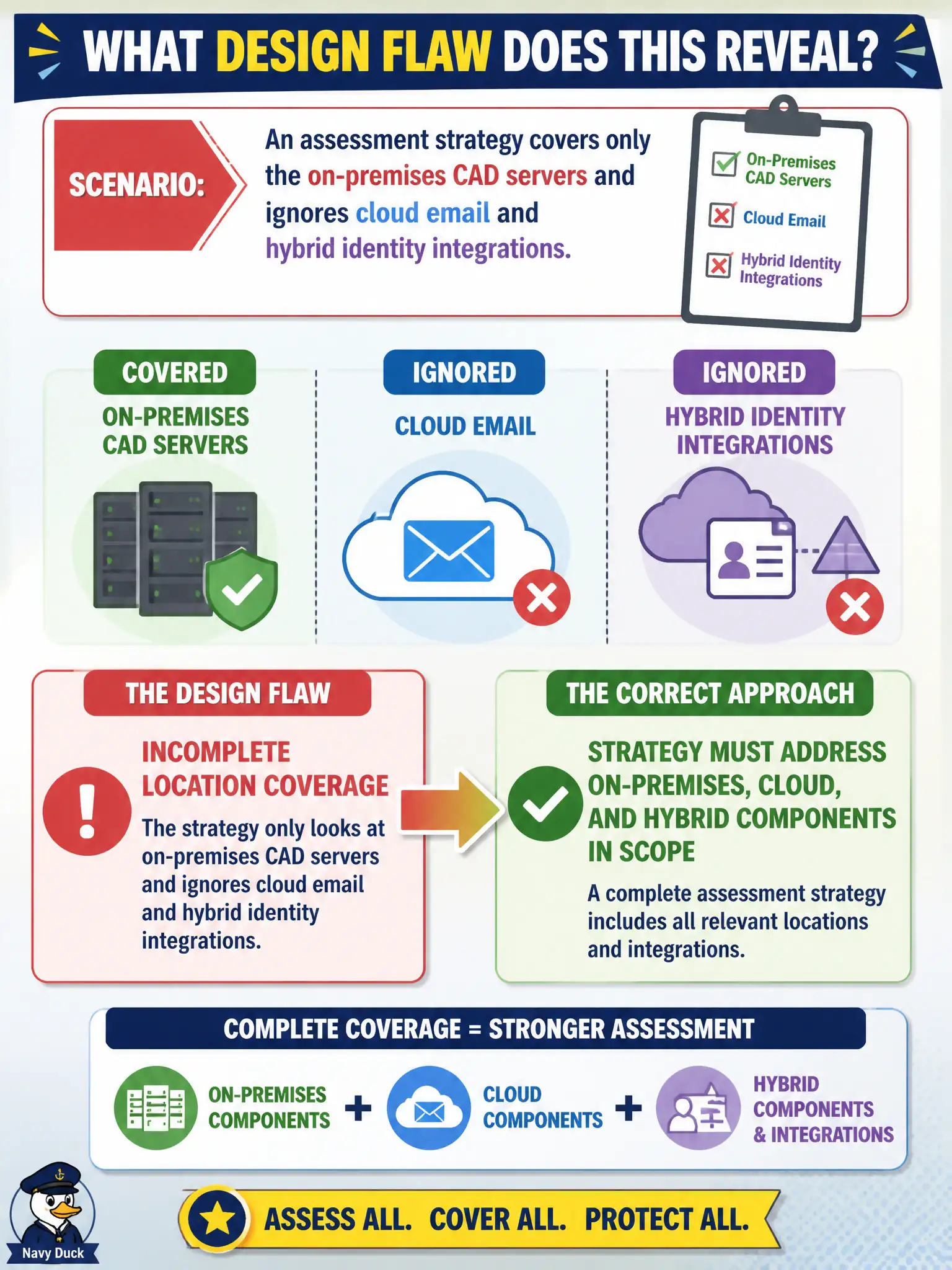
An assessment strategy covers only the on-premises CAD servers and ignores cloud email and hybrid identity integrations. What design flaw does that reveal?
Select an answer to reveal the explanation.
Short Explanation
If you only poke the CAD boxes in the basement and wave at cloud email and hybrid identity, your map has blank continents. Assessment strategy has to cover on-prem, cloud, and the hybrid glue.
Full Explanation
Assessment and audit strategies must cover the locations where systems and identity actually live. Limiting scope to on-premises CAD servers while ignoring cloud email and hybrid identity integrations leaves major control surfaces—federated auth, SaaS configurations, sync agents, conditional access—untested. Incomplete location coverage is the design flaw; a municipal strategy should address on-premises, cloud, and hybrid components that fall in organizational scope.
Calling the approach over-scoping because CAD is “the only system that can fail” invents a false monoculture; email and identity failures disrupt city operations daily. Claiming cloud services never need testing ignores shared-responsibility gaps and tenant misconfiguration risk. Asserting hybrid identity is out of scope by definition is incorrect when the city operates the hybrid connectors and policies that bridge directories to cloud IdPs.
Exam caveat: Domain 6 scoping questions punish on-prem-only habits in hybrid cities—extend location coverage explicitly. Operational check: inventory CAD, cloud email, and hybrid identity in the assessment universe, assign test methods per environment, verify cloud admin and federation controls in the same cycle as server scans, and update the strategy when new SaaS or identity bridges appear.