
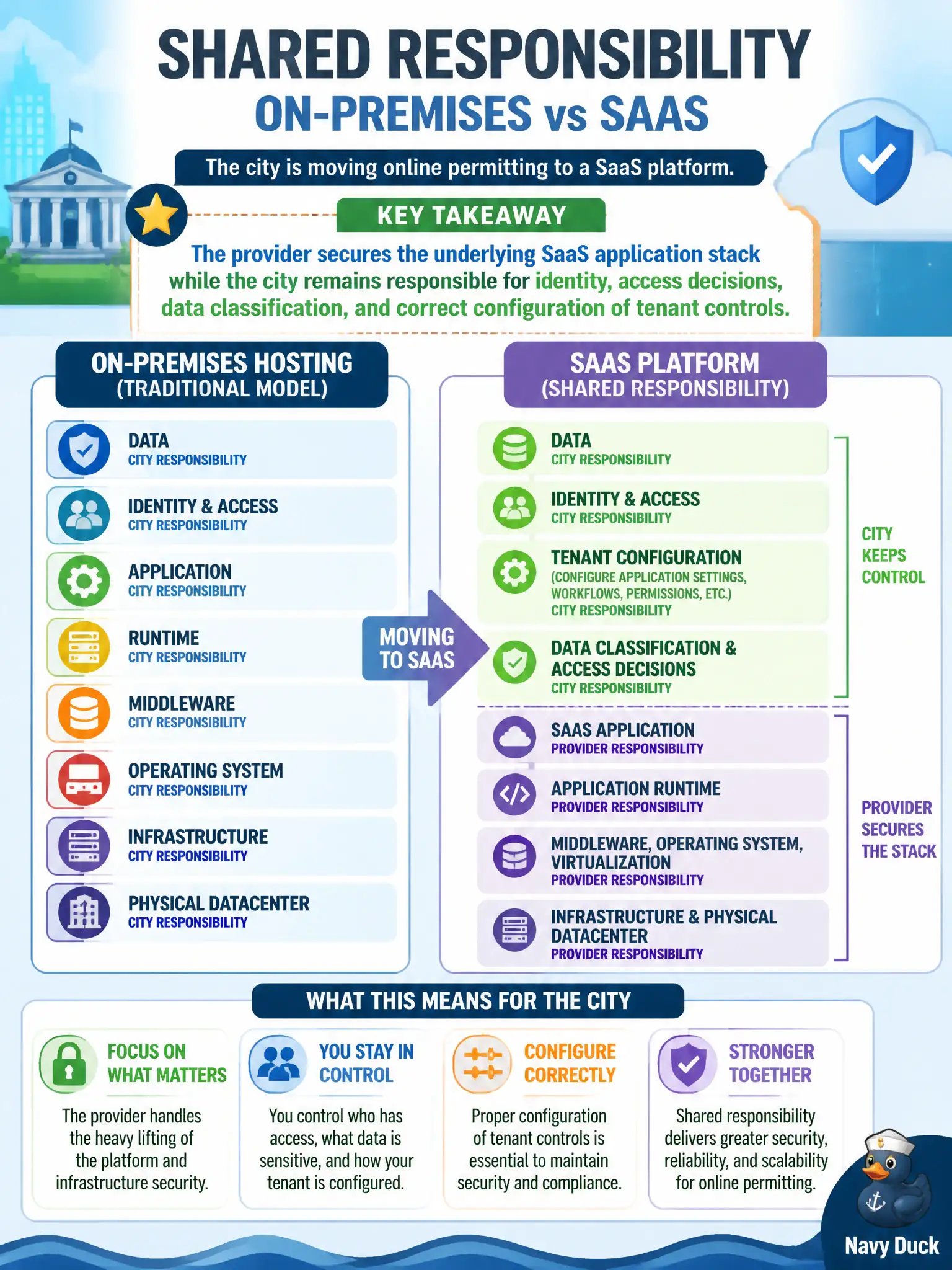
The city is moving online permitting to a SaaS platform. Which statement best reflects how shared responsibility changes versus on-premises hosting?
Select an answer to reveal the explanation.
Short Explanation
SaaS is like leasing a fully staffed kitchen—the city does not fix their ovens, but still decides who gets keys to the recipes and how spicy the data is. The remaining job shifts to identity, data, and tenant settings.
Full Explanation
Moving online permitting to SaaS changes—but does not erase—the city’s security responsibilities under the shared-responsibility model. The provider typically secures the underlying SaaS application stack, platform availability, and infrastructure it operates, while the city remains responsible for identity and access decisions, data classification and what is entered into the tenant, correct configuration of tenant security controls, user lifecycle, and many logging/monitoring choices available to the customer. Claiming SaaS means zero remaining city security duties after contract signature is a dangerous myth that fails audits and incident response. SaaS does not transfer physical datacenter fire suppression responsibility onto the city’s facilities crew; that remains with the provider’s facility controls. Under SaaS the city does not patch the provider’s hypervisor firmware; that is a provider-side infrastructure duty. Exam caveat: know what shifts up the stack as you move IaaS→PaaS→SaaS, and that customer duties around identity, data, and configuration persist even in SaaS. Operational check: complete a shared-responsibility matrix for the permitting tenant, enforce SSO/MFA and least-privilege admin roles, classify permit PII correctly, harden tenant settings (sharing, encryption, retention), and test that city incident playbooks cover misconfiguration and compromised clerk accounts—not only provider outages.