
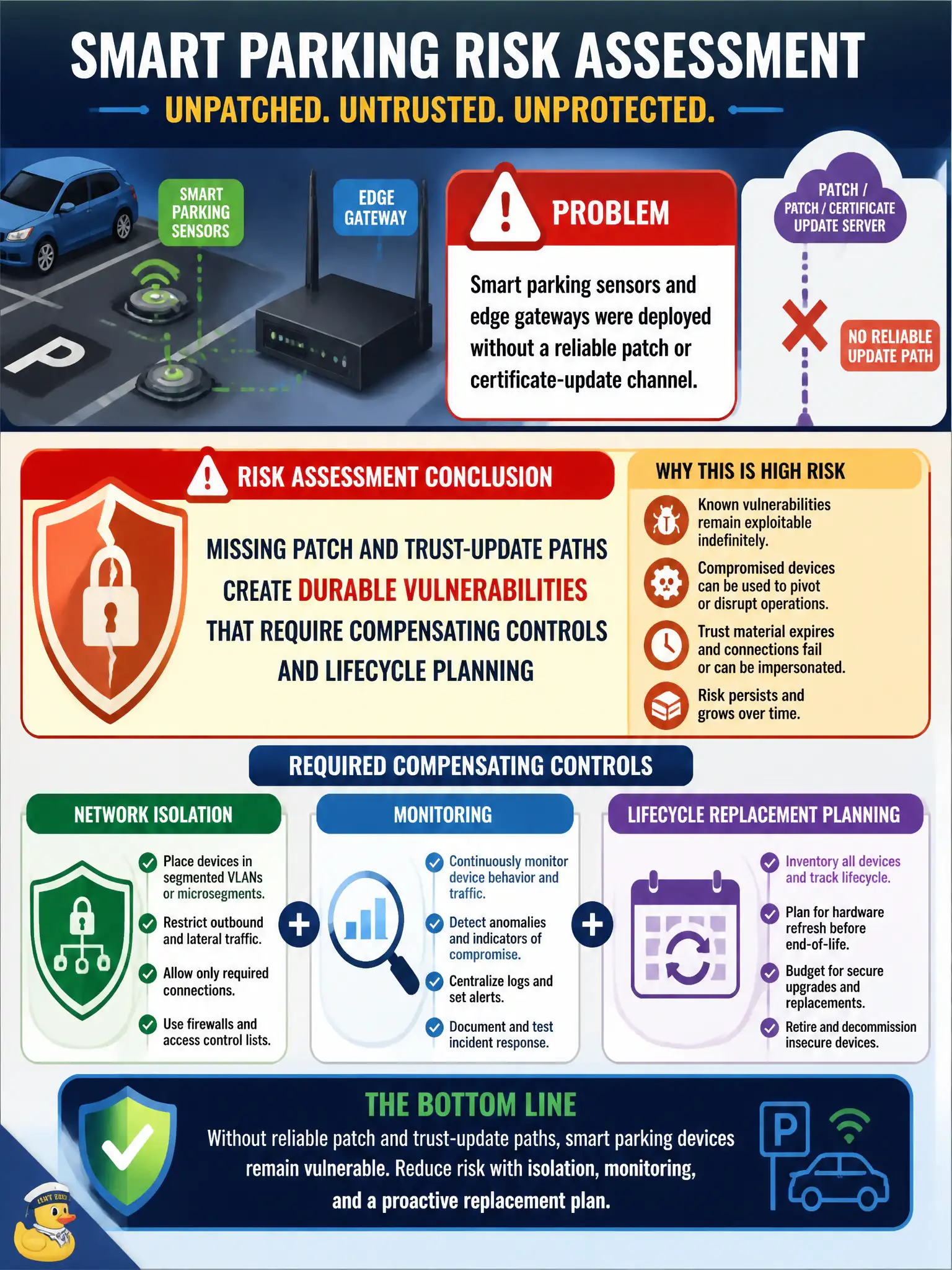
Smart parking sensors and edge gateways were deployed without a reliable patch or certificate-update channel. What risk assessment conclusion is most accurate?
Select an answer to reveal the explanation.
Short Explanation
Unpatchable parking sensors are little bricks that age in place. Without an update path, fence them off, watch them, and plan to replace them—do not pretend occupancy data makes them immortal.
Full Explanation
Smart parking sensors and edge gateways deployed without a reliable patch or certificate-update channel create devices that cannot receive security fixes or renew trust material over their operational life. The accurate risk conclusion is that missing patch and trust-update paths produce durable vulnerabilities requiring compensating network isolation, continuous monitoring, and lifecycle replacement planning—not a declaration that the devices are safe or out of scope. Treating IoT/edge as inherently out of scope for architecture risk reviews leaves unmanaged attack surface on city streets and networks. Claiming sensors are safe because they “only” handle parking occupancy ignores pivoting, botnet recruitment, and gateway compromise into municipal networks. Granting edge gateways domain admin rights to “simplify future fixes” couples fragile IoT into directory dominance and worsens impact. Exam caveat: unpatchable or hard-to-patch IoT is a known architectural risk; compensating controls and replacement cycles are expected answers when update channels were never designed in. Operational check: inventory sensors/gateways lacking update paths, isolate them on constrained networks with deny-by-default egress, monitor for anomalous traffic, track certificate expiry, and fund a replacement program that requires signed update capability in the next procurement.