
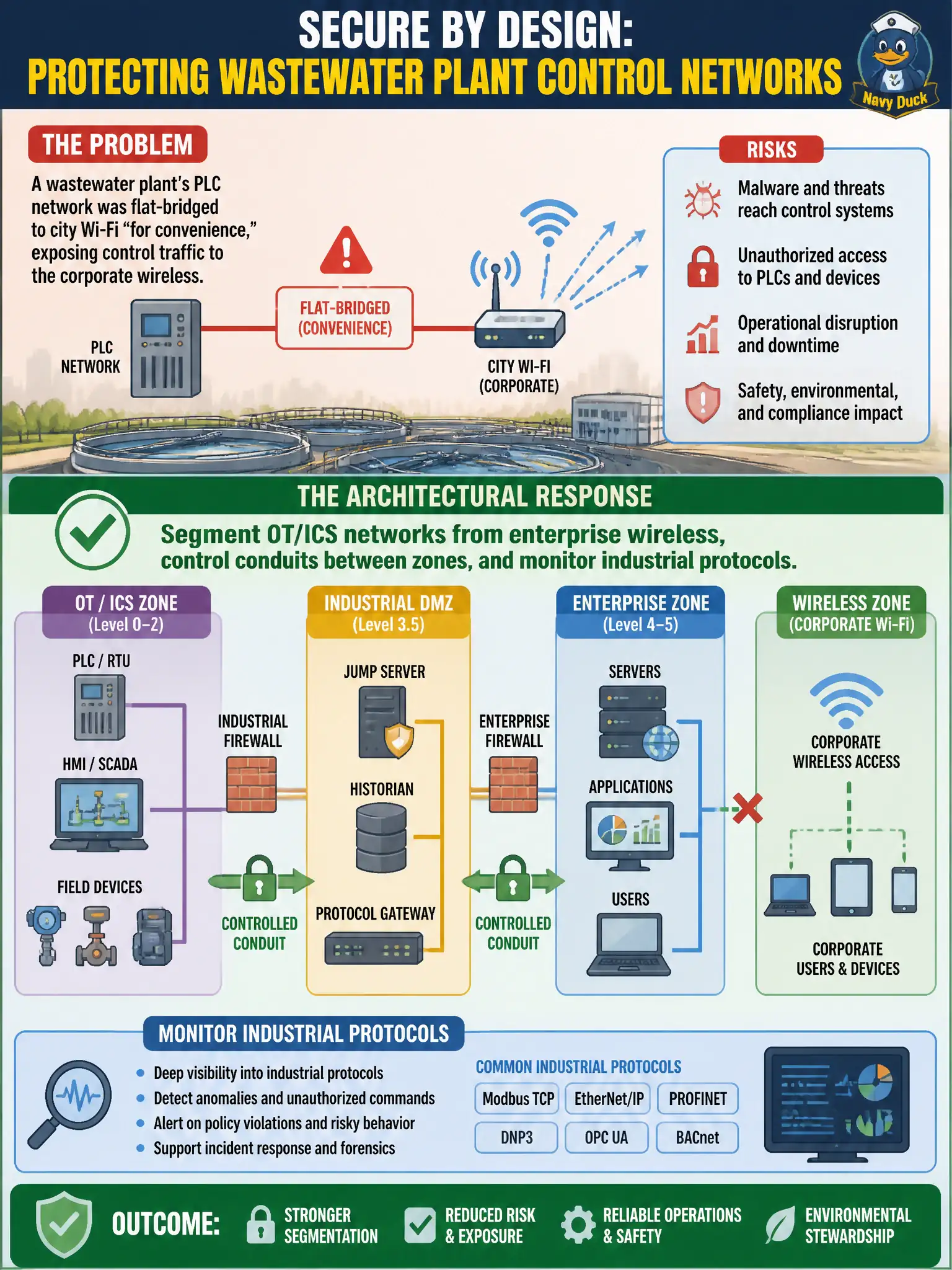
A wastewater plant's PLC network was flat-bridged to city Wi-Fi "for convenience," exposing control traffic to the corporate wireless. What architectural response is most appropriate?
Select an answer to reveal the explanation.
Short Explanation
PLCs and city guest Wi-Fi on one flat party line is how convenience becomes a spill into the control room. Segment the plant network, gate the few needed links, and watch the industrial chatter.
Full Explanation
Flat-bridging a wastewater plant’s PLC network to city Wi-Fi for convenience collapses OT/ICS and enterprise wireless trust domains, exposing industrial control traffic to a relatively open corporate wireless attack surface. The appropriate architectural response is to segment OT/ICS networks from enterprise wireless, permit only controlled conduits between zones (firewalled, authenticated, protocol-filtered links), and monitor industrial protocols for unauthorized logic changes or anomalous commands. Keeping the flat bridge and renaming the SSID humorously is obscurity without isolation. Placing PLCs on the public internet with UPnP enabled maximizes remote attack surface under the pretext of vendor support. Allowing any Wi-Fi guest to push ladder-logic changes without authentication invites sabotage of treatment processes. Exam caveat: ICS/OT questions emphasize zoning, conduits, and monitoring (aligned with ISA/IEC 62443-style thinking) over convenience bridging. Operational check: remove the flat bridge, place PLCs in a dedicated OT segment, document and restrict cross-zone conduits, disable guest wireless paths to controllers, and deploy protocol-aware monitoring with alerts on engineering-workstation and write operations outside maintenance windows.