
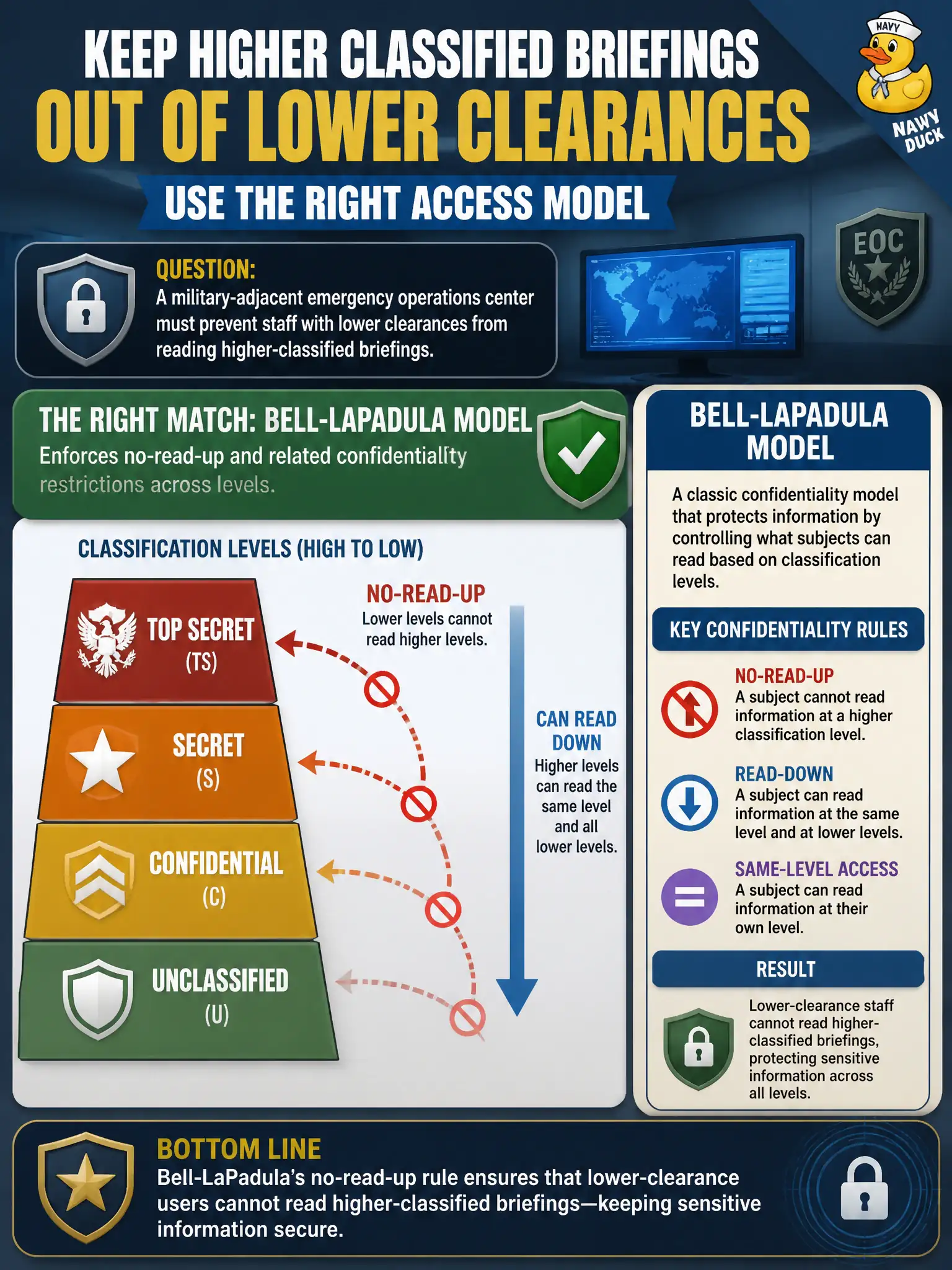
A military-adjacent emergency operations center must prevent staff with lower clearances from reading higher-classified briefings. Which classic access model’s confidentiality rules best match that goal?
Select an answer to reveal the explanation.
Short Explanation
Classified briefings are like floors in a tower—lower badges should not ride the elevator up to peek. Bell-LaPadula is the classic no-read-up rulebook built for that confidentiality problem.
Full Explanation
An emergency operations center that must stop lower-clearance staff from reading higher-classified briefings is solving a multilevel confidentiality problem. Bell-LaPadula is the classic model built for that goal: subjects cannot read objects at higher sensitivity (no-read-up), and write rules constrain downward leakage (no-write-down / ★-property variants), matching military-style classification lattices. Biba emphasizes integrity (no-write-up / no-read-down in its integrity form) and would be the wrong primary choice when the stated goal is preventing disclosure of higher-classified content. Brewer-Nash (Chinese Wall) addresses conflict-of-interest compartments in commercial consulting, not MLS clearance ladders for classified briefings. Clark-Wilson focuses on well-formed transactions and integrity validation in commercial systems, not secrecy across clearance levels. Exam caveat: map the dominant security objective first—confidentiality versus integrity versus conflict-of-interest—then pick the model; memorizing names without goals is a common failure mode. Operational check: classify briefing repositories by level, enforce mandatory access controls or equivalent label checks so lower clearances cannot open higher objects, audit read attempts, and verify that convenient shared folders do not bypass the lattice with “everyone” ACLs.