
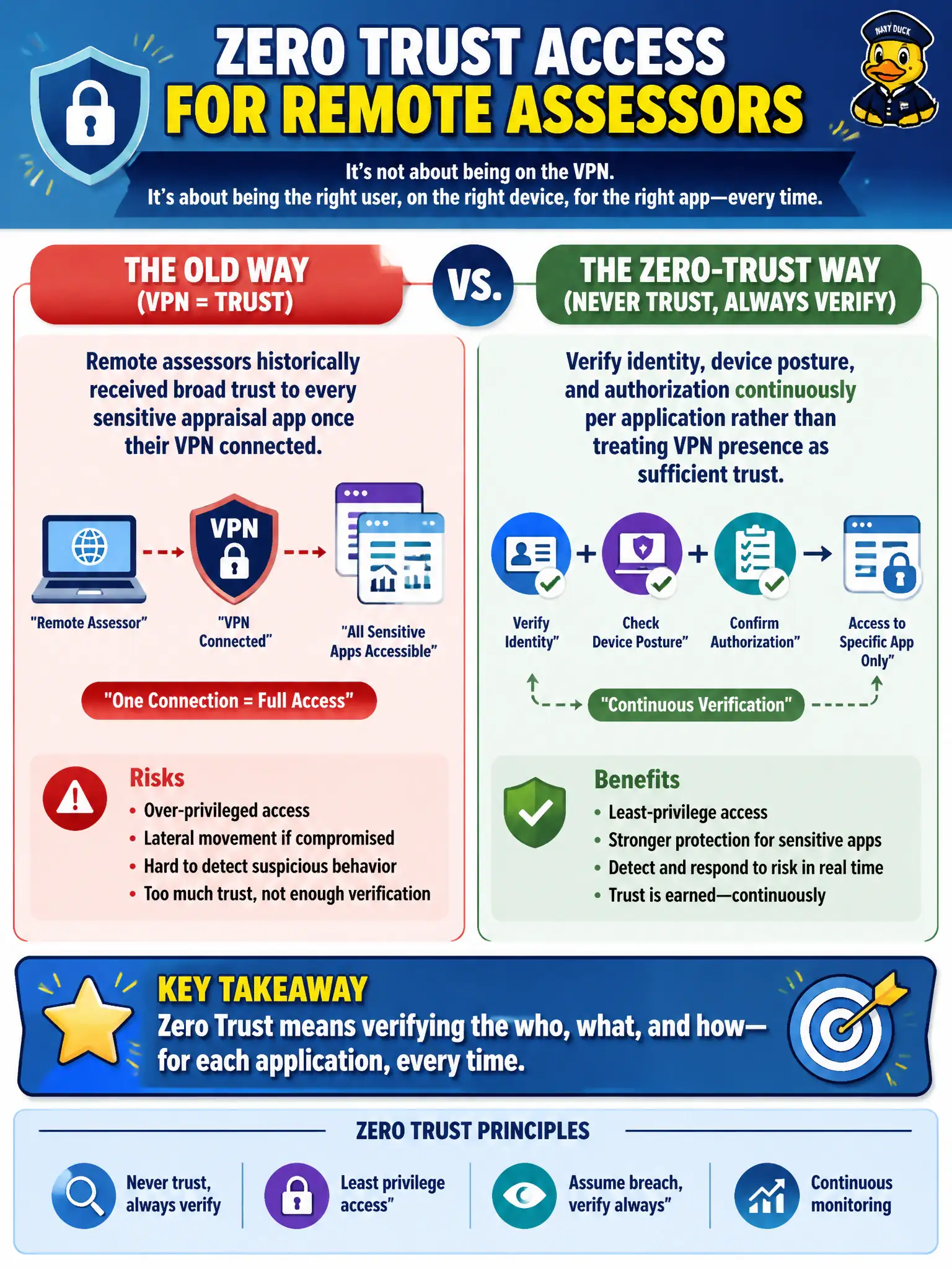
Remote assessors historically received broad trust to every sensitive appraisal app once their VPN connected. What access design best aligns with zero-trust principles?
Select an answer to reveal the explanation.
Short Explanation
Old-school VPN trust is like letting someone roam every locked office once they clear the lobby. Zero trust checks the badge, the laptop health, and the specific door—every time—not just the front gate.
Full Explanation
Historical VPN designs often treated network presence as sufficient trust: once remote assessors connected with a valid certificate, they inherited broad reach to sensitive appraisal applications. Zero-trust principles reject that perimeter assumption. Access design should verify identity (including MFA), device posture (patch level, disk encryption, managed status), and per-application authorization continuously—or at least at each sensitive request—rather than treating VPN membership as a season pass to every database. Trusting any session that only presents a VPN certificate skips user assurance, device health, and app-level least privilege. Permanent standing admin rights inside appraisal databases amplify blast radius for stolen remote sessions. Disabling MFA after VPN login removes a core identity signal exactly when remote risk is elevated. Exam caveat: VPN can still be a transport; zero trust means it is not the sole trust decision. Expect questions contrasting legacy “inside the network” trust with identity- and context-aware access. Operational check: place appraisal apps behind an identity-aware proxy or ZTNA path, require MFA and device compliance checks, scope tokens to specific apps, eliminate standing DB admin for assessors, and monitor for lateral movement attempts that assume VPN equals full trust.