
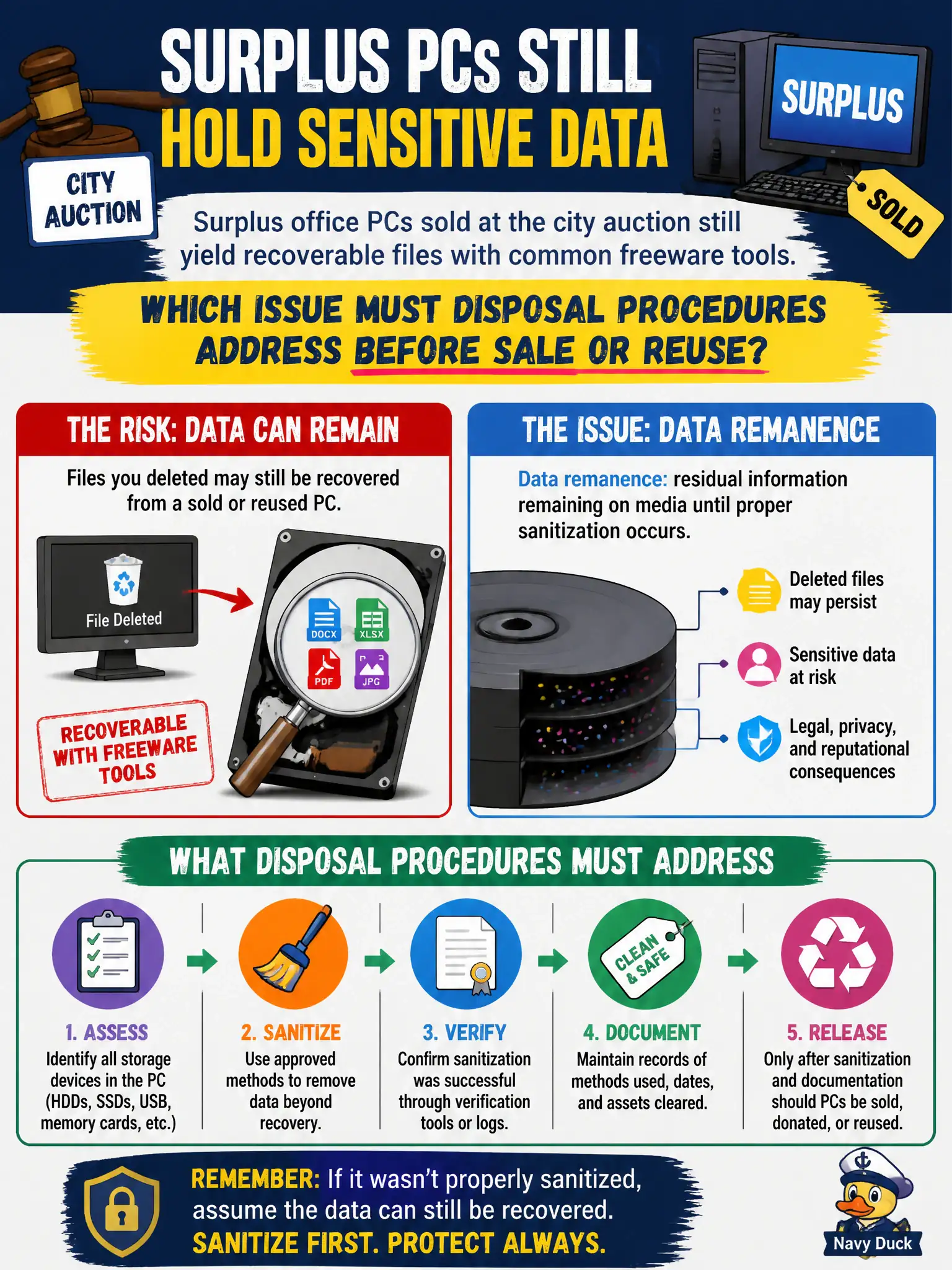
Surplus office PCs sold at the city auction still yield recoverable files with common freeware tools. Which issue must disposal procedures address before sale or reuse?
Select an answer to reveal the explanation.
Short Explanation
Hitting Delete and dragging to the Recycle Bin is not a vanishing act—the bits often hang around for anyone with basic recovery tools. Before PCs hit the auction block, sanitize the drives so old files cannot rise from the dead. Remanence is why "we wiped it" has to mean a real sanitization method.
Full Explanation
Surplus office PCs that still yield recoverable files with common freeware illustrate data remanence: residual information remaining on media until proper sanitization occurs. Simple delete, empty-recycle, or casual reformat often leaves recoverable content; auction buyers must not resurrect resident or employee files from city disks. Disposal procedures must sanitize or destroy media to a method matching classification and media type before sale or reuse so remanence does not become a public data dump.
Factory-default screen resolution on monitors fails by concept: display settings are not residual data risk on storage media and do not explain freeware file recovery. Missing purchase-order stickers fails as an asset-tagging nicety unrelated to recoverable former contents. BIOS clock drift fails as a trivial configuration distraction that neither causes nor remediates remanent data on sold drives.
Exam caveat: remanence is the reason CISSP stresses verified sanitization before reuse, resale, or disposal—not casual delete. Operational check: apply approved wipe, cryptographic erase, or physical destruction per media and classification, verify a sample cannot be recovered with common tools, then release PCs to auction only with sanitization records attached.