
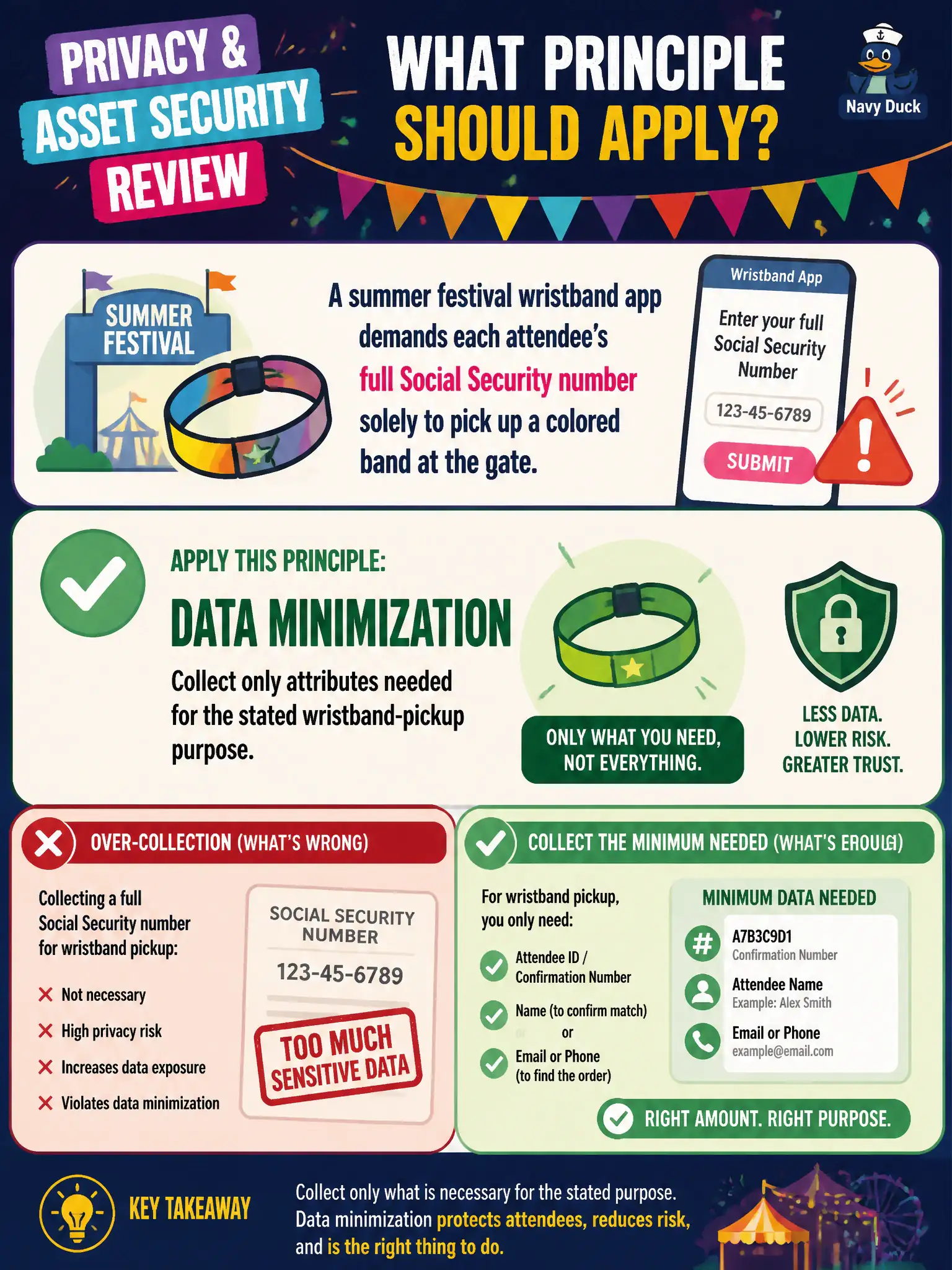
A summer festival wristband app demands each attendee's full Social Security number solely to pick up a colored band at the gate. What principle should the privacy and asset-security review apply?
Select an answer to reveal the explanation.
Short Explanation
Asking for someone's SSN to hand them a neon wristband is like demanding a passport to borrow a library pencil. Collect only what the job needs—maybe a name and order code—not the keys to their financial life. Minimization shrinks breach blast radius before you ever encrypt a byte.
Full Explanation
A festival wristband app demanding full Social Security numbers solely to pick up a colored band should be stopped by data minimization: collect only attributes needed for the stated wristband-pickup purpose. Minimization shrinks breach blast radius and privacy harm before encryption or retention debates begin. Name plus order or confirmation code typically suffices; SSNs are high-value identifiers unrelated to handing out neon bands at a gate.
Collecting SSN plus mother's maiden name for unrelated future identity proofing fails by concept: purpose creep expands collection beyond the stated need. Retaining every SSN indefinitely for future marketing profiles fails both minimization and retention discipline. Requiring SSNs because any money-adjacent municipal app must gather primary account numbers fails as a false mandatory rule—payment-adjacent logistics do not automatically authorize collection of government identifiers.
Exam caveat: privacy-aligned asset security emphasizes collect only what the process needs; SSNs are a classic over-collection example. Operational check: rewrite the wristband intake to the minimum fields, remove SSN from schemas and forms, and document the purpose limitation in the privacy review before the festival opens.