
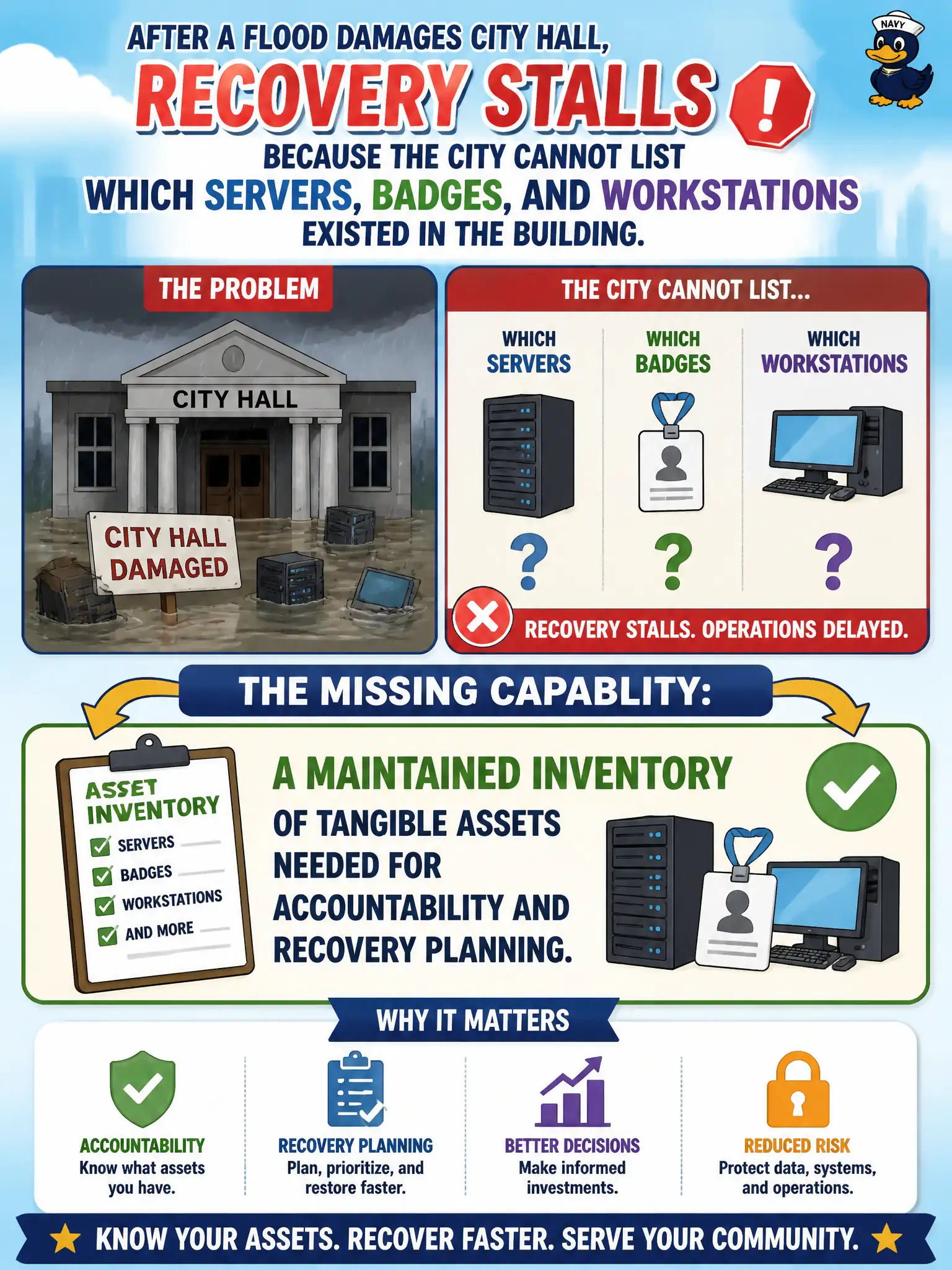
After a flood damages city hall, recovery stalls because the city cannot list which servers, badges, and workstations existed in the building. What capability was missing?
Select an answer to reveal the explanation.
Short Explanation
You cannot rebuild what you cannot name. A living inventory of servers, badges, and workstations is the packing list for disaster recovery and the attendance sheet for accountability. After a flood, "we think we had some boxes upstairs" is not an asset program.
Full Explanation
After a flood, recovery stalls without a list of servers, badges, and workstations because the city lacked a maintained inventory of tangible assets needed for accountability and recovery planning. You cannot restore, replace, or prove custody of what you never recorded. A living inventory of physical IT and related assets is both the packing list for disaster recovery and the attendance sheet for accountability before and after loss events.
A verbal staff survey only after the flood fails by concept: post-event memory is incomplete, biased, and too late to be the primary inventory control. Relying on vendor packing slips alone without tracking after deployment fails because receipts do not equal current location, assignment, or existence in the building. Classification labels on paper forms without equipment identifiers fail as a different control domain—labels on documents do not inventory racks, badges, or endpoints.
Exam caveat: tangible asset inventory is foundational to Asset Security and BCP/DR readiness; exams often pair missing inventories with failed recovery. Operational check: maintain an authoritative hardware inventory with location and owner, reconcile quarterly, and include inventory exports in continuity kits stored offsite.