
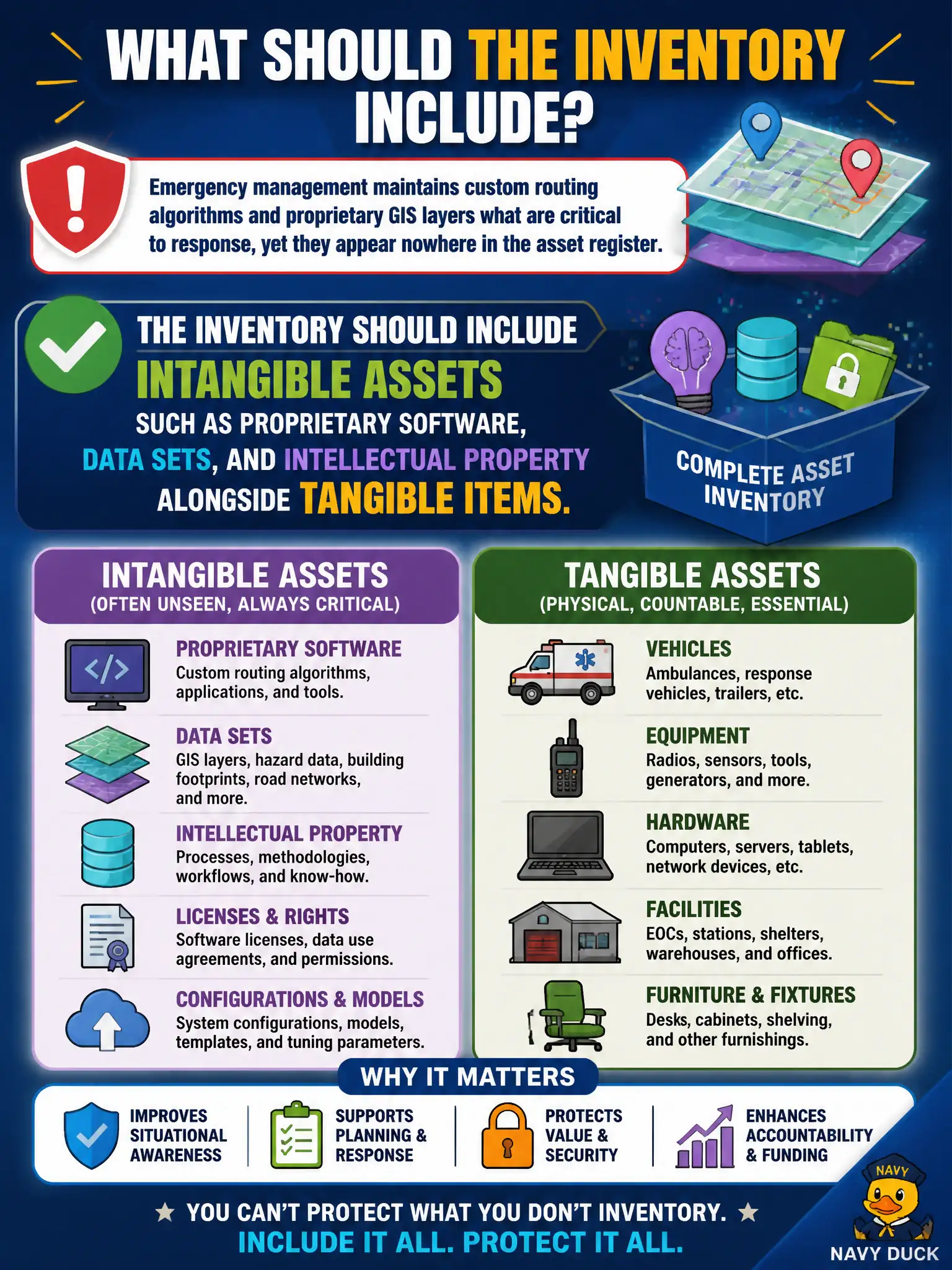
Emergency management maintains custom routing algorithms and proprietary GIS layers that are critical to response, yet they appear nowhere in the asset register. What should the inventory include?
Select an answer to reveal the explanation.
Short Explanation
The secret sauce in the dispatch map is still an asset even though you cannot trip over it. Custom algorithms and GIS layers need inventory, ownership, and protection just like servers. If it creates value or harm when lost, it belongs on the register.
Full Explanation
Emergency management's custom routing algorithms and proprietary GIS layers must appear in the asset register as intangible assets—proprietary software, data sets, and intellectual property—alongside tangible items. If loss or disclosure creates mission harm, the item belongs on the register whether or not you can trip over it. Intangibles need ownership, classification, backups, and protection just as servers do; omitting them leaves critical response capability invisible to governance.
Limiting inventory to rack-mounted servers and vehicles because algorithms are not assets fails by concept: CISSP asset security explicitly includes information and intellectual property. Tracking only public OpenStreetMap tiles because city-created layers have no value fails—the proprietary city layers are precisely the high-value intangibles at risk. Inventorying badge printers exclusively until software gets a barcode sticker fails by conflating physical tagging methods with the requirement to register intangible assets by other identifiers.
Exam caveat: assets are tangible and intangible; software, data, and IP count even without stickers. Operational check: add algorithm names, GIS layer catalogs, and data-set owners to the register, classify them, and include them in backup and continuity plans for emergency management.