
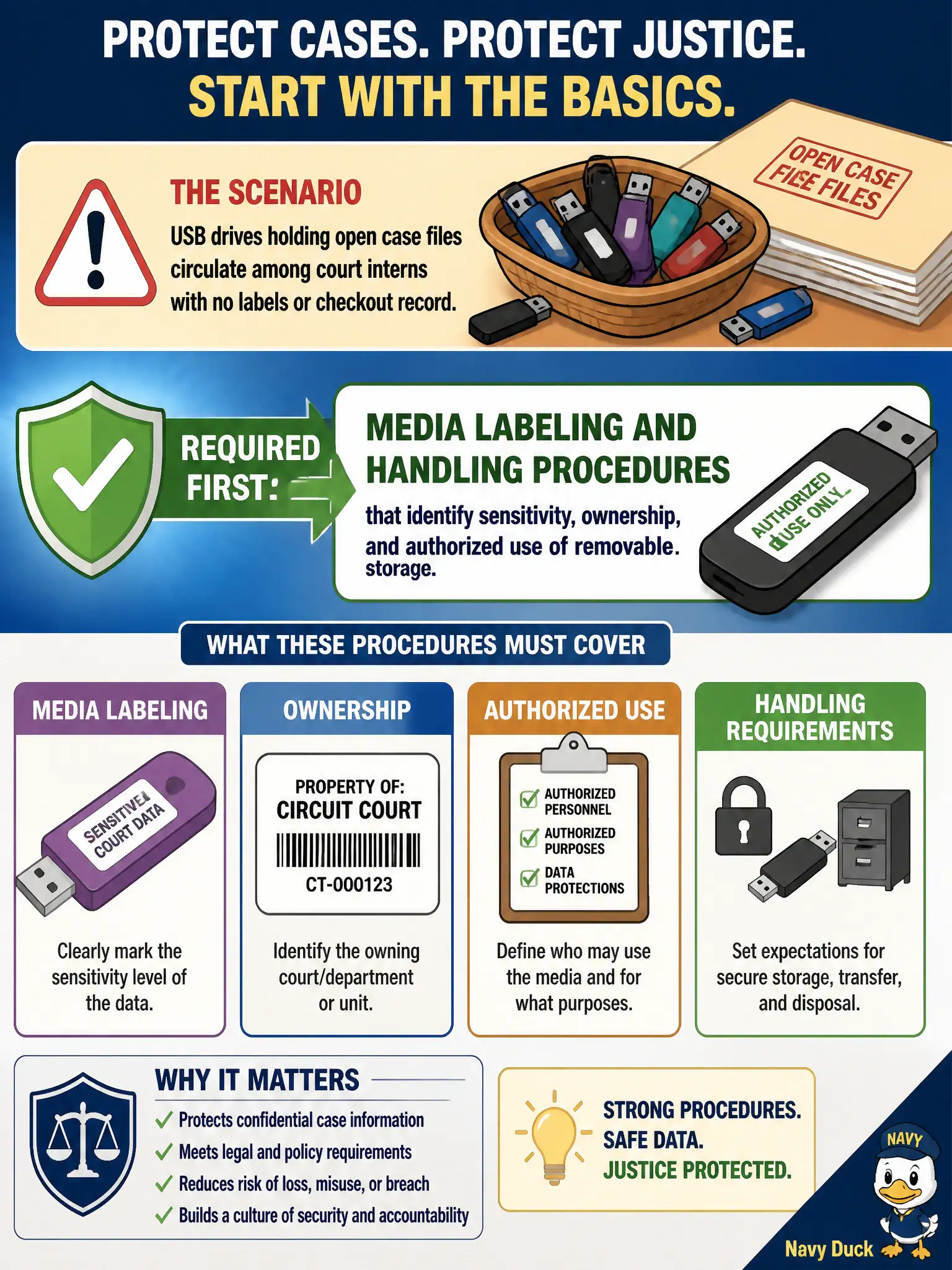
USB drives holding open case files circulate among court interns with no labels or checkout record. What should management require first?
Select an answer to reveal the explanation.
Short Explanation
A mystery thumb drive is like a unlabeled chemical bottle—you have no idea how careful to be. Removable media carrying case files needs labels, who owns it, and rules for where it can go. Without that, interns treat sensitive files like snack-share candy.
Full Explanation
USB drives holding open case files with no labels or checkout record require media labeling and handling procedures that identify sensitivity, ownership, and authorized use of removable storage. Removable media are portable assets: without markings and custody rules, interns cannot know how carefully to treat contents, and the court cannot account for who held which drive. Labeling plus checkout creates the minimum accountability fabric for case-file media before stronger technical controls are layered on.
Permanently disabling all removable media and relying only on verbal briefings fails by concept: verbal case facts still leak, and blanket bans often drive shadow USB use without procedure. Allowing unlabeled drives on verbal promises fails because oral assurances are not durable controls and provide no inventory trail. Encrypting only after a loss is reported fails as purely reactive protection—encryption and labeling must precede loss to reduce blast radius, not commemorate it.
Exam caveat: CISSP media security emphasizes marking, handling, and accountability for portable storage carrying sensitive information, not only encryption after incidents. Operational check: issue labeled, inventoried court USB media with sensitivity and owner fields, require checkout logs, ban unlabeled personal sticks for case files, and audit intern media use weekly.