
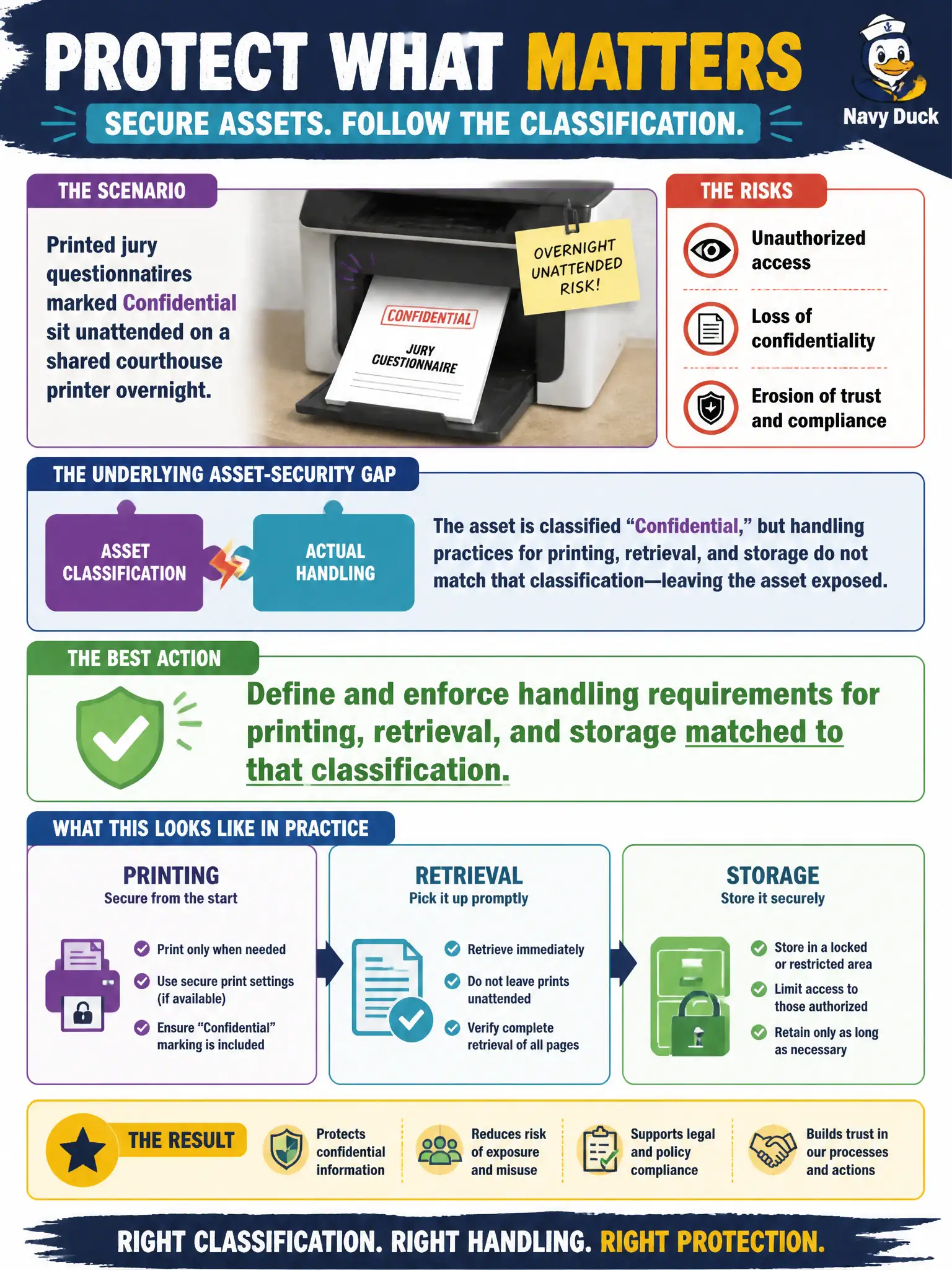
Printed jury questionnaires marked Confidential sit unattended on a shared courthouse printer overnight. Which action best addresses the underlying asset-security gap?
Select an answer to reveal the explanation.
Short Explanation
Leaving sealed envelopes on the open counter is not "printing"—it is broadcasting. Confidential printouts need clear rules: pull them promptly, cover them, lock them up, and never leave them on a shared tray. Handling rules turn the classification label into everyday behavior.
Full Explanation
Confidential jury questionnaires left overnight on a shared courthouse printer show a handling gap, not a labeling vocabulary problem. The correct response is to define and enforce handling requirements for printing, retrieval, and storage matched to that classification—prompt pull of print jobs, cover sheets, locked storage, and prohibition on unattended trays. Handling rules turn Confidential into everyday courthouse behavior so juror data does not become hallway reading material.
Banning all printers and forcing text-message responses fails by concept: extreme technology bans ignore legitimate paper workflows and do not teach classification-aligned handling. Relabeling questionnaires Public so abandoned printouts stop violating policy fails as fraudulent downgrade—sensitivity did not change because retrieval was lazy. Moving the printer into the public lobby fails because increasing passerby visibility increases exposure rather than enforcing Confidential retrieval and storage discipline.
Exam caveat: asset security questions often separate classification (what it is) from handling (how staff must behave); printers and clear desks are classic physical/handling exemplars. Operational check: publish Confidential print rules, configure secure release/pull-printing where feasible, train clerks and bailiffs, and spot-check shared trays after hours for abandoned juror materials.