
Two water-district pump PLCs share the same unauthenticated-protocol weakness. Pump A accepts sessions only from its local HMI. Pump B also accepts sessions from the enterprise reporting VLAN. Which risk reading is sound?
Select an answer to reveal the explanation.
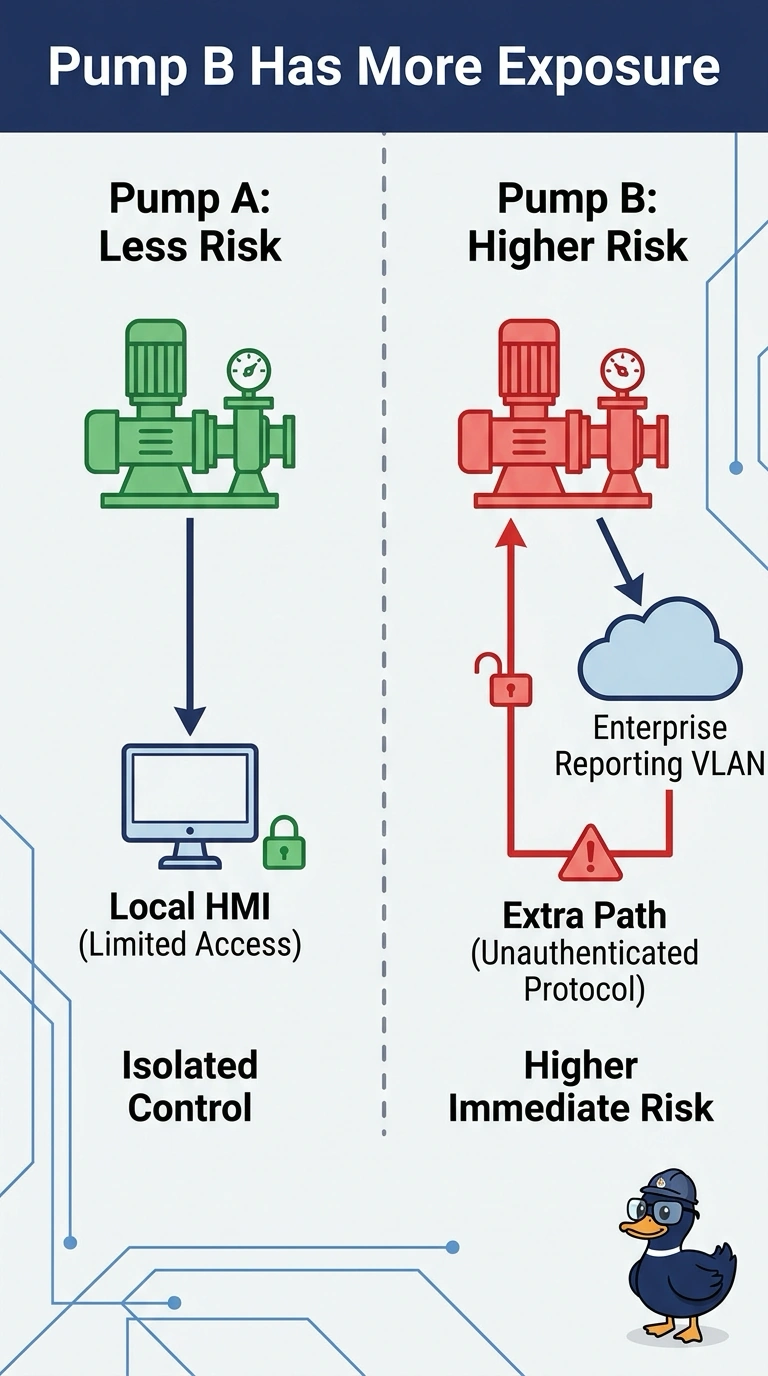
Short Explanation
The same unlocked protocol is a side door on a fenced pad or a side door that opens toward the office. You treat pump B as the higher immediate risk because the enterprise reporting VLAN can already start a session. Matching weaknesses do not erase a wider path.
Full Explanation
The weakness is the same on both pumps: a protocol that does not authenticate the client. Immediate risk still follows who can open a session. Pump A accepts only its local HMI, so the path is narrow. Pump B also accepts sessions from the enterprise reporting VLAN, so many more hosts can attempt the same unauthenticated exchange. Pump B is the higher immediate risk. Calling Pump A higher because a local HMI is supposedly easier to abuse reverses the exposure. The local HMI is one intended peer. The enterprise VLAN is an extra, wider path. Equal labels, or an identical weakness, do not make the immediate risk equal when the paths differ. Neither pump is free of risk merely because its local HMI is allowed. The allowed HMI is the normal peer. The finding is about everyone else who can also connect, and that set is larger on Pump B. Exam caveat: Pump A stays on the list. A narrow path is lower immediate risk, not a closed item, and the order flips if someone later permits the enterprise VLAN to Pump A. Operational check: compare the ACL or firewall policy in front of each pump and confirm whether any address outside the local HMI can open a session to Pump B.