
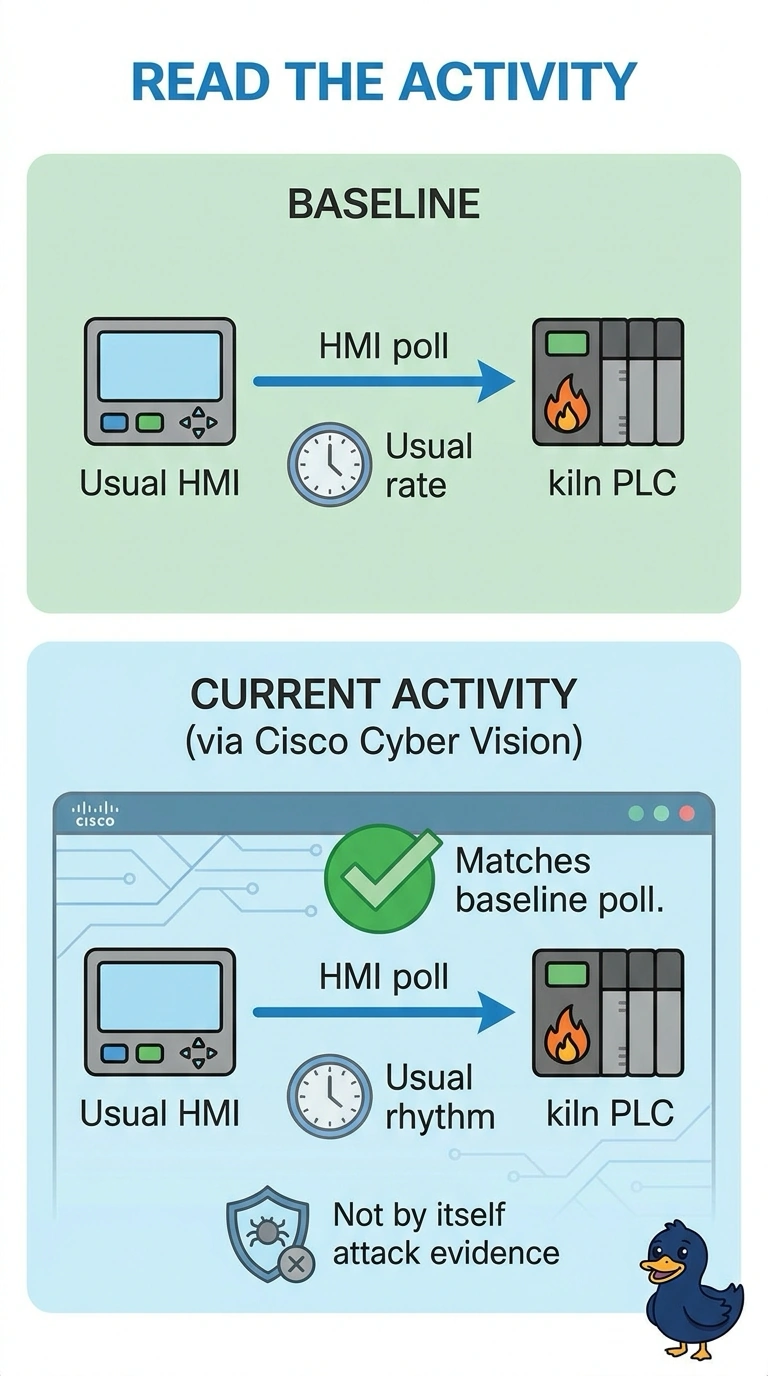
Cisco Cyber Vision shows an activity on a kiln PLC that matches the HMI poll already in the baseline, at the usual rate, from the usual HMI. No other change is listed. Which reading fits?
Select an answer to reveal the explanation.
Short Explanation
The HMI asking the kiln PLC the same question at its usual rate is the plant breathing, not a break-in. You compare the activity with the baseline before calling it an attack. A line on the screen is not automatically a new incident.
Full Explanation
Cisco Cyber Vision records activities, including conversations that are normal. This activity matches the HMI, the kiln PLC, and the rate already saved in the baseline, and no other change is listed. That makes the poll expected supervisory traffic, not evidence of an attack by itself. Treating a repeated poll as an intrusion simply because the sensor recorded it confuses observation with a security finding and can train the crew to ignore alerts. A lost traffic copy does not explain this activity: it would stop new observations, not invent a poll from the usual HMI at the usual rate. A firmware change is also unsupported; it would appear as a change to a controller property or image, not as a familiar poll line with no other difference. Exam caveat: a poll at the usual rate can still deserve investigation if its operation changes from a read to a write, or if it comes from a new host. Here, the stated source and rate are usual, with no other change. Practical check: confirm that the HMI address and poll match the entries already saved in the baseline, and do not open an incident for this activity unless another field in the event actually changed.