
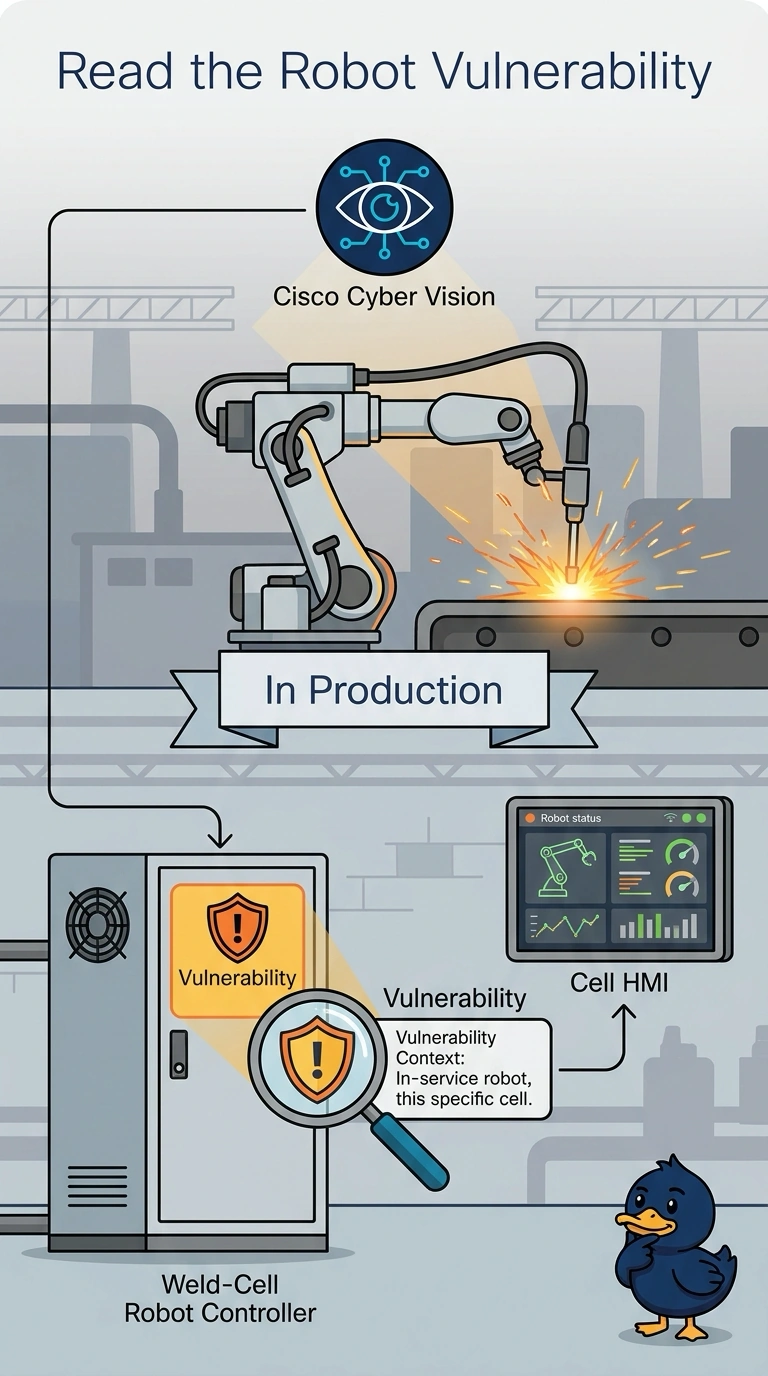
Cisco Cyber Vision ties a vulnerability to one weld-cell robot controller that is in production and reachable from the cell HMI. It does not report a new device or a firmware-string change. Which reading fits?
Select an answer to reveal the explanation.
Short Explanation
A vulnerability tied to one weld robot is a weakness on a specific machine in service today, not a weather report for the whole plant. You read it in the context of that controller and the HMI that can reach it. The trap is treating it as a new device, a firmware change, or a score for every spare; the report describes this robot.
Full Explanation
Cisco Cyber Vision can attach a vulnerability to a component it already knows, in the context of how that device is used. Here, the component is one weld-cell robot controller in production, and the cell HMI can reach it. The report describes a weakness on that in-service robot, considered with its role in the cell and the HMI path; it does not report a new device or a changed firmware string. Reading the finding as a new component from an unexpected vendor that arrived overnight would mistake it for an asset-discovery event, which the stem explicitly rules out. Reading it as a firmware property change would mistake the vulnerability label for a change in the controller’s stored identity; the firmware string did not change. Treating it as a plant-wide score for every spare in the crib would erase the component and cell context: those spares are not the in-service, HMI-reachable robot described. Exam caveat: the finding does not prove an exploit is underway; it identifies a weakness on this controller and shows the HMI path beside it. Practical check: match the reported controller to the weld-cell drawing, confirm that the HMI path is real, and bring that controller-path pair into the risk review rather than averaging the finding across the storeroom.