
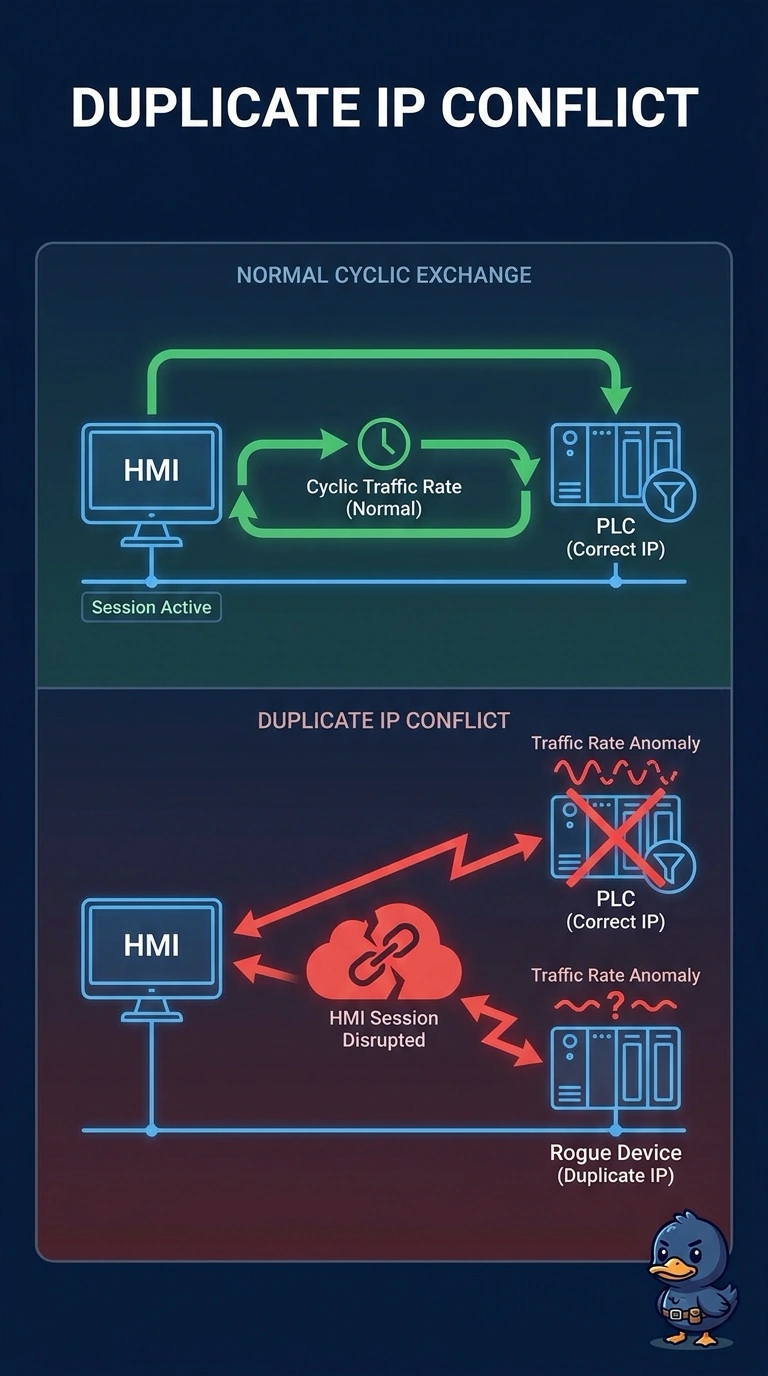
At a water-treatment plant, the visibility tool reports two devices answering for the same filter-PLC IP address, and the HMI session flaps. The cyclic traffic rate is unchanged. Which issue is that?
Select an answer to reveal the explanation.
Short Explanation
You’ve got two devices answering for the filter-PLC address, which points to a duplicate IP conflict, not a healthy cyclic exchange. The unchanged packet rate is useful context, but the flapping HMI session fits competing claimants—not a calm heartbeat.
Full Explanation
Two devices answering for the same filter-PLC IP address, along with a flapping HMI session, indicates a duplicate IP address conflict: two MAC identities are competing for the address the HMI is trying to reach. The unchanged cyclic traffic rate does not make this a healthy heartbeat; it only shows that the packet rate matches its baseline. The anomaly is the second claimant, not an increase in cyclic traffic. A lost historian archive on an enterprise file server outside the plant may be a genuine issue, but it does not explain two devices answering for the PLC’s address. A GOOSE retransmission storm between relays in another building is also a different issue: GOOSE is Layer 2 multicast used between substation relays, and that traffic does not account for two devices claiming this treatment-plant IP address. Exam caveat: an approved redundant pair may legitimately share a virtual address, so confirm the plant’s design before treating shared addressing as unauthorized. Practical check: record both MAC addresses claiming the IP and locate their switch ports before clearing the alarm.