
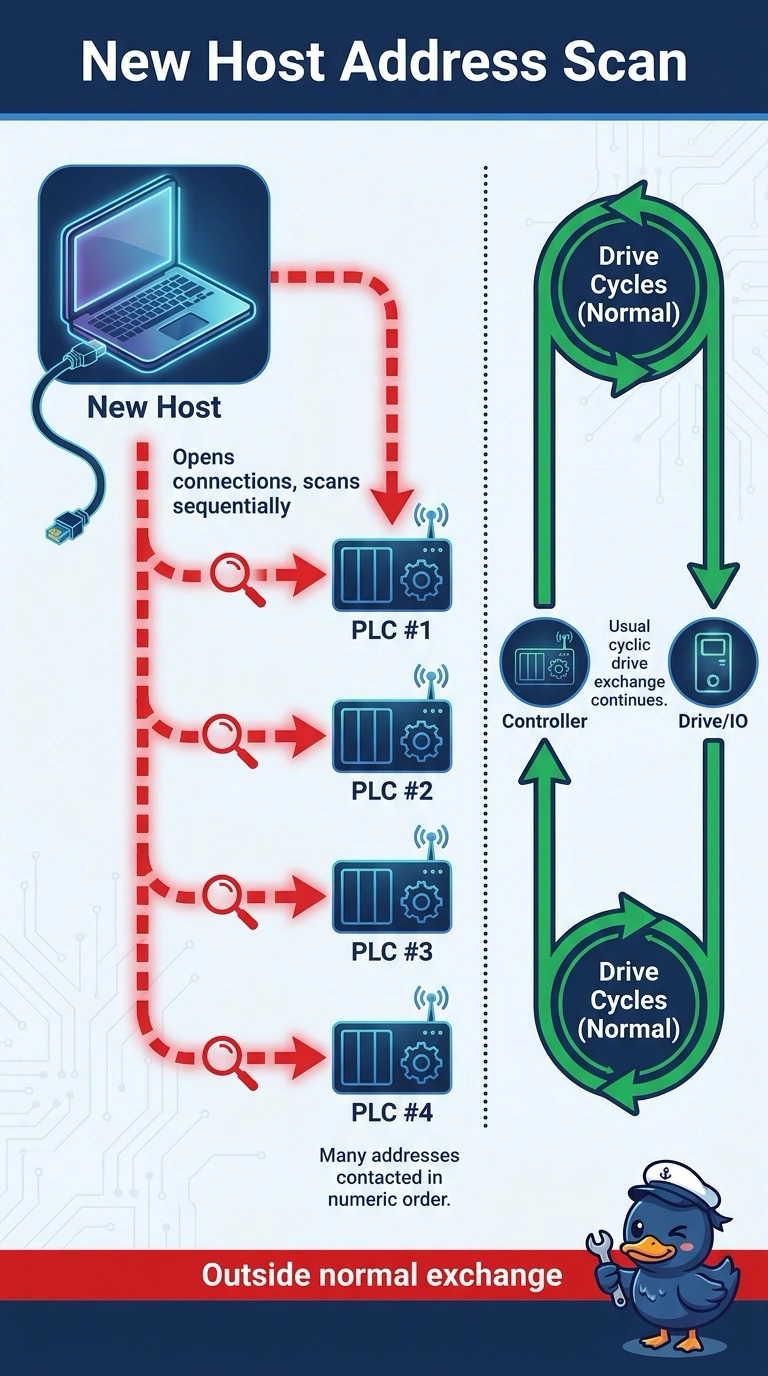
On a mining-hoist cell, the visibility tool shows one new host opening connections to PLC addresses in numeric order while the usual drive cycles continue. Which issue is that?
Select an answer to reveal the explanation.
Short Explanation
You’re seeing a scan: a new host is probing PLC addresses in numeric order while the hoist’s usual drive cycles continue. That differs from the normal cyclic drive-controller exchange, the one-way historian export through a data diode, and a clock correction between enterprise mail servers.
Full Explanation
A new host opening connections to PLC addresses in numeric order is sweeping the controller network, so the issue is a scan. The usual drive cycles continuing alongside it are baseline traffic: cyclic exchange is repetitive communication between the drive and its controller, not a numeric walk across many addresses by a new host. A one-way historian export through a data diode sends data out of the cell by design; it does not open connections inward to PLC addresses in order. A clock correction between enterprise mail servers concerns the mail system, not mining-hoist PLCs, and does not explain connection attempts in the cell. Exam caveat: an authorized maintenance host inventorying the cell can resemble a scan, so check whether its source is known and the activity is covered by a change ticket. Here the host is described as new, so treat the activity as anomalous until it is identified. Practical check: trace the host to its switch port, confirm whether a change authorized the sweep, and remove the host if the hoist team cannot identify it.