
A mine-hoist security monitor collects Windows event logs from HMIs and servers and has never shown a message between the hoist PLC and its drive. Which visibility gap is that?
Select an answer to reveal the explanation.
Short Explanation
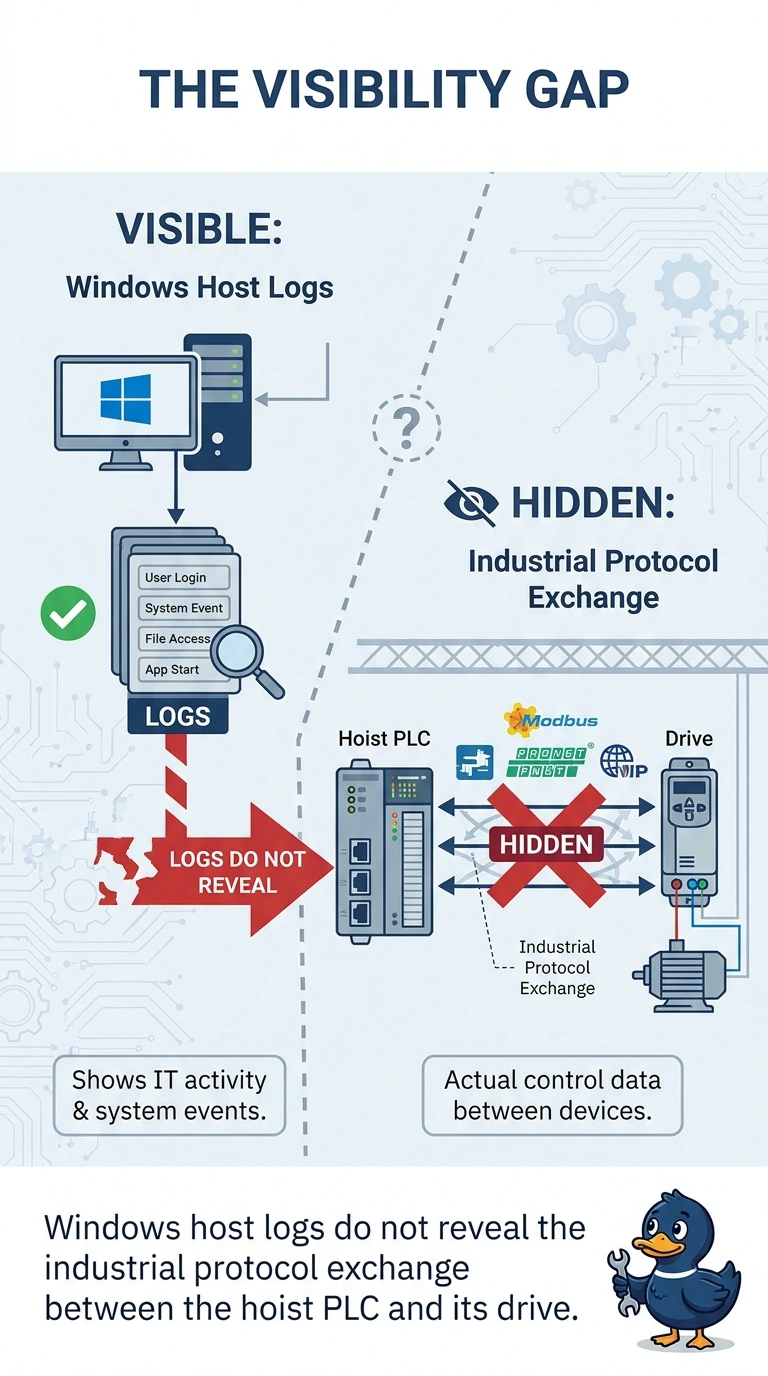
The hoist HMI's diary will not quote the private conversation between the PLC and the drive. You are collecting Windows events, and those events do not decode that industrial exchange. The monitor stays blind to the cell protocol even while the host logs look busy.
Full Explanation
Windows event logs record what the host operating system chooses to write: sign-ins, processes, and similar host activity. They do not decode the industrial protocol between a hoist PLC and its drive. A monitor that collects only those logs can look complete for the HMIs and still never show that cell conversation. The gap is the kind of telemetry, not a broken hoist. Treating the logs as a full decode of drive traffic will send the crew looking for a dead link whenever the industrial exchange is simply invisible to Windows. Silence in those logs is the wrong evidence for link state. The claim that Windows logs carry function codes, and that silence means the hoist stopped entirely, invents a decoder the logs do not have. Clock skew can disorder events that were collected. It does not explain a missing protocol the collector never parsed, and drive messages were not sitting in the Windows log waiting for a clock fix. Exam caveat: keep the Windows logs for what they do show on the HMI host. They remain the wrong instrument for the hoist-drive exchange. Operational check: confirm whether any sensor on the hoist cell can decode the PLC-to-drive protocol, and do not close a drive incident from Windows logs alone.