
A mine concentrator placed its only OT visibility sensor on the enterprise firewall. Cell controllers talk to each other all day and never appear. Which placement fixes that gap?
Select an answer to reveal the explanation.
Short Explanation
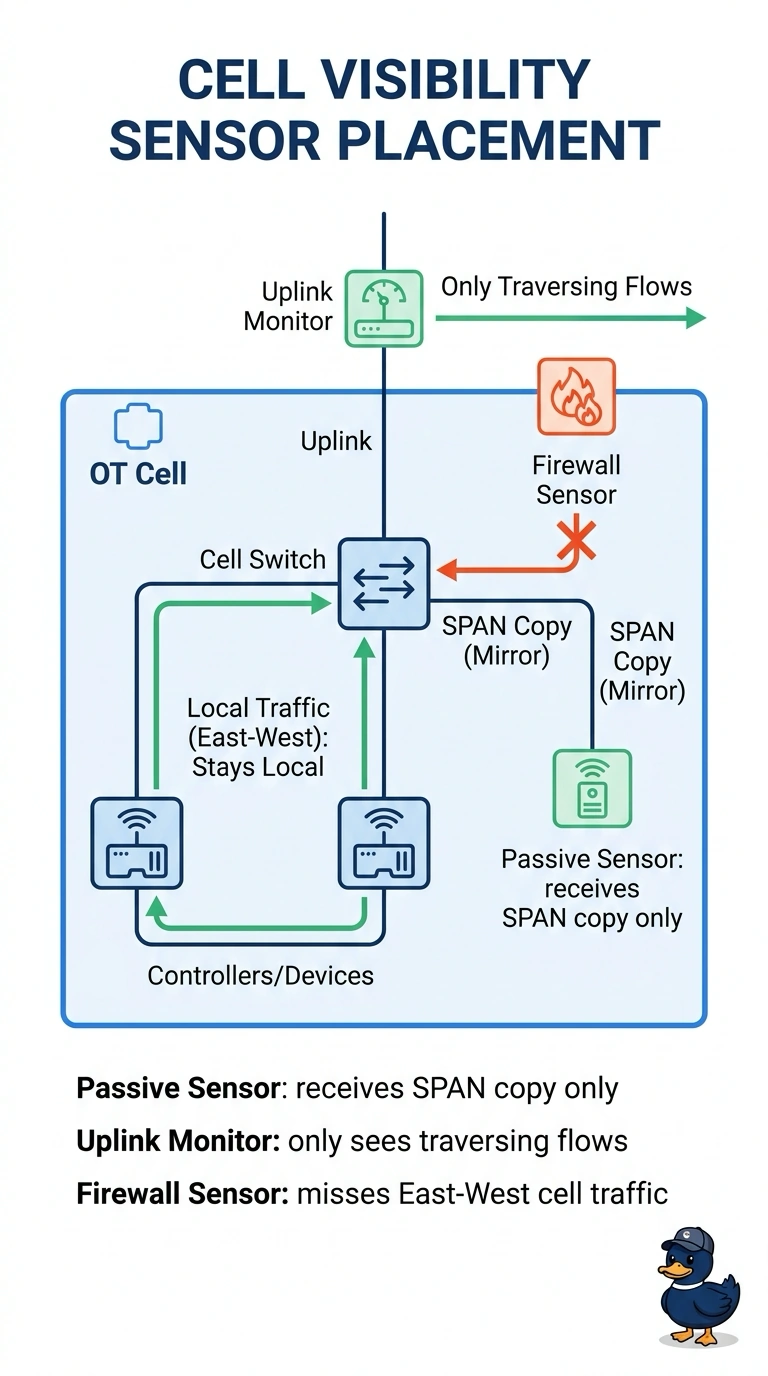
A camera at the front gate never sees what happens in the back room. Same-switch controller traffic can remain local and never traverse a cell uplink; SPAN source selection must include the required local traffic. You fix this by mirroring the right ports or VLANs to your passive sensor, using the uplink only for what crosses it.
Full Explanation
An OT visibility tool can only describe traffic it receives. Conversations between concentrator controllers are east-west inside the cell. They are not forwarded through the enterprise firewall, so a sensor that only watches that firewall will inventory the boundary and miss the process network. The placement that closes the gap is to mirror the relevant controller ports or VLAN traffic on the cell switches to a passive sensor; monitor the uplink only for conversations that actually traverse it. Same-switch controller traffic can remain local and never traverse a cell uplink; SPAN source selection must include the required local traffic. Inferring the cell from flows the firewall denied toward the internet invents an inventory from the wrong population. Those denies are north-south attempts, not the cyclic traffic between controllers. An active credentialed scan from an IT server is not a placement of a passive sensor, and aiming it at every controller during production is the disruption a visibility design is meant to avoid. Guest wireless is not where plant control traffic goes by default, and watching it will not reveal controller conversations on the cell VLAN. Exam caveat: a boundary sensor is still useful for OT/IT flows. The failure is using it as the only sensor and expecting it to see traffic that never arrives.