
Cisco Cyber Vision reports a new activity on a steel-mill cooling PLC: a maintenance laptop that only read registers last week has now written Modbus holding registers. No change ticket exists. Which reading fits?
Select an answer to reveal the explanation.
Short Explanation
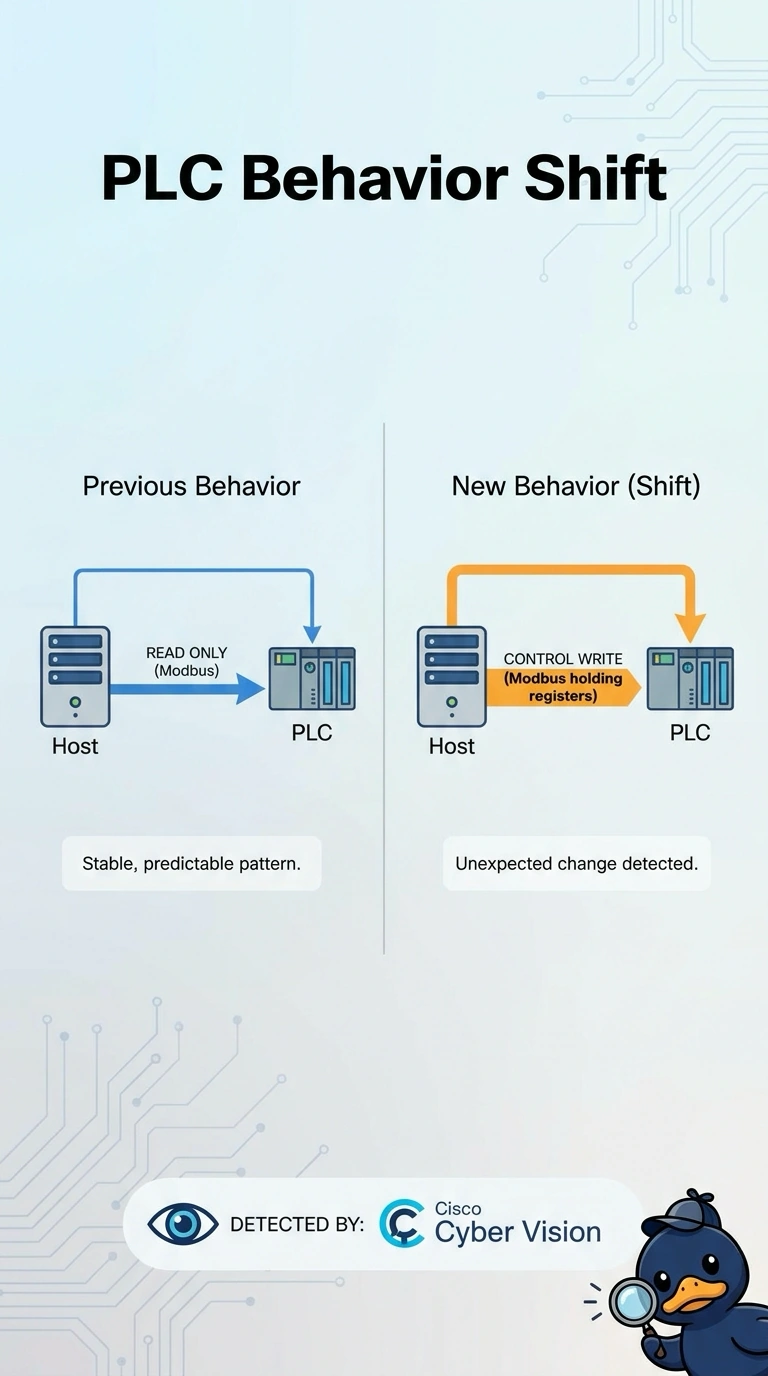
Last week this laptop was looking through the window, and this week it is turning the knobs with no ticket on the board. You treat that shift from a read to a write as a change in behavior. A DHCP lease or a file backup does not write holding registers.
Full Explanation
Cisco Cyber Vision builds activities from the industrial traffic it decodes. A Modbus holding-register write is a control action, different from a read of the same PLC by the same laptop a week earlier. With no change ticket, the event is a behavior change: a host that used to observe the cooling PLC is now able to alter it, and that deserves an operations conversation before anyone calls it maintenance. A DHCP lease renewal is not a Modbus write function, and a sensor that has decoded the function code is not guessing from an address assignment. A historian backup of a laptop profile is file-level activity on the laptop, not a write of holding registers on the PLC. GOOSE is a Layer 2 protection message used between substation devices. It is not the Modbus TCP activity this report describes, and it does not explain a laptop writing to a mill cooling controller. Exam caveat: the write might be a legitimate, unticketed maintenance session. Interpretation still starts from what the protocol did, then you confirm authorization. Do not invert it and assume the decoder invented a write from an unrelated protocol. Operational check: identify the laptop, the Modbus function, and the target PLC in the event, then ask the mill control lead whether that write was requested.