
On a Cisco IE switch in a building-automation closet, packets should not be allowed to choose their own forwarding path. Which hardening step matches that goal?
Select an answer to reveal the explanation.
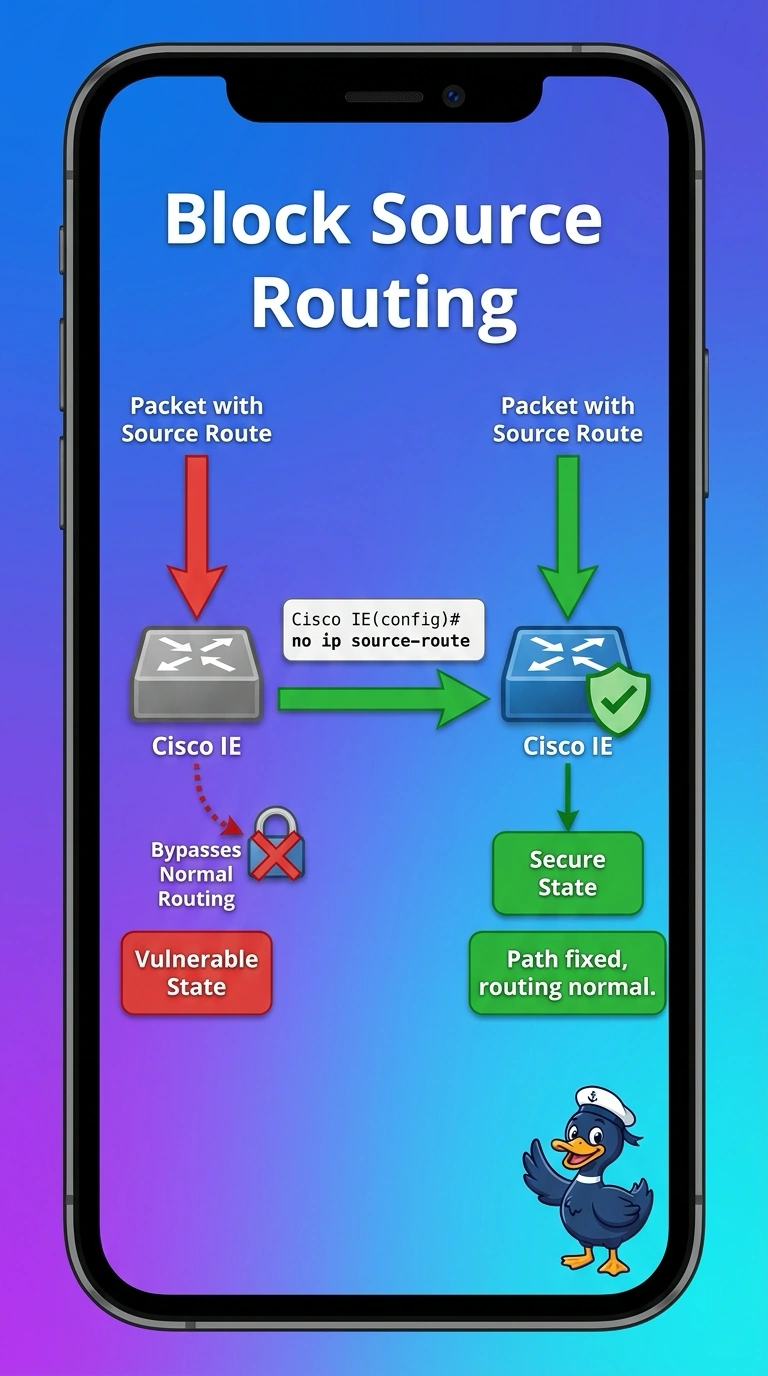
Short Explanation
Source routing lets a packet draw its own map through your closet switch. You turn that behavior off with no ip source-route, and a sentence in the login banner does not do it for you. Shutting an empty jack is useful and still leaves source routing running on the ports you use.
Full Explanation
IP source routing lets a packet carry its own forwarding instructions instead of following the routing table. On Cisco IOS the hardening command that stops the device from honoring those packets is no ip source-route. That is the step that matches a building-automation switch which should not let packets choose their own path. A login banner can warn a human. It does not change packet forwarding, so a banner that forbids source routing leaves the feature running. Shutting unused access ports is a sound baseline for empty jacks and does not affect source routing on the ports that stay up and still forward traffic. Disabling CDP toward the enterprise limits what the switch advertises on that uplink. CDP is a discovery protocol, not the feature that honors source routes, so turning it off leaves source routing in place. Exam caveat: no ip source-route addresses source routing only. It does not encrypt management sessions or shut unused ports, and this stem did not ask for those other baseline items. Operational check: confirm the saved configuration contains no ip source-route, and confirm a test plan does not depend on packets that set their own route.