
A passenger-station switch displays a legal warning banner on Telnet, and the crew treats that banner as the management security control. Which statement is sound?
Select an answer to reveal the explanation.
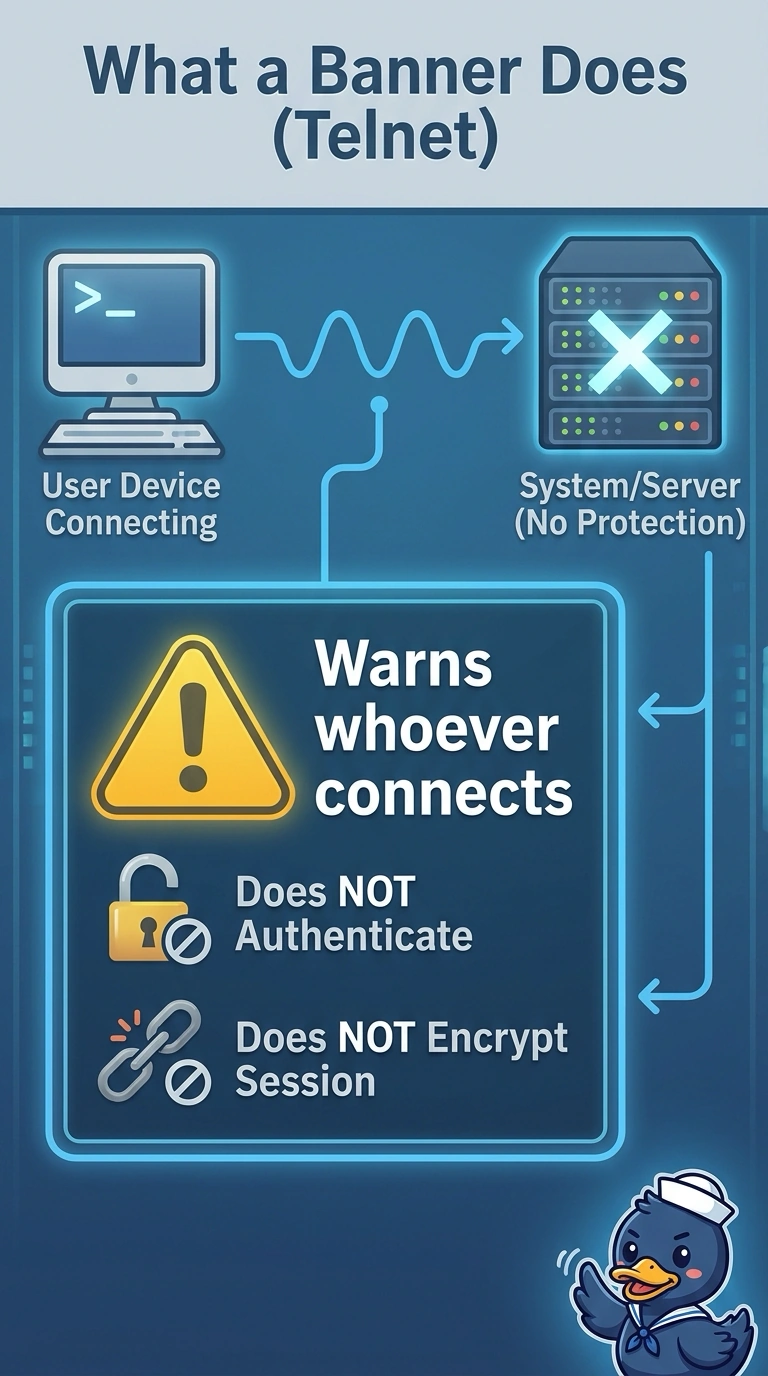
Short Explanation
Think of the banner as a sign, not a lock: it warns whoever connects but does not check a badge. Your Telnet banner does not authenticate the person or encrypt the session, so you still need real management security controls.
Full Explanation
A login banner is a message presented to a session that has already reached the switch. It can warn that access is monitored and unauthorized use is prohibited, but it does not check identity or encrypt Telnet. The sound statement is that the banner warns whoever connects and does not authenticate them or encrypt the session. Treating it as the management security control leaves cleartext remote administration in place. Encryption is a property of the protocol, not of the warning text, so displaying a banner does not protect a Telnet session. The banner also does not change interface state: displaying warning text will not shut unused switch ports, which must be configured shut. Nor does the banner identify each technician or stop cleartext login on its own; it supplies no account or credential and does not block login merely because it was read. Exam caveat: a banner can still be useful as a warning before a real login, but it is not a substitute for authentication or encryption. Practical check: read the banner in a test session, confirm it does not contain a password, and verify that the switch still requests credentials rather than admitting a user based on the warning alone.