
A distribution utility runs DNP3 between the control center and field outstations and assumes every session is authenticated because the protocol is DNP3. Which fact applies?
Select an answer to reveal the explanation.
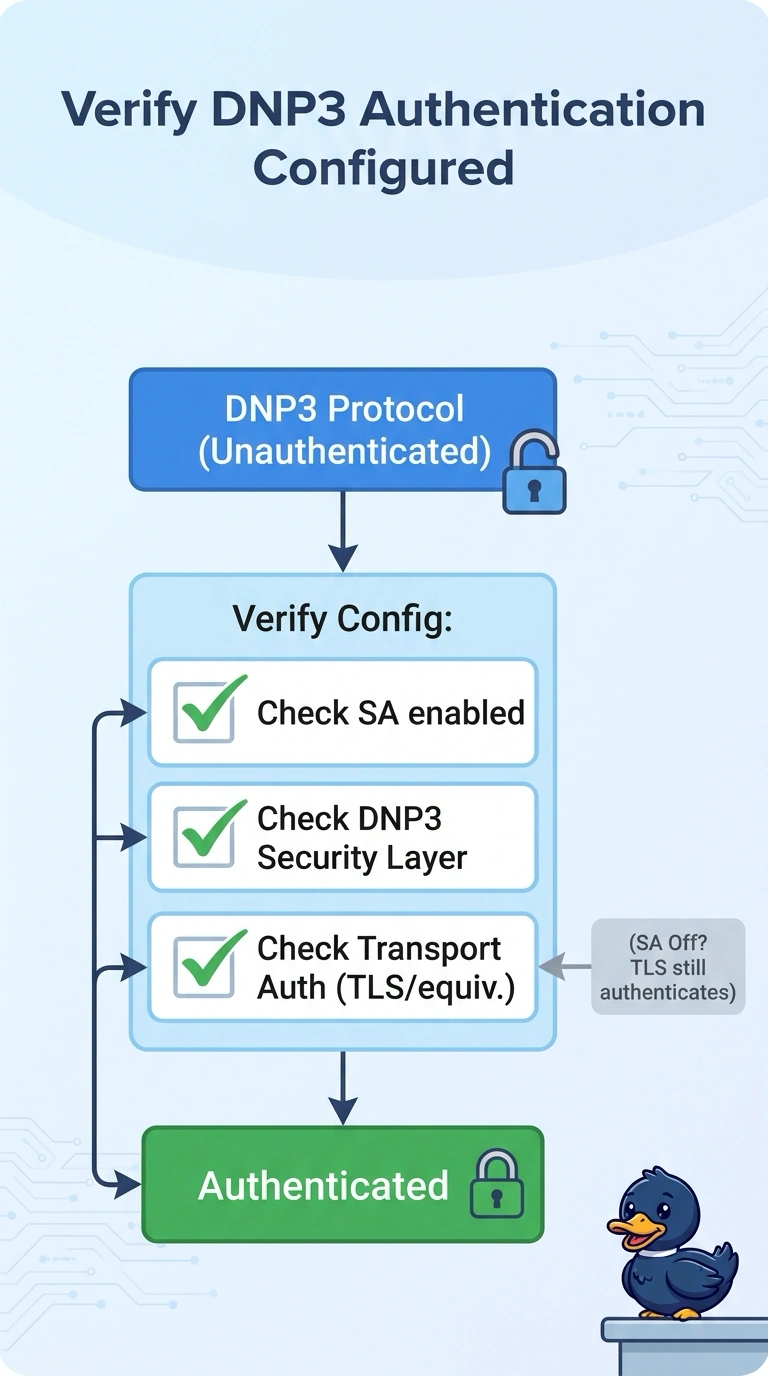
Short Explanation
Saying the protocol name is not the same as saying the speakers showed identification. Disabling SA does not by itself rule out authentication supplied by TLS or another configured protection. You still have to verify what protection is actually configured before you trust the session.
Full Explanation
DNP3 alone does not guarantee authentication; the review must verify that Secure Authentication, DNP3 Security Layer, or an appropriate authenticated transport is actually configured rather than trusting the protocol name. DNP3 can be deployed with or without its authentication features, so use of DNP3, including DNP3 over TCP port 20000, has not automatically turned protection on. Disabling SA does not by itself rule out authentication supplied by TLS or another configured protection. Assuming every frame is authenticated by default on port 20000 treats a transport port as a security feature. The port only means DNP3 over TCP. DNP3 is not Layer 2 only. Over TCP it crosses a wide-area network to field outstations, which is why those links exist. Secure Authentication is also not IEC 61850 GOOSE. GOOSE is a Layer 2 multicast protection message, and renaming it does not describe DNP3. Operational check: on a sample outstation and the master, confirm whether Secure Authentication, DNP3 Security Layer, or TLS or another authenticated transport is enabled and correctly keyed.