
A kiln publishes non-safety telemetry to a broker in cleartext on the standard MQTT port. The safety trip is still a separate wired circuit. Which change fits?
Select an answer to reveal the explanation.
Short Explanation
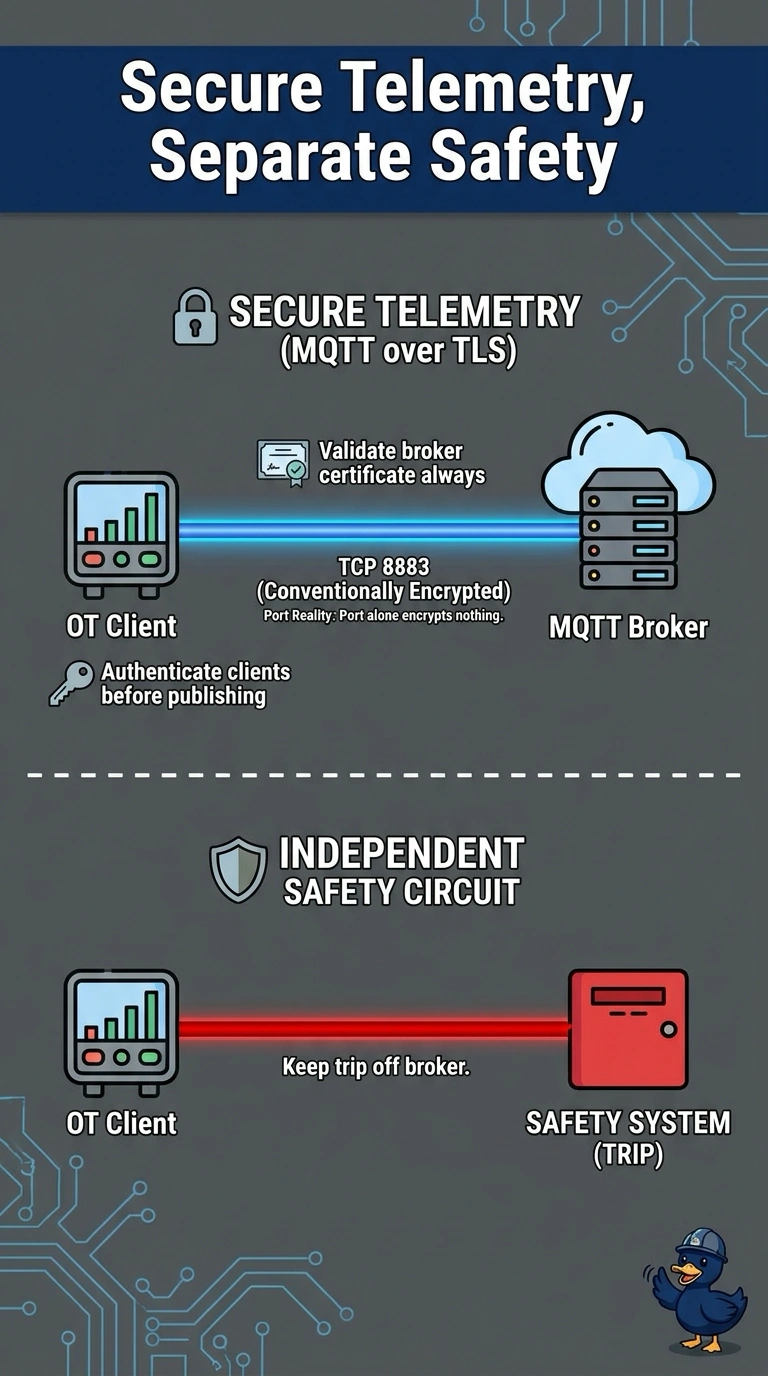
You can protect your telemetry with validated TLS and proper client authentication while you keep the safety trip on its wired circuit. A port-number change alone does not encrypt telemetry. So you must verify the TLS session and keep the trip off the broker.
Full Explanation
IANA assigns MQTT to port 1883 and MQTT over TLS conventionally to TCP 8883. Cleartext telemetry on 1883 can be observed on the path. Configure MQTT over TLS with certificate validation and appropriate client authentication, conventionally on TCP 8883, while retaining the approved safety circuit. A port-number change alone does not encrypt telemetry; protection comes only from negotiated TLS to a validated broker identity with authenticated clients. The safety trip stays on its deterministic wired circuit, where loss of the broker cannot become loss of protection. Replacing that wired circuit with an anonymous topic drops authentication and determinism and ties a hazard function to a publish service. Moving protection onto the same cleartext session creates one common failure path for measurement and tripping that was never built for safety timing. Treating MQTT as inherently a safety protocol confuses transport with an approved safety function. Certificates and client credentials must remain valid and managed, or the secure port is only a number. Confirm by capture that telemetry is protected on 8883 and the trip remains independent, then record interface, time, and approval.