
A gas-plant designer wants a compressor emergency shutdown to travel as an MQTT message through the site broker. Which judgment fits?
Select an answer to reveal the explanation.
Short Explanation
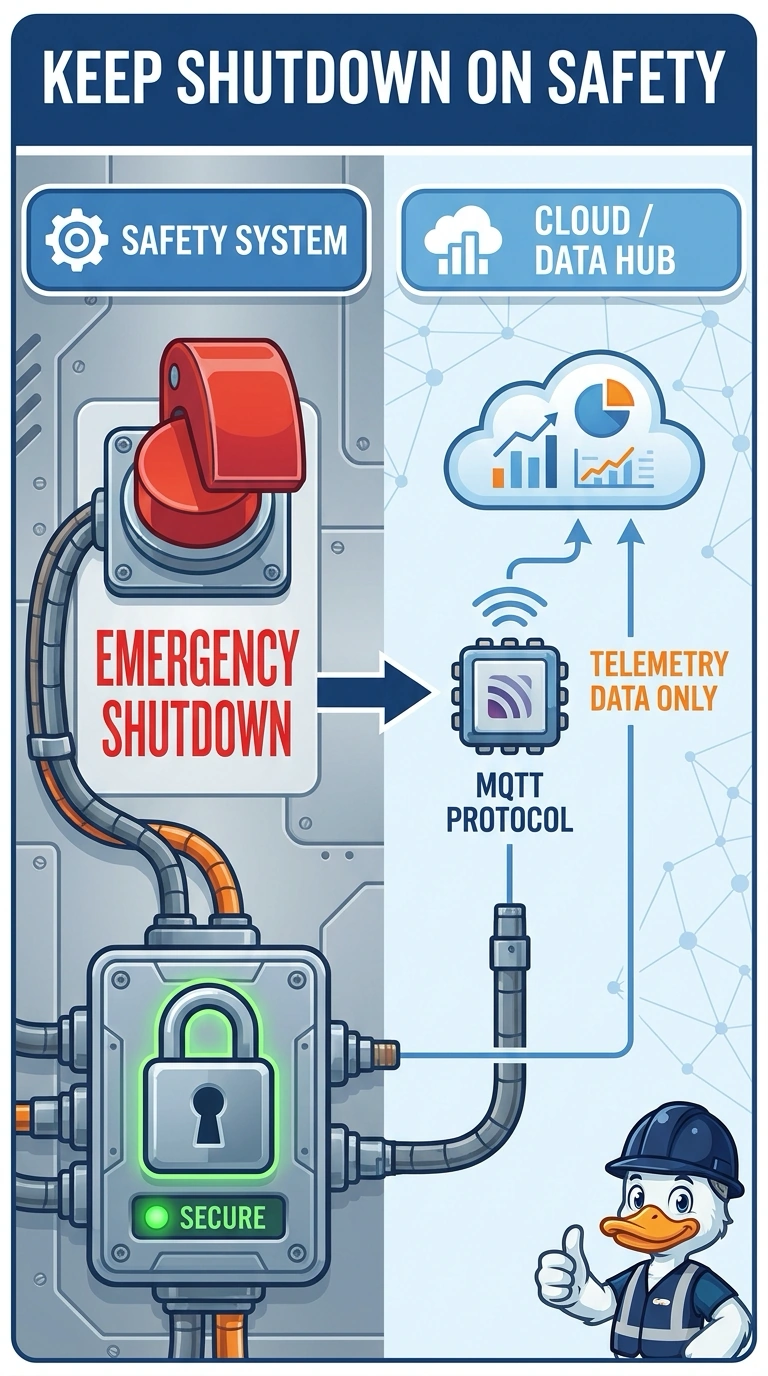
You keep that trip on the safety system and let MQTT carry status — think brake cable, not a note you toss into a mailbox and hope the broker delivers. MQTT QoS defines message delivery behavior between sender and receiver. Raising QoS does not by itself establish deterministic timing or the safety integrity required for an emergency shutdown.
Full Explanation
MQTT is a publish-and-subscribe transport for telemetry and similar messages. A compressor emergency shutdown is a safety function that has to ride the safety system, on its own inputs and outputs, not a topic that waits on a broker. The judgment that fits is to leave the trip where the safety design put it and to let MQTT carry status if the plant wants a dashboard. MQTT QoS defines message delivery behavior between sender and receiver. Raising QoS does not by itself establish deterministic timing or the safety integrity required for an emergency shutdown. Allowing anonymous clients to publish a retained trip still puts the shutdown on MQTT and adds an open publisher. Retention stores a last value. It does not create a deterministic stop. Moving the same trip onto Modbus and expecting the MQTT broker to sign it mixes two protocols and still abandons the safety system. Classic Modbus is not a signed safety bus, and the broker is not in that path. Exam caveat: an MQTT status topic can still announce that a compressor tripped. Announcing the event is not the trip itself. Operational check: the safety drawing should show the shutdown on the safety controller, and the broker topic list should contain status points rather than the trip output.