
A textile plant wants to move a steam-boiler high-temperature trip off its safety wire and onto MQTT publishes to a broker on TCP 1883. Which protocol limit rules that out?
Select an answer to reveal the explanation.
Short Explanation
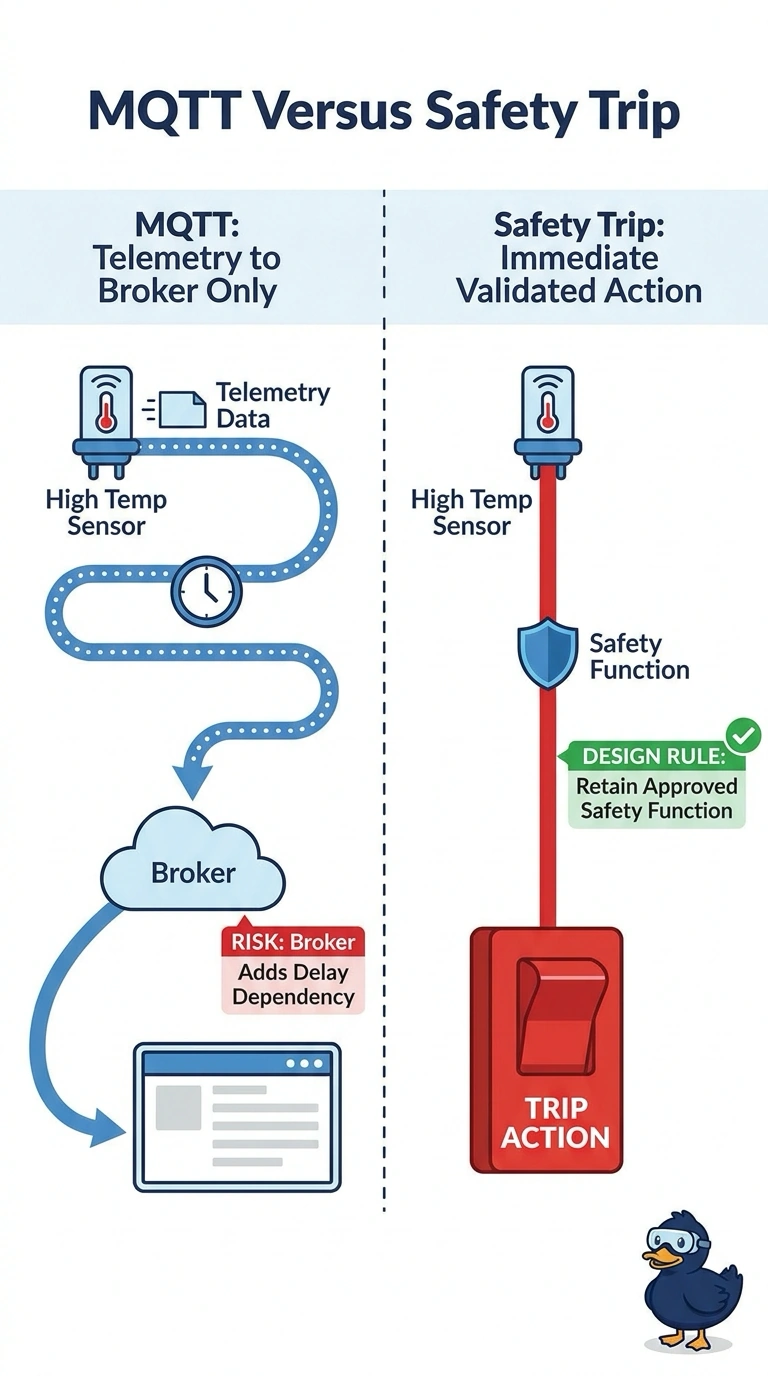
A boiler trip has to win immediately, the way a hard-wired stop does, not the way a note waits on a clerk's desk. You keep MQTT for telemetry and you leave the safety trip off that broker. A queue on TCP 1883 is the wrong shape for a trip.
Full Explanation
MQTT is a publish-and-subscribe protocol used to carry telemetry to a broker, commonly on TCP port 1883 when the session is not wrapped in TLS. A high-temperature trip has to act immediately on a path the safety case can predict. Moving it onto publishes means the trip now depends on the broker, on subscribers being connected, and on whatever delay the quality of service adds. Retain the approved safety function. MQTT can carry arbitrary application payloads, but a brokered message does not itself provide a validated safety function. Queuing the stop until subscribers are idle makes the trip wait, which is the failure mode a hard-wired trip is meant to avoid. MQTT does not stand in for IEC 61850 GOOSE, and it does not carry substation sampled values. Those are different mechanisms on a substation LAN. An anonymous client on a typical TCP 1883 broker is not authenticated and does not sign each payload with a device certificate by default. Assuming that signature exists would overstate what classic MQTT provides. Exam caveat: the same broker can still receive non-safety trends, such as boiler temperature for a dashboard. The trip itself stays on the safety wire. Operational check: the trip drawing should still show the safety wire, and TCP 1883 should not appear on that path.