
A quarry publishes truck positions to an MQTT broker that allows anonymous clients on TCP 1883. The designer wants the pit emergency stop on that same broker. Which decision is sound?
Select an answer to reveal the explanation.
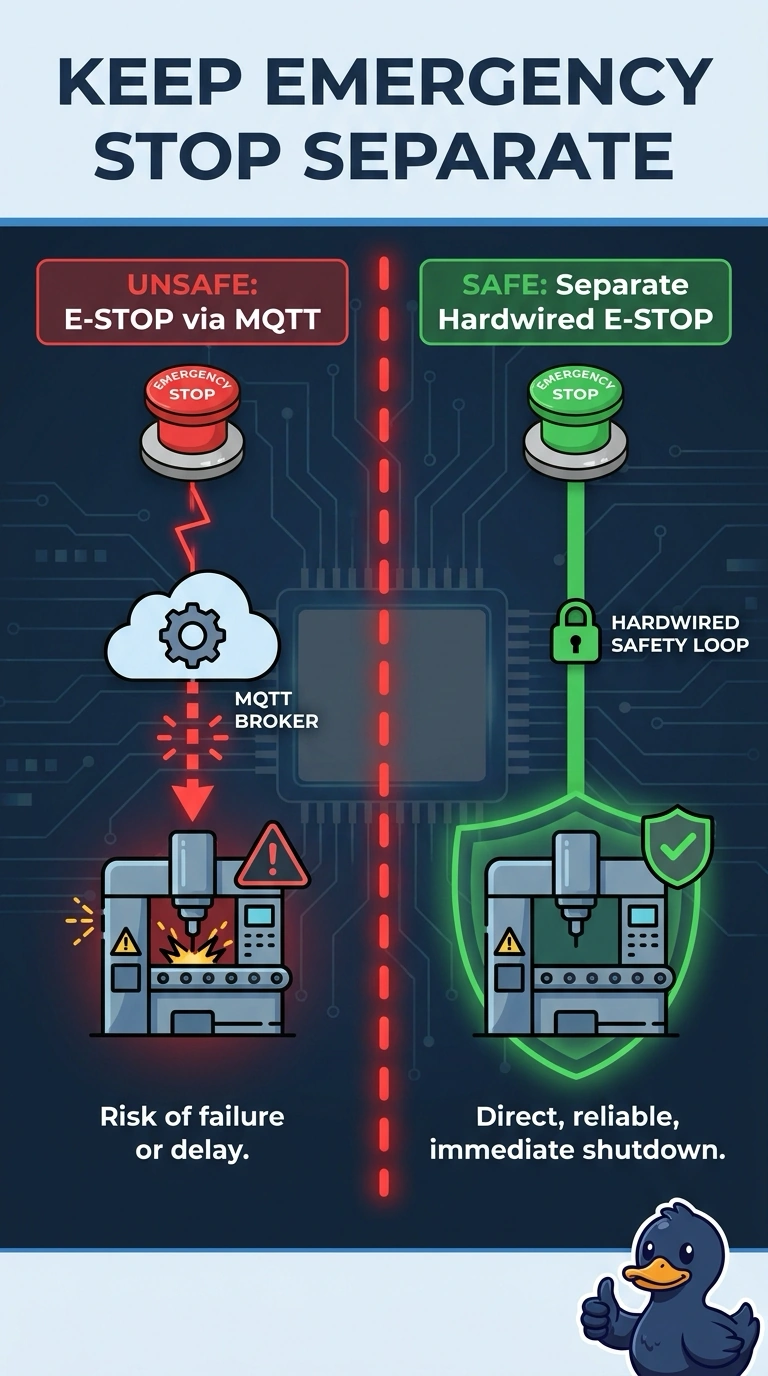
Short Explanation
You need an emergency stop to act like a brake cable, not a note dropped in a mailbox. You keep the pit emergency stop off the MQTT broker, even when it carries truck positions and allows anonymous clients. QoS 2 improves delivery behavior, but it does not make a queue a safety function.
Full Explanation
MQTT is a publish-and-subscribe channel suited to telemetry such as truck position. An emergency stop needs a predictable, dedicated action, not a broker that queues a message among those positions. Keeping the pit emergency stop off this broker is sound whether or not clients are anonymous. Putting the stop on the anonymous broker and treating QoS 2 as a safety trip confuses delivery behavior with a safety function: QoS 2 means exactly-once delivery of a publish, but it does not make the stop deterministic, and an anonymous broker still accepts a publisher nobody authorized. Leaving the stop on the broker and only enabling TLS on port 8883 encrypts the session; encryption does not turn a queued telemetry bus into an emergency stop. Allowing anonymous clients because a position feed and a trip seem alike erases the distinction between telemetry and a safety action. The truck feed can be redesigned on its own; it is not a reason to put the stop on the broker. Exam caveat: an authenticated feed can still carry non-safety truck positions. That improvement does not move the emergency stop onto the broker. Practical check: the safety drawing should show the pit stop on its dedicated path, and the broker should not list a stop publisher.