
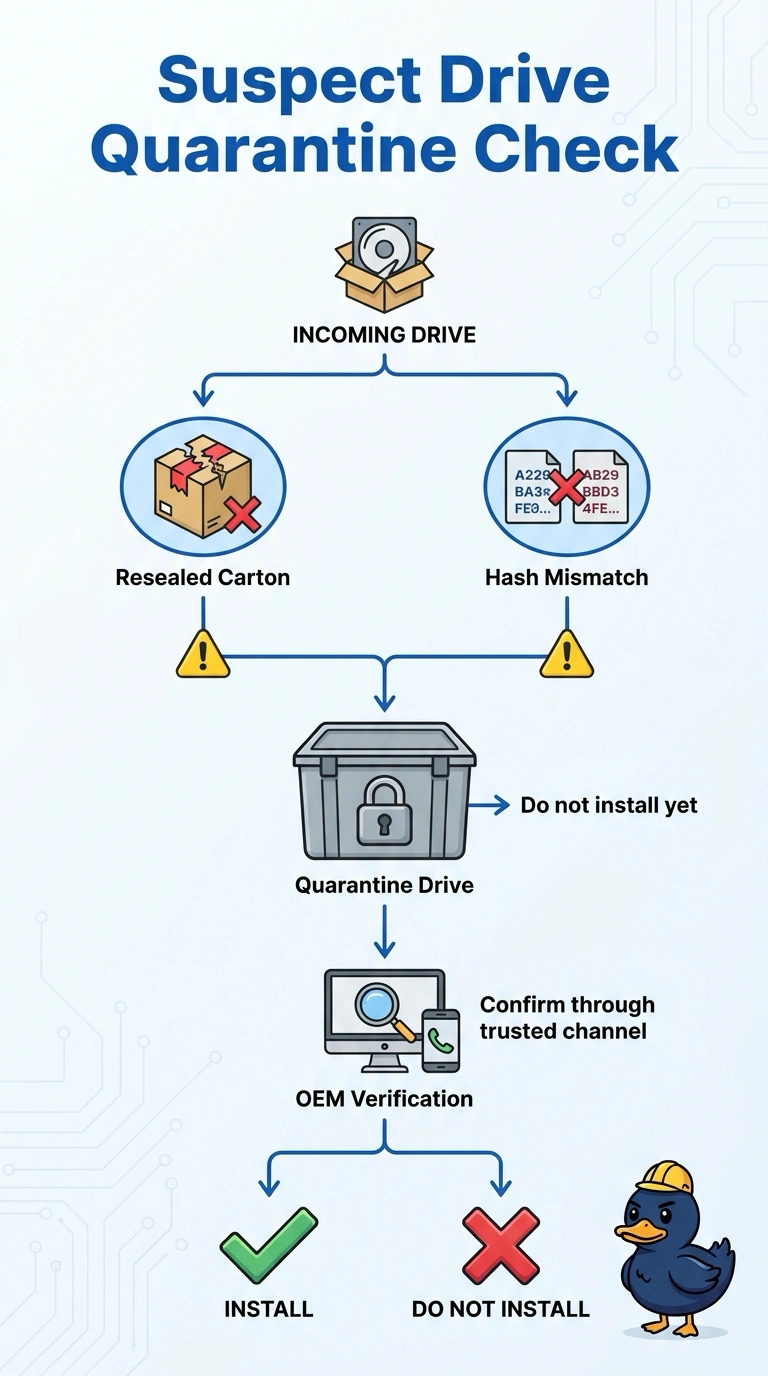
A mining site receives a replacement conveyor drive from a reseller. The carton was resealed, and the firmware hash does not match the OEM notice. Which threat does that illustrate?
Select an answer to reveal the explanation.
Short Explanation
You’ve spotted a replacement drive arriving with a resealed carton and a firmware hash that does not match the OEM notice. That points to a supply-chain integrity concern, not a traffic flood against a running controller, office ransomware, or a phishing note. Keep the drive out of service until the OEM verifies it.
Full Explanation
A suspected supply-chain integrity failure means the drive may have been altered or mishandled before installation, so quarantine it pending verification. The resealed carton and mismatched firmware hash warrant investigation, but they do not by themselves prove malicious modification. Do not install the drive: compare its hash with the OEM’s published value using a channel you already trust, and return it if the OEM cannot account for it. A phishing note in an operator mailbox can steal credentials or deliver a link, but it does not explain a resealed carton or changed firmware on a replacement drive still in receiving. A traffic flood is a denial-of-service attack against a controller already on the network; the scenario describes neither a flood nor a running controller. Ransomware on office file shares encrypts office data but leaves drive firmware hashes untouched, so it does not explain the mismatch. One caveat is that corruption in transit can also cause a hash mismatch, so the evidence calls for quarantine and verification rather than a conclusion that compromise is proven. As a practical check, confirm the hash through a trusted OEM channel before installation.