
A substation engineer wants protection relays to exchange a trip with IEC 61850 native Ethernet GOOSE across a routed WAN, the same way MMS sessions travel. Which statement about GOOSE is correct?
Select an answer to reveal the explanation.
Short Explanation
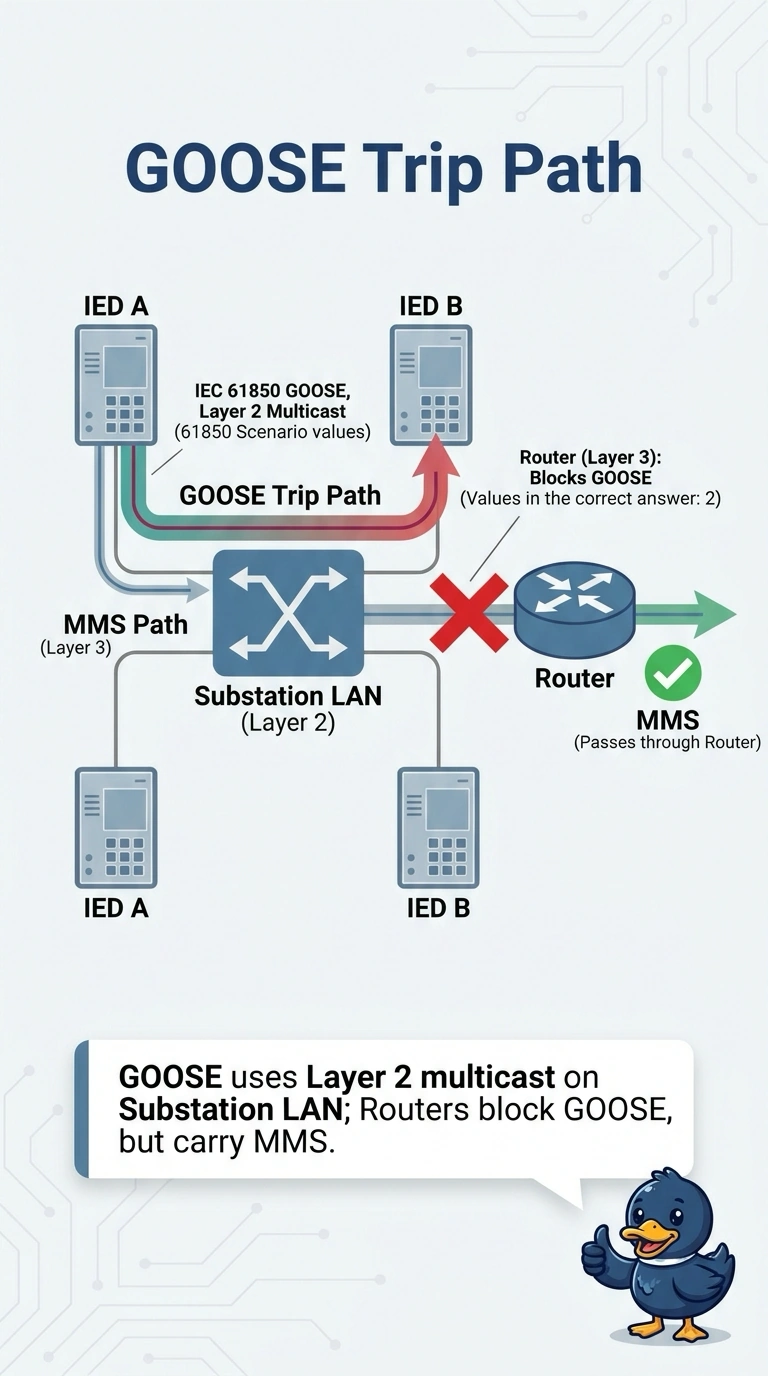
You can think of native Ethernet GOOSE as a shout across the substation LAN, not a message sent through a router. Keep the protection trip on the local Layer 2 multicast network; it is not an MMS session on TCP port 102.
Full Explanation
IEC 61850 native Ethernet GOOSE publishes a protection event, such as a trip, as Ethernet multicast on the local substation LAN. Routers do not forward that Layer 2 multicast the way they forward IP, so native Ethernet GOOSE will not deliver a trip across a routed WAN in the same way an MMS session can. The relays that must receive the trip need to share that LAN, and GOOSE is issued when an event happens rather than being wrapped as a client session. MMS is the client-server profile that uses TCP port 102 and can be routed between a station and a control center; native Ethernet GOOSE does not use that port. A serial master-slave poll waits for the next request from a master, whereas GOOSE is published to listeners on the local Ethernet rather than held for a poll. An MQTT broker is also not the path: protection relays do not exchange GOOSE by publishing through a broker. Exam caveat: a stem about an MMS report to a control center points to TCP port 102, but this stem specifies native Ethernet GOOSE. Practical check: capture traffic on the relay VLAN during a test trip and confirm that you see a multicast Ethernet frame, not a TCP session to port 102.