
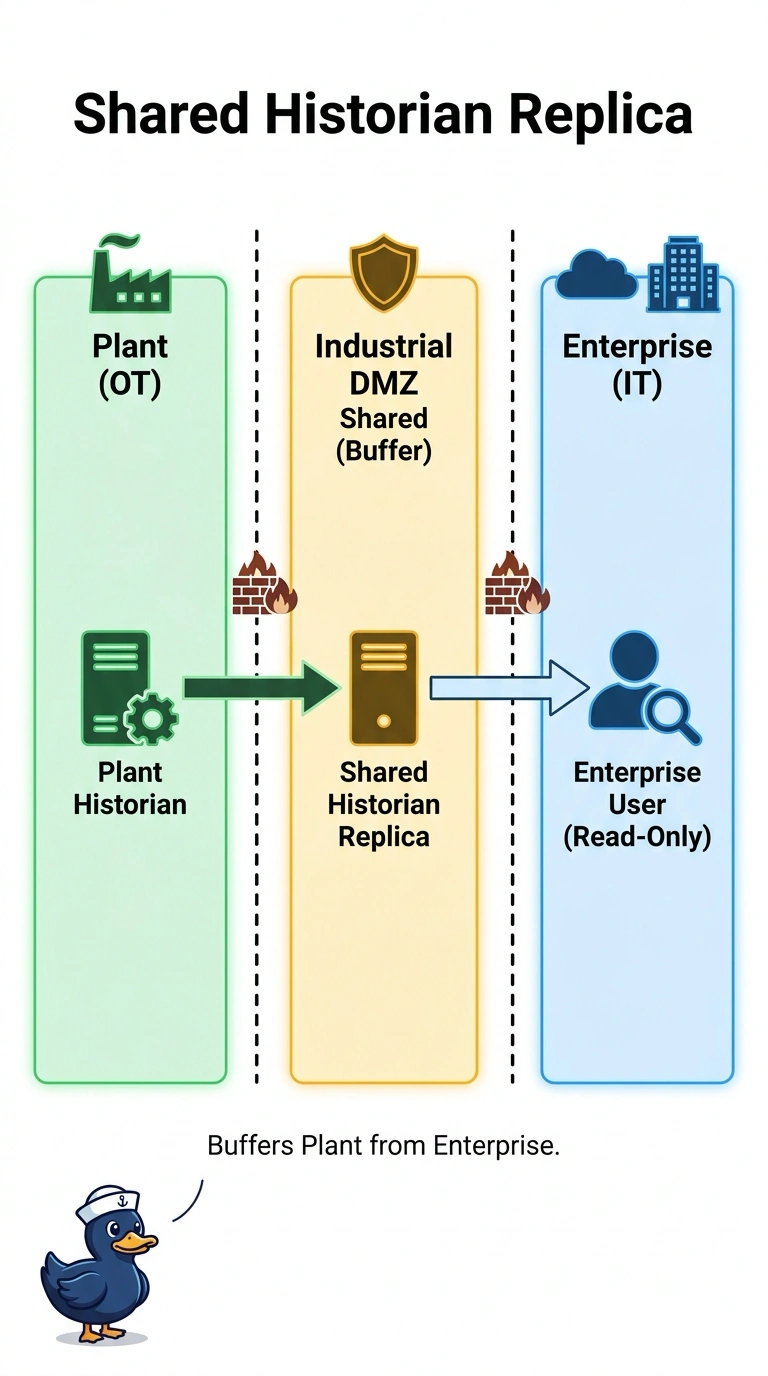
A water utility wants enterprise analysts to query historian data without a route into the treatment-cell controllers. Where should that shared replica sit in the Purdue model?
Select an answer to reveal the explanation.
Short Explanation
Analysts need a reading room, not a walk through the filter gallery. You place the shared historian replica in the industrial DMZ so they can query a copy without a route into the cell. Putting that replica on the controller VLAN hands them the gallery.
Full Explanation
The industrial DMZ is the buffer between the plant and the enterprise. A replica of historian data placed there lets analysts query a copy while the treatment-cell controllers stay behind the boundary, with no route from the analyst workstation into the filtration VLAN. That is the Purdue placement the requirement describes. Putting the replica on the filtration PLC VLAN, or skipping it so analysts poll the controllers, gives the enterprise a path into basic control and drops the buffer the utility asked for. Level 0 is the physical process: sensors, actuators, and the water itself. A historian replica is not a field instrument. Level 1 is basic control, where the PLC that runs the filters belongs. Replacing that PLC with a replica would remove the controller and still would not be a safe place for enterprise queries. Exam caveat: the replica in the DMZ is the copy built for sharing outward. It does not authorize the analyst to open a session to the filtration PLC, which is the outcome this design is avoiding. Operational check: from an analyst workstation the replica should answer, and a connection toward a filtration PLC address should fail.