
A power plant proposes moving turbine-trip logic off the safety controller and into the basic process PLC to free a panel. Which position is sound?
Select an answer to reveal the explanation.
Short Explanation
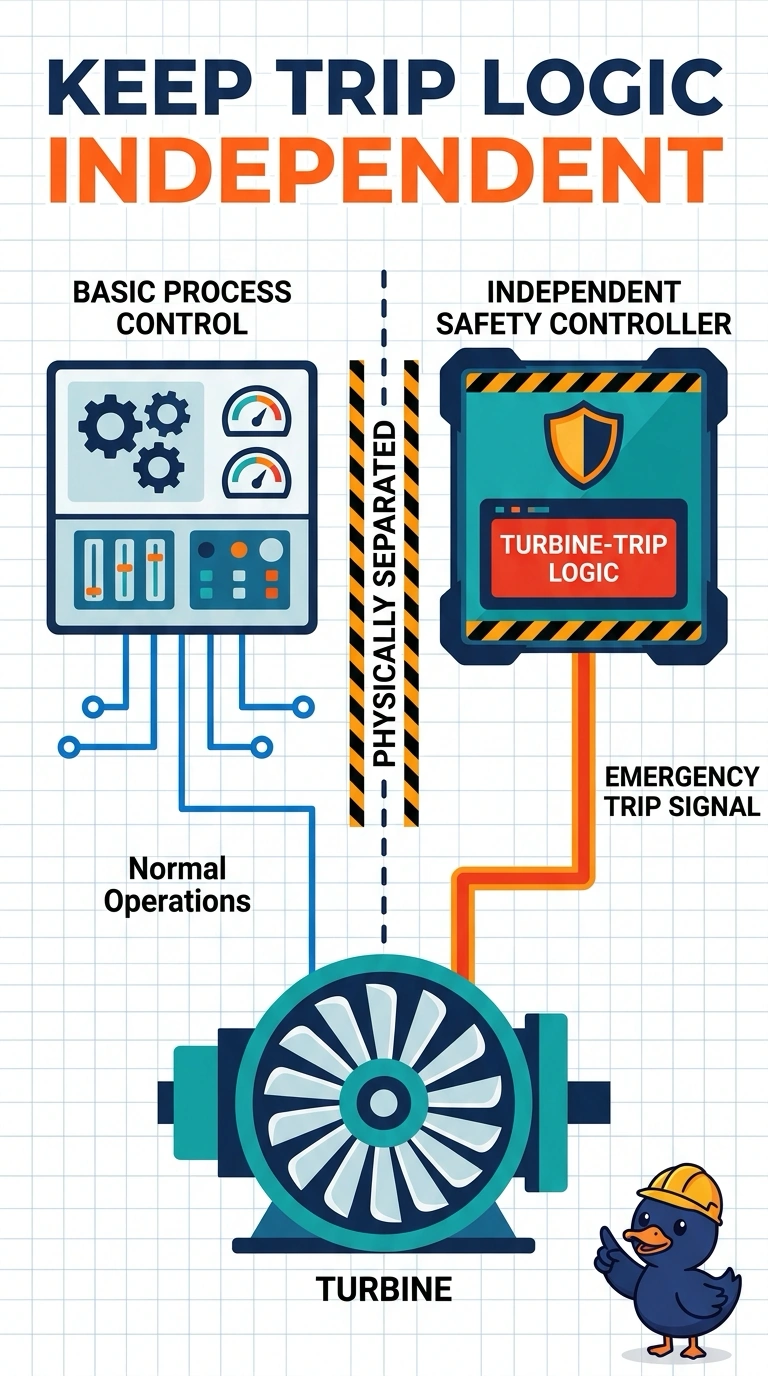
The safety trip is a second brake, and you do not mount it on the same pedal as everyday speed control. Keep the turbine trip on an independent safety controller so a basic-process fault does not take the trip with it. Saving a panel is a weak reason to merge the two.
Full Explanation
A safety function is there so a dangerous condition can still be driven to a safe state when basic process control fails or is wrong. Turbine-trip logic on its own safety controller keeps that independence. Folding the trip into the basic process PLC to free a panel couples the protection to the same box that runs everyday control, so one failure or one bad change can take both. The sound position is to leave the trip where it is. Easier patching and less delay are maintenance preferences. They do not replace the reason the safety controller is separate, and a second box is the point of the design rather than an accident. Moving the trip to a Level 4 ERP server puts a protection function in the business layer, where office staff and office outages sit between the plant and a turbine trip. That is not independence from basic control. It is a move even farther from the process. A shared cabinet password is an access shortcut. Two functions that share a password are not separated, and a secret does not keep a basic-process fault from taking the trip if both live in one PLC. Exam caveat: independence does not mean the safety controller is unmonitored. A watched, separate safety controller is still separate. This stem is about merging the logic. Operational check: the turbine-trip drawing should still show a safety controller that is not the basic process PLC, with its own engineering access.