
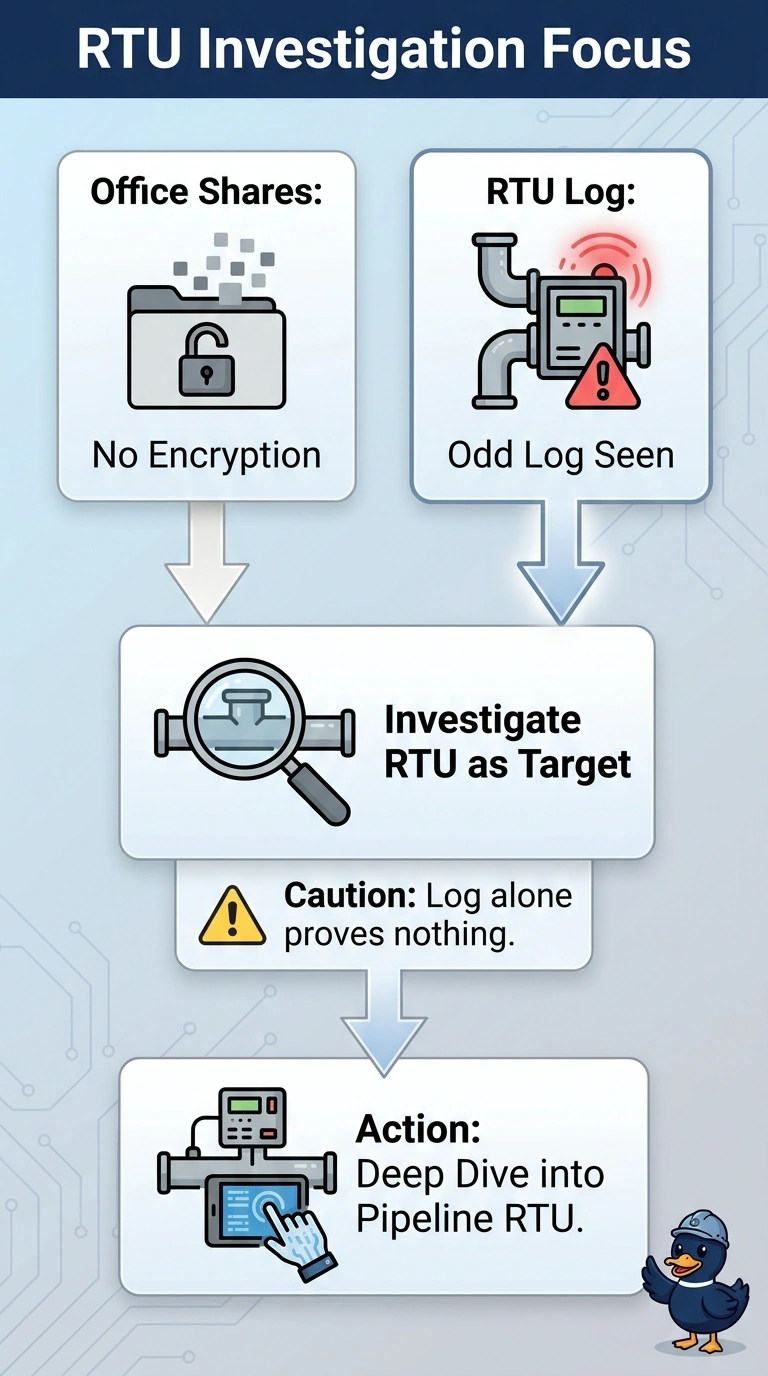
A pipeline operator hears that last night's incident encrypted no office file shares. The only odd log is on a remote RTU. An unusual log alone does not establish an attack. Which asset should the response team investigate as a possible operational target?
Select an answer to reveal the explanation.
Short Explanation
Not every incident shows up as scrambled spreadsheets. You investigate the pipeline RTU as a possible operational target even though office shares were not encrypted, remembering an unusual log alone does not establish an attack. The trap is waiting for a ransom note before you check the process.
Full Explanation
OT threats include attacks on critical infrastructure, not only ransomware against file servers. A pipeline RTU is part of that infrastructure. An incident that leaves office shares untouched can still merit investigation of monitoring or control. An unusual log alone does not establish an attack. Investigate the pipeline RTU as a possible operational target even though office shares were not encrypted. Ignoring the RTU because the file servers are healthy uses the wrong definition of harm. Calling the RTU a laptop so an office playbook fits does not change what the device does. Waiting for corporate mail delays the site response. The caveat is that you still avoid an unplanned reboot of a healthy RTU while you investigate. The check is the RTU's communication log and who talked to it, compared with the normal telemetry baseline. Put the before-and-after evidence in the work order, including the interface or account you changed, the time, and the person who approved it. On the next shift, confirm the original symptom is gone and that the change did not open a second path while closing the first. If the process is still inside a live batch, leave the controller running and finish only the part of this work that does not restart it. That sequence keeps a correct fix from turning into an unplanned outage.